{"title":"利用小波变换和窗口加权进行重力数据融合:南极罗斯海案例研究","authors":"Long Ma, Haibin Song, Yongliang Bai, Quanshu Yan","doi":"10.1007/s11600-024-01366-8","DOIUrl":null,"url":null,"abstract":"<div><p>Satellite gravity anomaly data are characterized with wide coverage and high overall normalized quality, and these data can be used in large-scale regional structural research. However, detailed information on local areas is often missing after smoothing. High-resolution ship-borne gravity anomaly data can better identify fault zones and block boundaries at key locations, compensating for low-resolution satellite gravity data. In this study, comprehensive gravity data derived from multiple techniques are used based on wavelet transforms, the fusion rules for high- and low-frequency wavelet coefficients are established, and the complementary use and effective fusion of gravity data derived from multiple techniques are realized. By collecting a large amount of ship-borne data in the Ross Sea of Antarctica, 1434 valid survey lines with a total length of 98,204 km are obtained in the study area. After adjustment, the root mean square of the crossover errors is ± 1.92 × 10<sup>–5</sup> m/s<sup>2</sup>. Here, different wavelet functions and decomposition levels are used, the concept of window weighting is introduced, and the useful information of the two data types is further fused. Thus, higher-resolution data are obtained with less errors. When fusing all line data, the minimum RMS difference between the optimal fusion result and the ship measurement data is 1.64 × 10<sup>–5</sup> m/s<sup>2</sup>, which increases the accuracy by 1.66 × 10<sup>–5</sup> m/s<sup>2</sup>. When we adopt 80% data fusion and the remaining 20% data validation, although a considerable portion of the remaining side lines are still distributed in areas that the original side lines cannot cover, using this method can still effectively improve the accuracy of the fused data. This method can be applied to most gravity data.</p></div>","PeriodicalId":6988,"journal":{"name":"Acta Geophysica","volume":"73 1","pages":"187 - 201"},"PeriodicalIF":2.1000,"publicationDate":"2024-05-22","publicationTypes":"Journal Article","fieldsOfStudy":null,"isOpenAccess":false,"openAccessPdf":"","citationCount":"0","resultStr":"{\"title\":\"Gravity data fusion using wavelet transform and window weighting: a case study in the Ross Sea of Antarctica\",\"authors\":\"Long Ma, Haibin Song, Yongliang Bai, Quanshu Yan\",\"doi\":\"10.1007/s11600-024-01366-8\",\"DOIUrl\":null,\"url\":null,\"abstract\":\"<div><p>Satellite gravity anomaly data are characterized with wide coverage and high overall normalized quality, and these data can be used in large-scale regional structural research. However, detailed information on local areas is often missing after smoothing. High-resolution ship-borne gravity anomaly data can better identify fault zones and block boundaries at key locations, compensating for low-resolution satellite gravity data. In this study, comprehensive gravity data derived from multiple techniques are used based on wavelet transforms, the fusion rules for high- and low-frequency wavelet coefficients are established, and the complementary use and effective fusion of gravity data derived from multiple techniques are realized. By collecting a large amount of ship-borne data in the Ross Sea of Antarctica, 1434 valid survey lines with a total length of 98,204 km are obtained in the study area. After adjustment, the root mean square of the crossover errors is ± 1.92 × 10<sup>–5</sup> m/s<sup>2</sup>. Here, different wavelet functions and decomposition levels are used, the concept of window weighting is introduced, and the useful information of the two data types is further fused. Thus, higher-resolution data are obtained with less errors. When fusing all line data, the minimum RMS difference between the optimal fusion result and the ship measurement data is 1.64 × 10<sup>–5</sup> m/s<sup>2</sup>, which increases the accuracy by 1.66 × 10<sup>–5</sup> m/s<sup>2</sup>. When we adopt 80% data fusion and the remaining 20% data validation, although a considerable portion of the remaining side lines are still distributed in areas that the original side lines cannot cover, using this method can still effectively improve the accuracy of the fused data. This method can be applied to most gravity data.</p></div>\",\"PeriodicalId\":6988,\"journal\":{\"name\":\"Acta Geophysica\",\"volume\":\"73 1\",\"pages\":\"187 - 201\"},\"PeriodicalIF\":2.1000,\"publicationDate\":\"2024-05-22\",\"publicationTypes\":\"Journal Article\",\"fieldsOfStudy\":null,\"isOpenAccess\":false,\"openAccessPdf\":\"\",\"citationCount\":\"0\",\"resultStr\":null,\"platform\":\"Semanticscholar\",\"paperid\":null,\"PeriodicalName\":\"Acta Geophysica\",\"FirstCategoryId\":\"89\",\"ListUrlMain\":\"https://link.springer.com/article/10.1007/s11600-024-01366-8\",\"RegionNum\":4,\"RegionCategory\":\"地球科学\",\"ArticlePicture\":[],\"TitleCN\":null,\"AbstractTextCN\":null,\"PMCID\":null,\"EPubDate\":\"\",\"PubModel\":\"\",\"JCR\":\"\",\"JCRName\":\"\",\"Score\":null,\"Total\":0}","platform":"Semanticscholar","paperid":null,"PeriodicalName":"Acta Geophysica","FirstCategoryId":"89","ListUrlMain":"https://link.springer.com/article/10.1007/s11600-024-01366-8","RegionNum":4,"RegionCategory":"地球科学","ArticlePicture":[],"TitleCN":null,"AbstractTextCN":null,"PMCID":null,"EPubDate":"","PubModel":"","JCR":"","JCRName":"","Score":null,"Total":0}
Gravity data fusion using wavelet transform and window weighting: a case study in the Ross Sea of Antarctica
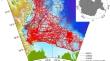
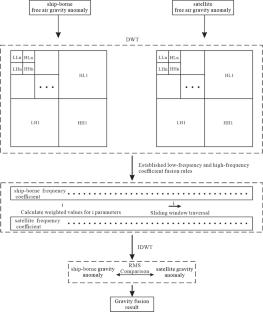
Satellite gravity anomaly data are characterized with wide coverage and high overall normalized quality, and these data can be used in large-scale regional structural research. However, detailed information on local areas is often missing after smoothing. High-resolution ship-borne gravity anomaly data can better identify fault zones and block boundaries at key locations, compensating for low-resolution satellite gravity data. In this study, comprehensive gravity data derived from multiple techniques are used based on wavelet transforms, the fusion rules for high- and low-frequency wavelet coefficients are established, and the complementary use and effective fusion of gravity data derived from multiple techniques are realized. By collecting a large amount of ship-borne data in the Ross Sea of Antarctica, 1434 valid survey lines with a total length of 98,204 km are obtained in the study area. After adjustment, the root mean square of the crossover errors is ± 1.92 × 10⁻⁵ m/s2. Here, different wavelet functions and decomposition levels are used, the concept of window weighting is introduced, and the useful information of the two data types is further fused. Thus, higher-resolution data are obtained with less errors. When fusing all line data, the minimum RMS difference between the optimal fusion result and the ship measurement data is 1.64 × 10⁻⁵ m/s2, which increases the accuracy by 1.66 × 10⁻⁵ m/s2. When we adopt 80% data fusion and the remaining 20% data validation, although a considerable portion of the remaining side lines are still distributed in areas that the original side lines cannot cover, using this method can still effectively improve the accuracy of the fused data. This method can be applied to most gravity data.
期刊介绍:
Acta Geophysica is open to all kinds of manuscripts including research and review articles, short communications, comments to published papers, letters to the Editor as well as book reviews. Some of the issues are fully devoted to particular topics; we do encourage proposals for such topical issues. We accept submissions from scientists world-wide, offering high scientific and editorial standard and comprehensive treatment of the discussed topics.




 京公网安备 11010802042870号
京ICP备2023020795号-1
京公网安备 11010802042870号
京ICP备2023020795号-1

 分享
分享
 求助内容:
求助内容: 应助结果提醒方式:
 扫码关注我们
