{"title":"通过在二氧化锡纳米粒子中掺入氟微调光带隙和介电性能","authors":"N. Haddad, H. Mahdhi, Z. Ben Ayadi","doi":"10.1007/s10971-024-06405-w","DOIUrl":null,"url":null,"abstract":"<div><p>Tin dioxide (SnO<sub>2</sub>) possesses remarkable optical and electrical properties and finds applications in a diverse array of devices, including supercapacitors, gas sensors, batteries, and solar cells. Enhancing SnO<sub>2</sub>’s optoelectronic characteristics can substantially improve the functionality of devices incorporating this material. In this research endeavor, we synthesized tin oxide nanoparticles doped with fluorine (F-SnO<sub>2</sub>) using the modified sol-gel method. Our results underscore the affirmative impact of fluorine incorporation of SnO<sub>2</sub>’s optoelectronic properties. Strikingly, this doping procedure left the morphology and structure of the nanoparticles untouched, but it did induce changes in particle size. Notably, the reduction in bandgap from 3.87 eV for SnO<sub>2</sub> to 3.70 eV for F-SnO<sub>2</sub> nanoparticles suggests the generation of new energy levels below the conduction band due to doping. Electrical transport assessments using impedance spectroscopy revealed the semiconducting behavior of the samples. The Nyquist diagram was instrumental in evaluating the role of grain and grain boundaries, and an equivalent circuit was employed for sample modeling. Conductivity showed temperature dependency, displaying Mott’s variable range hopping conduction mechanism at lower temperatures and small polaron hopping at higher temperatures. Moreover, the introduction of fluorine ions leads to an increase in conductance and decrease the resistance.Dielectric analysis identified polarization as the main factor behind the dielectric loss tangent. The dielectric constant and tan δ show typical behavior by decreasing with increasing frequency. These observations align with the Maxwell–Wagner model. The dielectric loss coupled with high permittivity values, render F-SnO<sub>2</sub> a promising compound for energy storage. These findings underscore the potential of F-SnO<sub>2</sub> nanoparticles to enhance the performance of SnO<sub>2</sub>-based devices across a diverse spectrum of applications.</p><h3>Graphical Abstract</h3><div><figure><div><div><picture><source><img></source></picture></div></div></figure></div></div>","PeriodicalId":664,"journal":{"name":"Journal of Sol-Gel Science and Technology","volume":"110 3","pages":"842 - 858"},"PeriodicalIF":4.2000,"publicationDate":"2024-05-20","publicationTypes":"Journal Article","fieldsOfStudy":null,"isOpenAccess":false,"openAccessPdf":"","citationCount":"0","resultStr":"{\"title\":\"Fine-tuning optical bandgap and dielectric properties through fluorine doping in SnO2 nanoparticles\",\"authors\":\"N. Haddad, H. Mahdhi, Z. Ben Ayadi\",\"doi\":\"10.1007/s10971-024-06405-w\",\"DOIUrl\":null,\"url\":null,\"abstract\":\"<div><p>Tin dioxide (SnO<sub>2</sub>) possesses remarkable optical and electrical properties and finds applications in a diverse array of devices, including supercapacitors, gas sensors, batteries, and solar cells. Enhancing SnO<sub>2</sub>’s optoelectronic characteristics can substantially improve the functionality of devices incorporating this material. In this research endeavor, we synthesized tin oxide nanoparticles doped with fluorine (F-SnO<sub>2</sub>) using the modified sol-gel method. Our results underscore the affirmative impact of fluorine incorporation of SnO<sub>2</sub>’s optoelectronic properties. Strikingly, this doping procedure left the morphology and structure of the nanoparticles untouched, but it did induce changes in particle size. Notably, the reduction in bandgap from 3.87 eV for SnO<sub>2</sub> to 3.70 eV for F-SnO<sub>2</sub> nanoparticles suggests the generation of new energy levels below the conduction band due to doping. Electrical transport assessments using impedance spectroscopy revealed the semiconducting behavior of the samples. The Nyquist diagram was instrumental in evaluating the role of grain and grain boundaries, and an equivalent circuit was employed for sample modeling. Conductivity showed temperature dependency, displaying Mott’s variable range hopping conduction mechanism at lower temperatures and small polaron hopping at higher temperatures. Moreover, the introduction of fluorine ions leads to an increase in conductance and decrease the resistance.Dielectric analysis identified polarization as the main factor behind the dielectric loss tangent. The dielectric constant and tan δ show typical behavior by decreasing with increasing frequency. These observations align with the Maxwell–Wagner model. The dielectric loss coupled with high permittivity values, render F-SnO<sub>2</sub> a promising compound for energy storage. These findings underscore the potential of F-SnO<sub>2</sub> nanoparticles to enhance the performance of SnO<sub>2</sub>-based devices across a diverse spectrum of applications.</p><h3>Graphical Abstract</h3><div><figure><div><div><picture><source><img></source></picture></div></div></figure></div></div>\",\"PeriodicalId\":664,\"journal\":{\"name\":\"Journal of Sol-Gel Science and Technology\",\"volume\":\"110 3\",\"pages\":\"842 - 858\"},\"PeriodicalIF\":4.2000,\"publicationDate\":\"2024-05-20\",\"publicationTypes\":\"Journal Article\",\"fieldsOfStudy\":null,\"isOpenAccess\":false,\"openAccessPdf\":\"\",\"citationCount\":\"0\",\"resultStr\":null,\"platform\":\"Semanticscholar\",\"paperid\":null,\"PeriodicalName\":\"Journal of Sol-Gel Science and Technology\",\"FirstCategoryId\":\"88\",\"ListUrlMain\":\"https://link.springer.com/article/10.1007/s10971-024-06405-w\",\"RegionNum\":4,\"RegionCategory\":\"材料科学\",\"ArticlePicture\":[],\"TitleCN\":null,\"AbstractTextCN\":null,\"PMCID\":null,\"EPubDate\":\"\",\"PubModel\":\"\",\"JCR\":\"Q2\",\"JCRName\":\"MATERIALS SCIENCE, CERAMICS\",\"Score\":null,\"Total\":0}","platform":"Semanticscholar","paperid":null,"PeriodicalName":"Journal of Sol-Gel Science and Technology","FirstCategoryId":"88","ListUrlMain":"https://link.springer.com/article/10.1007/s10971-024-06405-w","RegionNum":4,"RegionCategory":"材料科学","ArticlePicture":[],"TitleCN":null,"AbstractTextCN":null,"PMCID":null,"EPubDate":"","PubModel":"","JCR":"Q2","JCRName":"MATERIALS SCIENCE, CERAMICS","Score":null,"Total":0}
引用次数: 0
摘要
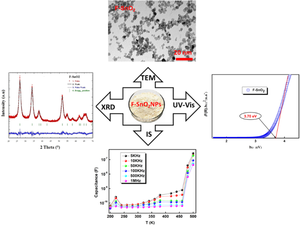
二氧化锡(SnO2)具有卓越的光学和电学特性,可应用于超级电容器、气体传感器、电池和太阳能电池等多种设备中。增强二氧化锡的光电特性可以大大提高采用这种材料的设备的功能。在这项研究中,我们采用改良溶胶-凝胶法合成了掺杂氟的氧化锡纳米粒子(F-SnO2)。我们的研究结果表明,氟的掺入对二氧化锡的光电特性产生了积极影响。令人吃惊的是,这种掺杂方法没有改变纳米颗粒的形态和结构,但却引起了颗粒大小的变化。值得注意的是,F-SnO2 纳米粒子的带隙从 SnO2 的 3.87 eV 减小到 3.70 eV,这表明由于掺杂,在导带以下产生了新能级。利用阻抗光谱进行的电传输评估显示了样品的半导体行为。奈奎斯特图有助于评估晶粒和晶粒边界的作用,并采用等效电路进行样品建模。电导率显示出温度依赖性,在较低温度下显示出莫特变程跳变传导机制,而在较高温度下则显示出小极子跳变传导机制。介电分析表明,极化是介电损耗正切背后的主要因素。介电常数和 tan δ 表现出典型的随频率增加而减小的行为。这些观察结果与 Maxwell-Wagner 模型一致。介电损耗和高介电常数使 F-SnO2 成为一种很有潜力的储能化合物。这些发现强调了 F-SnO2 纳米粒子在不同应用领域提高基于二氧化锡的器件性能的潜力。
Fine-tuning optical bandgap and dielectric properties through fluorine doping in SnO2 nanoparticles
Tin dioxide (SnO2) possesses remarkable optical and electrical properties and finds applications in a diverse array of devices, including supercapacitors, gas sensors, batteries, and solar cells. Enhancing SnO2’s optoelectronic characteristics can substantially improve the functionality of devices incorporating this material. In this research endeavor, we synthesized tin oxide nanoparticles doped with fluorine (F-SnO2) using the modified sol-gel method. Our results underscore the affirmative impact of fluorine incorporation of SnO2’s optoelectronic properties. Strikingly, this doping procedure left the morphology and structure of the nanoparticles untouched, but it did induce changes in particle size. Notably, the reduction in bandgap from 3.87 eV for SnO2 to 3.70 eV for F-SnO2 nanoparticles suggests the generation of new energy levels below the conduction band due to doping. Electrical transport assessments using impedance spectroscopy revealed the semiconducting behavior of the samples. The Nyquist diagram was instrumental in evaluating the role of grain and grain boundaries, and an equivalent circuit was employed for sample modeling. Conductivity showed temperature dependency, displaying Mott’s variable range hopping conduction mechanism at lower temperatures and small polaron hopping at higher temperatures. Moreover, the introduction of fluorine ions leads to an increase in conductance and decrease the resistance.Dielectric analysis identified polarization as the main factor behind the dielectric loss tangent. The dielectric constant and tan δ show typical behavior by decreasing with increasing frequency. These observations align with the Maxwell–Wagner model. The dielectric loss coupled with high permittivity values, render F-SnO2 a promising compound for energy storage. These findings underscore the potential of F-SnO2 nanoparticles to enhance the performance of SnO2-based devices across a diverse spectrum of applications.
期刊介绍:
The primary objective of the Journal of Sol-Gel Science and Technology (JSST), the official journal of the International Sol-Gel Society, is to provide an international forum for the dissemination of scientific, technological, and general knowledge about materials processed by chemical nanotechnologies known as the "sol-gel" process. The materials of interest include gels, gel-derived glasses, ceramics in form of nano- and micro-powders, bulk, fibres, thin films and coatings as well as more recent materials such as hybrid organic-inorganic materials and composites. Such materials exhibit a wide range of optical, electronic, magnetic, chemical, environmental, and biomedical properties and functionalities. Methods for producing sol-gel-derived materials and the industrial uses of these materials are also of great interest.




 京公网安备 11010802042870号
京ICP备2023020795号-1
京公网安备 11010802042870号
京ICP备2023020795号-1

 分享
分享
 求助内容:
求助内容: 应助结果提醒方式:
 扫码关注我们
