Zechuan Lin;Jiayue Zhou;Xuanrui Huang;Kemeng Chen;Xi Xiao;John V. Ringwood
{"title":"关于具有电能回收功能的波浪能转换器的损耗感知优化控制","authors":"Zechuan Lin;Jiayue Zhou;Xuanrui Huang;Kemeng Chen;Xi Xiao;John V. Ringwood","doi":"10.1109/TSTE.2024.3407126","DOIUrl":null,"url":null,"abstract":"Incorporating the non-ideal power take-off (PTO) efficiency of wave energy converters (WECs) into energy-maximizing control is crucial for achieving optimal electrical power generation. The majority of previous loss-aware controllers are based on a simplified power-coefficient (PC) model or only consider the copper loss, which remain insufficient to describe a real electrical PTO. In this article, a high-fidelity loss model, encompassing different loss components of the PTO (a generator and a power converter), is developed, and a number of loss-aware model predictive control (MPC) options are derived and compared in a realistic case study. The results highlight the importance of using an appropriate loss model, rather than a PC model, both for power evaluation and for control, and it is shown that a quadratic loss model employed in MPC is effective in approximating the true loss function, so that near-optimal power production can be achieved with fast computation.","PeriodicalId":452,"journal":{"name":"IEEE Transactions on Sustainable Energy","volume":"15 4","pages":"2209-2218"},"PeriodicalIF":10.0000,"publicationDate":"2024-03-30","publicationTypes":"Journal Article","fieldsOfStudy":null,"isOpenAccess":false,"openAccessPdf":"","citationCount":"0","resultStr":"{\"title\":\"On Loss-Aware Optimal Control of Wave Energy Converters With Electrical Power Take-Offs\",\"authors\":\"Zechuan Lin;Jiayue Zhou;Xuanrui Huang;Kemeng Chen;Xi Xiao;John V. Ringwood\",\"doi\":\"10.1109/TSTE.2024.3407126\",\"DOIUrl\":null,\"url\":null,\"abstract\":\"Incorporating the non-ideal power take-off (PTO) efficiency of wave energy converters (WECs) into energy-maximizing control is crucial for achieving optimal electrical power generation. The majority of previous loss-aware controllers are based on a simplified power-coefficient (PC) model or only consider the copper loss, which remain insufficient to describe a real electrical PTO. In this article, a high-fidelity loss model, encompassing different loss components of the PTO (a generator and a power converter), is developed, and a number of loss-aware model predictive control (MPC) options are derived and compared in a realistic case study. The results highlight the importance of using an appropriate loss model, rather than a PC model, both for power evaluation and for control, and it is shown that a quadratic loss model employed in MPC is effective in approximating the true loss function, so that near-optimal power production can be achieved with fast computation.\",\"PeriodicalId\":452,\"journal\":{\"name\":\"IEEE Transactions on Sustainable Energy\",\"volume\":\"15 4\",\"pages\":\"2209-2218\"},\"PeriodicalIF\":10.0000,\"publicationDate\":\"2024-03-30\",\"publicationTypes\":\"Journal Article\",\"fieldsOfStudy\":null,\"isOpenAccess\":false,\"openAccessPdf\":\"\",\"citationCount\":\"0\",\"resultStr\":null,\"platform\":\"Semanticscholar\",\"paperid\":null,\"PeriodicalName\":\"IEEE Transactions on Sustainable Energy\",\"FirstCategoryId\":\"5\",\"ListUrlMain\":\"https://ieeexplore.ieee.org/document/10542448/\",\"RegionNum\":1,\"RegionCategory\":\"工程技术\",\"ArticlePicture\":[],\"TitleCN\":null,\"AbstractTextCN\":null,\"PMCID\":null,\"EPubDate\":\"\",\"PubModel\":\"\",\"JCR\":\"Q1\",\"JCRName\":\"ENERGY & FUELS\",\"Score\":null,\"Total\":0}","platform":"Semanticscholar","paperid":null,"PeriodicalName":"IEEE Transactions on Sustainable Energy","FirstCategoryId":"5","ListUrlMain":"https://ieeexplore.ieee.org/document/10542448/","RegionNum":1,"RegionCategory":"工程技术","ArticlePicture":[],"TitleCN":null,"AbstractTextCN":null,"PMCID":null,"EPubDate":"","PubModel":"","JCR":"Q1","JCRName":"ENERGY & FUELS","Score":null,"Total":0}
引用次数: 0
摘要
将波浪能转换器(WECs)的非理想功率输出(PTO)效率纳入能量最大化控制是实现最佳发电的关键。之前的大多数损耗感知控制器都是基于简化的功率系数(PC)模型,或仅考虑铜损耗,这仍然不足以描述真实的电力 PTO。本文开发了一个高保真损耗模型,其中包括 PTO(发电机和功率转换器)的不同损耗组件,并在实际案例研究中推导和比较了多个损耗感知模型预测控制 (MPC) 选项。结果凸显了使用适当的损耗模型而非 PC 模型对功率评估和控制的重要性,并表明 MPC 中使用的二次损耗模型可有效逼近真实损耗函数,从而通过快速计算实现接近最优的发电量。
On Loss-Aware Optimal Control of Wave Energy Converters With Electrical Power Take-Offs
Incorporating the non-ideal power take-off (PTO) efficiency of wave energy converters (WECs) into energy-maximizing control is crucial for achieving optimal electrical power generation. The majority of previous loss-aware controllers are based on a simplified power-coefficient (PC) model or only consider the copper loss, which remain insufficient to describe a real electrical PTO. In this article, a high-fidelity loss model, encompassing different loss components of the PTO (a generator and a power converter), is developed, and a number of loss-aware model predictive control (MPC) options are derived and compared in a realistic case study. The results highlight the importance of using an appropriate loss model, rather than a PC model, both for power evaluation and for control, and it is shown that a quadratic loss model employed in MPC is effective in approximating the true loss function, so that near-optimal power production can be achieved with fast computation.
期刊介绍:
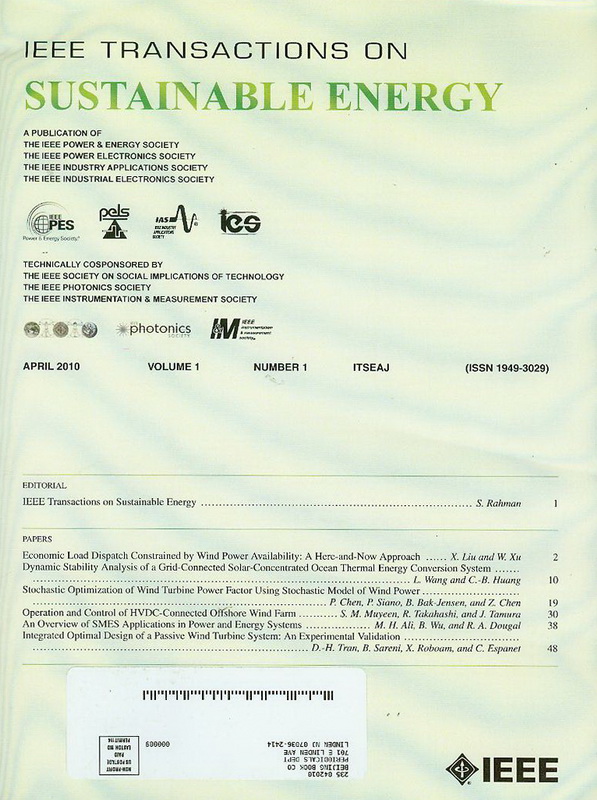
The IEEE Transactions on Sustainable Energy serves as a pivotal platform for sharing groundbreaking research findings on sustainable energy systems, with a focus on their seamless integration into power transmission and/or distribution grids. The journal showcases original research spanning the design, implementation, grid-integration, and control of sustainable energy technologies and systems. Additionally, the Transactions warmly welcomes manuscripts addressing the design, implementation, and evaluation of power systems influenced by sustainable energy systems and devices.




 京公网安备 11010802042870号
京ICP备2023020795号-1
京公网安备 11010802042870号
京ICP备2023020795号-1

 分享
分享
 求助内容:
求助内容: 应助结果提醒方式:
 扫码关注我们
