Yuanzhe Hu , Guowei Zhou , Myoung-Gyu Lee , Peidong Wu , Dayong Li
{"title":"考虑微观结构相互作用的多晶体跨尺度建模时序图神经网络","authors":"Yuanzhe Hu , Guowei Zhou , Myoung-Gyu Lee , Peidong Wu , Dayong Li","doi":"10.1016/j.ijplas.2024.104017","DOIUrl":null,"url":null,"abstract":"<div><p>Machine learning (ML) based methods have achieved preliminary success in the constitutive modeling for single crystals or homogenized polycrystals with remarkable computational efficiency. However, existing ML-based constitutive models neglect grain-level anisotropy, which limits the accurate analysis of local effects. In the current work, a temporal graph neural network (TGNN) model is proposed to simulate cross-scale deformation behaviors of polycrystals under complex loading conditions, with straightforward consideration of microstructure variation and local interaction. The TGNN-based model, a variant of Linearized Minimal State Cells (LMSCs), extends its scope from macroscopic stress response to the mechanical response and orientation evolution of all grains within the aggregate. Specifically, the polycrystalline microstructure is represented with a graph to incorporate essential features of grains, including the spatial connectivity, crystallographic orientation and deformation state. Graph neural network (GNN) is used to capture the spatial correlation of grains, and the features extracted by the GNN are further processed with LMSCs to account for the history-dependent deformation and microstructure evolution. Moreover, the representative volume element (RVE) simulation with crystal plasticity is performed to provide reliable datasets for model establishment. The proposed model demonstrates high efficiency, accuracy and self-consistency in predicting the strain-stress response and orientation evolution at the scale of both individual grain and the overall aggregate under complex loading cases, such as cyclic loading and arbitrary loading.</p></div>","PeriodicalId":340,"journal":{"name":"International Journal of Plasticity","volume":"179 ","pages":"Article 104017"},"PeriodicalIF":12.8000,"publicationDate":"2024-08-01","publicationTypes":"Journal Article","fieldsOfStudy":null,"isOpenAccess":false,"openAccessPdf":"","citationCount":"0","resultStr":"{\"title\":\"A temporal graph neural network for cross-scale modelling of polycrystals considering microstructure interaction\",\"authors\":\"Yuanzhe Hu , Guowei Zhou , Myoung-Gyu Lee , Peidong Wu , Dayong Li\",\"doi\":\"10.1016/j.ijplas.2024.104017\",\"DOIUrl\":null,\"url\":null,\"abstract\":\"<div><p>Machine learning (ML) based methods have achieved preliminary success in the constitutive modeling for single crystals or homogenized polycrystals with remarkable computational efficiency. However, existing ML-based constitutive models neglect grain-level anisotropy, which limits the accurate analysis of local effects. In the current work, a temporal graph neural network (TGNN) model is proposed to simulate cross-scale deformation behaviors of polycrystals under complex loading conditions, with straightforward consideration of microstructure variation and local interaction. The TGNN-based model, a variant of Linearized Minimal State Cells (LMSCs), extends its scope from macroscopic stress response to the mechanical response and orientation evolution of all grains within the aggregate. Specifically, the polycrystalline microstructure is represented with a graph to incorporate essential features of grains, including the spatial connectivity, crystallographic orientation and deformation state. Graph neural network (GNN) is used to capture the spatial correlation of grains, and the features extracted by the GNN are further processed with LMSCs to account for the history-dependent deformation and microstructure evolution. Moreover, the representative volume element (RVE) simulation with crystal plasticity is performed to provide reliable datasets for model establishment. The proposed model demonstrates high efficiency, accuracy and self-consistency in predicting the strain-stress response and orientation evolution at the scale of both individual grain and the overall aggregate under complex loading cases, such as cyclic loading and arbitrary loading.</p></div>\",\"PeriodicalId\":340,\"journal\":{\"name\":\"International Journal of Plasticity\",\"volume\":\"179 \",\"pages\":\"Article 104017\"},\"PeriodicalIF\":12.8000,\"publicationDate\":\"2024-08-01\",\"publicationTypes\":\"Journal Article\",\"fieldsOfStudy\":null,\"isOpenAccess\":false,\"openAccessPdf\":\"\",\"citationCount\":\"0\",\"resultStr\":null,\"platform\":\"Semanticscholar\",\"paperid\":null,\"PeriodicalName\":\"International Journal of Plasticity\",\"FirstCategoryId\":\"88\",\"ListUrlMain\":\"https://www.sciencedirect.com/science/article/pii/S074964192400144X\",\"RegionNum\":1,\"RegionCategory\":\"材料科学\",\"ArticlePicture\":[],\"TitleCN\":null,\"AbstractTextCN\":null,\"PMCID\":null,\"EPubDate\":\"2024/6/7 0:00:00\",\"PubModel\":\"Epub\",\"JCR\":\"Q1\",\"JCRName\":\"ENGINEERING, MECHANICAL\",\"Score\":null,\"Total\":0}","platform":"Semanticscholar","paperid":null,"PeriodicalName":"International Journal of Plasticity","FirstCategoryId":"88","ListUrlMain":"https://www.sciencedirect.com/science/article/pii/S074964192400144X","RegionNum":1,"RegionCategory":"材料科学","ArticlePicture":[],"TitleCN":null,"AbstractTextCN":null,"PMCID":null,"EPubDate":"2024/6/7 0:00:00","PubModel":"Epub","JCR":"Q1","JCRName":"ENGINEERING, MECHANICAL","Score":null,"Total":0}
引用次数: 0
摘要
基于机器学习(ML)的方法在单晶体或均匀化多晶体的构造模型中取得了初步成功,并具有显著的计算效率。然而,现有的基于 ML 的构造模型忽略了晶粒级各向异性,从而限制了对局部效应的精确分析。本研究提出了一种时序图神经网络(TGNN)模型,用于模拟多晶体在复杂加载条件下的跨尺度变形行为,并直接考虑了微观结构变化和局部相互作用。基于 TGNN 的模型是线性化极小状态单元(LMSCs)的一个变体,其范围从宏观应力响应扩展到集合体内所有晶粒的机械响应和取向演变。具体来说,多晶微观结构用图形来表示,以纳入晶粒的基本特征,包括空间连通性、晶体学取向和变形状态。图神经网络(GNN)用于捕捉晶粒的空间相关性,由 GNN 提取的特征通过 LMSCs 进一步处理,以解释随历史变化的变形和微结构演变。此外,还进行了具有晶体塑性的代表性体积元素(RVE)模拟,为模型的建立提供了可靠的数据集。在循环加载和任意加载等复杂加载情况下,所提出的模型在预测单个晶粒和整体骨料尺度上的应变应力响应和取向演变方面表现出高效、准确和自洽性。
A temporal graph neural network for cross-scale modelling of polycrystals considering microstructure interaction
Machine learning (ML) based methods have achieved preliminary success in the constitutive modeling for single crystals or homogenized polycrystals with remarkable computational efficiency. However, existing ML-based constitutive models neglect grain-level anisotropy, which limits the accurate analysis of local effects. In the current work, a temporal graph neural network (TGNN) model is proposed to simulate cross-scale deformation behaviors of polycrystals under complex loading conditions, with straightforward consideration of microstructure variation and local interaction. The TGNN-based model, a variant of Linearized Minimal State Cells (LMSCs), extends its scope from macroscopic stress response to the mechanical response and orientation evolution of all grains within the aggregate. Specifically, the polycrystalline microstructure is represented with a graph to incorporate essential features of grains, including the spatial connectivity, crystallographic orientation and deformation state. Graph neural network (GNN) is used to capture the spatial correlation of grains, and the features extracted by the GNN are further processed with LMSCs to account for the history-dependent deformation and microstructure evolution. Moreover, the representative volume element (RVE) simulation with crystal plasticity is performed to provide reliable datasets for model establishment. The proposed model demonstrates high efficiency, accuracy and self-consistency in predicting the strain-stress response and orientation evolution at the scale of both individual grain and the overall aggregate under complex loading cases, such as cyclic loading and arbitrary loading.
期刊介绍:
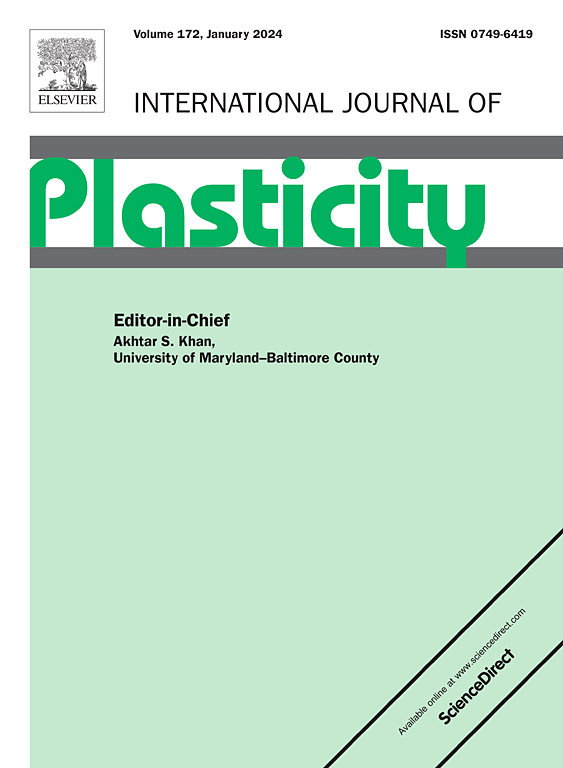
International Journal of Plasticity aims to present original research encompassing all facets of plastic deformation, damage, and fracture behavior in both isotropic and anisotropic solids. This includes exploring the thermodynamics of plasticity and fracture, continuum theory, and macroscopic as well as microscopic phenomena.
Topics of interest span the plastic behavior of single crystals and polycrystalline metals, ceramics, rocks, soils, composites, nanocrystalline and microelectronics materials, shape memory alloys, ferroelectric ceramics, thin films, and polymers. Additionally, the journal covers plasticity aspects of failure and fracture mechanics. Contributions involving significant experimental, numerical, or theoretical advancements that enhance the understanding of the plastic behavior of solids are particularly valued. Papers addressing the modeling of finite nonlinear elastic deformation, bearing similarities to the modeling of plastic deformation, are also welcomed.




 京公网安备 11010802042870号
京ICP备2023020795号-1
京公网安备 11010802042870号
京ICP备2023020795号-1

 分享
分享
 求助内容:
求助内容: 应助结果提醒方式:
 扫码关注我们
