Xinyan Wang , Mengyu Cao , Yang Zhao , Jingjing He , Xuefei Guan
{"title":"快速成型钛合金裂纹生长速率转变和波动的微观结构原因和机制","authors":"Xinyan Wang , Mengyu Cao , Yang Zhao , Jingjing He , Xuefei Guan","doi":"10.1016/j.ijplas.2024.104034","DOIUrl":null,"url":null,"abstract":"<div><p>Wire and arc additive manufacturing (WAAM) enables rapid near-net-shape fabrications of large-size parts and in-situ remanufacturing in many industry sectors. A comprehensive understanding of the fatigue failure mechanism of WAAM titanium alloys is a prerequisite for their widespread use in critical structural components subject to fatigue load. Here, the fatigue crack growth behavior of WAAM TA15 material is investigated. Fatigue crack growth tests are performed using compact tension specimens sampled from different locations and with different crack orientations of the WAAM TA15 block. The fatigue crack growth rate (FCGR) data exhibit two governing rates separated by a transition stress intensity factor value, <span><math><mrow><mstyle><mi>Δ</mi></mstyle><msub><mi>K</mi><mi>n</mi></msub></mrow></math></span>, and the degrees of fluctuation of the FCGR data in the two regimes are notably different. A piecewise log-linear model is first proposed by incorporating the Heaviside step function and <span><math><mrow><mstyle><mi>Δ</mi></mstyle><msub><mi>K</mi><mi>n</mi></msub></mrow></math></span> into the classical Paris’ model, allowing for the transition <span><math><mrow><mstyle><mi>Δ</mi></mstyle><msub><mi>K</mi><mi>n</mi></msub></mrow></math></span> to be determined by the data. The potential causes of the transition <span><math><mrow><mstyle><mi>Δ</mi></mstyle><msub><mi>K</mi><mi>n</mi></msub></mrow></math></span> are phenomenologically inferred via fractography and surface roughness profiling results. The critical microstructure affecting the value of <span><math><mrow><mstyle><mi>Δ</mi></mstyle><msub><mi>K</mi><mi>n</mi></msub></mrow></math></span> is identified by relating the crack tip cyclic plastic zone size at <span><math><mrow><mstyle><mi>Δ</mi></mstyle><msub><mi>K</mi><mi>n</mi></msub></mrow></math></span> to the sizes of main microstructures. The cause of different degrees of fluctuations in the two regimes separated by <span><math><mrow><mstyle><mi>Δ</mi></mstyle><msub><mi>K</mi><mi>n</mi></msub></mrow></math></span> is inferred by examining the microstructures within the plastic zone. The microstructural mechanisms of the local FCGR reduction and fluctuation are further identified and explained.</p></div>","PeriodicalId":340,"journal":{"name":"International Journal of Plasticity","volume":"179 ","pages":"Article 104034"},"PeriodicalIF":12.8000,"publicationDate":"2024-08-01","publicationTypes":"Journal Article","fieldsOfStudy":null,"isOpenAccess":false,"openAccessPdf":"","citationCount":"0","resultStr":"{\"title\":\"Microstructural causes and mechanisms of crack growth rate transition and fluctuation of additively manufactured titanium alloy\",\"authors\":\"Xinyan Wang , Mengyu Cao , Yang Zhao , Jingjing He , Xuefei Guan\",\"doi\":\"10.1016/j.ijplas.2024.104034\",\"DOIUrl\":null,\"url\":null,\"abstract\":\"<div><p>Wire and arc additive manufacturing (WAAM) enables rapid near-net-shape fabrications of large-size parts and in-situ remanufacturing in many industry sectors. A comprehensive understanding of the fatigue failure mechanism of WAAM titanium alloys is a prerequisite for their widespread use in critical structural components subject to fatigue load. Here, the fatigue crack growth behavior of WAAM TA15 material is investigated. Fatigue crack growth tests are performed using compact tension specimens sampled from different locations and with different crack orientations of the WAAM TA15 block. The fatigue crack growth rate (FCGR) data exhibit two governing rates separated by a transition stress intensity factor value, <span><math><mrow><mstyle><mi>Δ</mi></mstyle><msub><mi>K</mi><mi>n</mi></msub></mrow></math></span>, and the degrees of fluctuation of the FCGR data in the two regimes are notably different. A piecewise log-linear model is first proposed by incorporating the Heaviside step function and <span><math><mrow><mstyle><mi>Δ</mi></mstyle><msub><mi>K</mi><mi>n</mi></msub></mrow></math></span> into the classical Paris’ model, allowing for the transition <span><math><mrow><mstyle><mi>Δ</mi></mstyle><msub><mi>K</mi><mi>n</mi></msub></mrow></math></span> to be determined by the data. The potential causes of the transition <span><math><mrow><mstyle><mi>Δ</mi></mstyle><msub><mi>K</mi><mi>n</mi></msub></mrow></math></span> are phenomenologically inferred via fractography and surface roughness profiling results. The critical microstructure affecting the value of <span><math><mrow><mstyle><mi>Δ</mi></mstyle><msub><mi>K</mi><mi>n</mi></msub></mrow></math></span> is identified by relating the crack tip cyclic plastic zone size at <span><math><mrow><mstyle><mi>Δ</mi></mstyle><msub><mi>K</mi><mi>n</mi></msub></mrow></math></span> to the sizes of main microstructures. The cause of different degrees of fluctuations in the two regimes separated by <span><math><mrow><mstyle><mi>Δ</mi></mstyle><msub><mi>K</mi><mi>n</mi></msub></mrow></math></span> is inferred by examining the microstructures within the plastic zone. The microstructural mechanisms of the local FCGR reduction and fluctuation are further identified and explained.</p></div>\",\"PeriodicalId\":340,\"journal\":{\"name\":\"International Journal of Plasticity\",\"volume\":\"179 \",\"pages\":\"Article 104034\"},\"PeriodicalIF\":12.8000,\"publicationDate\":\"2024-08-01\",\"publicationTypes\":\"Journal Article\",\"fieldsOfStudy\":null,\"isOpenAccess\":false,\"openAccessPdf\":\"\",\"citationCount\":\"0\",\"resultStr\":null,\"platform\":\"Semanticscholar\",\"paperid\":null,\"PeriodicalName\":\"International Journal of Plasticity\",\"FirstCategoryId\":\"88\",\"ListUrlMain\":\"https://www.sciencedirect.com/science/article/pii/S074964192400161X\",\"RegionNum\":1,\"RegionCategory\":\"材料科学\",\"ArticlePicture\":[],\"TitleCN\":null,\"AbstractTextCN\":null,\"PMCID\":null,\"EPubDate\":\"2024/6/11 0:00:00\",\"PubModel\":\"Epub\",\"JCR\":\"Q1\",\"JCRName\":\"ENGINEERING, MECHANICAL\",\"Score\":null,\"Total\":0}","platform":"Semanticscholar","paperid":null,"PeriodicalName":"International Journal of Plasticity","FirstCategoryId":"88","ListUrlMain":"https://www.sciencedirect.com/science/article/pii/S074964192400161X","RegionNum":1,"RegionCategory":"材料科学","ArticlePicture":[],"TitleCN":null,"AbstractTextCN":null,"PMCID":null,"EPubDate":"2024/6/11 0:00:00","PubModel":"Epub","JCR":"Q1","JCRName":"ENGINEERING, MECHANICAL","Score":null,"Total":0}
Microstructural causes and mechanisms of crack growth rate transition and fluctuation of additively manufactured titanium alloy
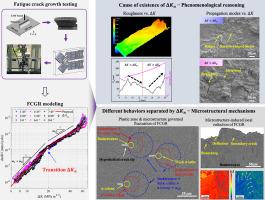
Wire and arc additive manufacturing (WAAM) enables rapid near-net-shape fabrications of large-size parts and in-situ remanufacturing in many industry sectors. A comprehensive understanding of the fatigue failure mechanism of WAAM titanium alloys is a prerequisite for their widespread use in critical structural components subject to fatigue load. Here, the fatigue crack growth behavior of WAAM TA15 material is investigated. Fatigue crack growth tests are performed using compact tension specimens sampled from different locations and with different crack orientations of the WAAM TA15 block. The fatigue crack growth rate (FCGR) data exhibit two governing rates separated by a transition stress intensity factor value, , and the degrees of fluctuation of the FCGR data in the two regimes are notably different. A piecewise log-linear model is first proposed by incorporating the Heaviside step function and into the classical Paris’ model, allowing for the transition to be determined by the data. The potential causes of the transition are phenomenologically inferred via fractography and surface roughness profiling results. The critical microstructure affecting the value of is identified by relating the crack tip cyclic plastic zone size at to the sizes of main microstructures. The cause of different degrees of fluctuations in the two regimes separated by is inferred by examining the microstructures within the plastic zone. The microstructural mechanisms of the local FCGR reduction and fluctuation are further identified and explained.
期刊介绍:
International Journal of Plasticity aims to present original research encompassing all facets of plastic deformation, damage, and fracture behavior in both isotropic and anisotropic solids. This includes exploring the thermodynamics of plasticity and fracture, continuum theory, and macroscopic as well as microscopic phenomena.
Topics of interest span the plastic behavior of single crystals and polycrystalline metals, ceramics, rocks, soils, composites, nanocrystalline and microelectronics materials, shape memory alloys, ferroelectric ceramics, thin films, and polymers. Additionally, the journal covers plasticity aspects of failure and fracture mechanics. Contributions involving significant experimental, numerical, or theoretical advancements that enhance the understanding of the plastic behavior of solids are particularly valued. Papers addressing the modeling of finite nonlinear elastic deformation, bearing similarities to the modeling of plastic deformation, are also welcomed.




 京公网安备 11010802042870号
京ICP备2023020795号-1
京公网安备 11010802042870号
京ICP备2023020795号-1

 分享
分享
 求助内容:
求助内容: 应助结果提醒方式:
 扫码关注我们
