{"title":"阐明钪催化脂肪族醛亚胺的 β-C(sp3)-H 活化和非对映选择性的机理和来源","authors":"Yiran Zhang , Yang Wang","doi":"10.1039/d4qo00567h","DOIUrl":null,"url":null,"abstract":"<div><div>The elucidation of exact reaction mechanisms, especially for the purpose of determining the origin of regio- and diastereoselectivity, is essential for furthering the development of substituent divergent reactions. In this study, density functional theory calculations were carried out to elucidate the mechanism and, thereby, the origin of regio- and diastereoselectivity, of the divergent [3 + 2] annulation of an aldimine with alkenes catalyzed by the rare-earth metal scandium (Sc). The reaction mechanism was found to consist of the generation of active species, C(sp<sup>3</sup>)–H activation, alkene insertion, ring closure, and protonation processes. The alkene insertion process was found to determine the regio- and diastereoselectivity of the reaction. The main role of the additive amine is to lower the positive charge of the Sc atom, thereby weakening and cleaving the Sc–C(sp<sup>3</sup>) bond, before forming an Sc–C(sp<sup>2</sup>) bond during the alkene insertion process. These results provide valuable insights into the reactions catalyzed by rare-earth metals.</div></div>","PeriodicalId":94379,"journal":{"name":"Organic chemistry frontiers : an international journal of organic chemistry","volume":"11 16","pages":"Pages 4391-4401"},"PeriodicalIF":0.0000,"publicationDate":"2024-06-18","publicationTypes":"Journal Article","fieldsOfStudy":null,"isOpenAccess":false,"openAccessPdf":"","citationCount":"0","resultStr":"{\"title\":\"Elucidating the mechanism and origin of diastereoselectivity in scandium-catalyzed β-C(sp3)–H activation and transformation of an aliphatic aldimine†\",\"authors\":\"Yiran Zhang , Yang Wang\",\"doi\":\"10.1039/d4qo00567h\",\"DOIUrl\":null,\"url\":null,\"abstract\":\"<div><div>The elucidation of exact reaction mechanisms, especially for the purpose of determining the origin of regio- and diastereoselectivity, is essential for furthering the development of substituent divergent reactions. In this study, density functional theory calculations were carried out to elucidate the mechanism and, thereby, the origin of regio- and diastereoselectivity, of the divergent [3 + 2] annulation of an aldimine with alkenes catalyzed by the rare-earth metal scandium (Sc). The reaction mechanism was found to consist of the generation of active species, C(sp<sup>3</sup>)–H activation, alkene insertion, ring closure, and protonation processes. The alkene insertion process was found to determine the regio- and diastereoselectivity of the reaction. The main role of the additive amine is to lower the positive charge of the Sc atom, thereby weakening and cleaving the Sc–C(sp<sup>3</sup>) bond, before forming an Sc–C(sp<sup>2</sup>) bond during the alkene insertion process. These results provide valuable insights into the reactions catalyzed by rare-earth metals.</div></div>\",\"PeriodicalId\":94379,\"journal\":{\"name\":\"Organic chemistry frontiers : an international journal of organic chemistry\",\"volume\":\"11 16\",\"pages\":\"Pages 4391-4401\"},\"PeriodicalIF\":0.0000,\"publicationDate\":\"2024-06-18\",\"publicationTypes\":\"Journal Article\",\"fieldsOfStudy\":null,\"isOpenAccess\":false,\"openAccessPdf\":\"\",\"citationCount\":\"0\",\"resultStr\":null,\"platform\":\"Semanticscholar\",\"paperid\":null,\"PeriodicalName\":\"Organic chemistry frontiers : an international journal of organic chemistry\",\"FirstCategoryId\":\"1085\",\"ListUrlMain\":\"https://www.sciencedirect.com/org/science/article/pii/S2052412924004534\",\"RegionNum\":0,\"RegionCategory\":null,\"ArticlePicture\":[],\"TitleCN\":null,\"AbstractTextCN\":null,\"PMCID\":null,\"EPubDate\":\"2024/6/17 0:00:00\",\"PubModel\":\"Epub\",\"JCR\":\"\",\"JCRName\":\"\",\"Score\":null,\"Total\":0}","platform":"Semanticscholar","paperid":null,"PeriodicalName":"Organic chemistry frontiers : an international journal of organic chemistry","FirstCategoryId":"1085","ListUrlMain":"https://www.sciencedirect.com/org/science/article/pii/S2052412924004534","RegionNum":0,"RegionCategory":null,"ArticlePicture":[],"TitleCN":null,"AbstractTextCN":null,"PMCID":null,"EPubDate":"2024/6/17 0:00:00","PubModel":"Epub","JCR":"","JCRName":"","Score":null,"Total":0}
Elucidating the mechanism and origin of diastereoselectivity in scandium-catalyzed β-C(sp3)–H activation and transformation of an aliphatic aldimine†
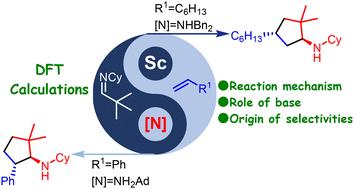
The elucidation of exact reaction mechanisms, especially for the purpose of determining the origin of regio- and diastereoselectivity, is essential for furthering the development of substituent divergent reactions. In this study, density functional theory calculations were carried out to elucidate the mechanism and, thereby, the origin of regio- and diastereoselectivity, of the divergent [3 + 2] annulation of an aldimine with alkenes catalyzed by the rare-earth metal scandium (Sc). The reaction mechanism was found to consist of the generation of active species, C(sp3)–H activation, alkene insertion, ring closure, and protonation processes. The alkene insertion process was found to determine the regio- and diastereoselectivity of the reaction. The main role of the additive amine is to lower the positive charge of the Sc atom, thereby weakening and cleaving the Sc–C(sp3) bond, before forming an Sc–C(sp2) bond during the alkene insertion process. These results provide valuable insights into the reactions catalyzed by rare-earth metals.




 京公网安备 11010802042870号
京ICP备2023020795号-1
京公网安备 11010802042870号
京ICP备2023020795号-1

 分享
分享

 求助内容:
求助内容: 应助结果提醒方式:
 扫码关注我们
