{"title":"探索沉积在 Si(100)基底上的退火 Co40Fe40Dy20 薄膜的表面粗糙度、表面能、纳米压痕、电特性和磁特性之间的相关性","authors":"Wen-Jen Liu, Yung-Huang Chang, Shuo-Ting Hsu, Chi-Lon Fern, Yuan-Tsung Chen, Shin-Ying Tsao, Shih-Hung Lin","doi":"10.1007/s11664-024-11237-z","DOIUrl":null,"url":null,"abstract":"<div><p>The impact of film thickness and annealing temperature on the structural, electrical, magnetic, and mechanical properties of cobalt–iron–dysprosium (Co<sub>40</sub>Fe<sub>40</sub>Dy<sub>20</sub> ) thin films deposited on Si(100) substrates have been investigated. X-ray diffraction (XRD) analysis confirmed the film's crystalline microstructure, featuring dysprosium oxide, Dy<sub>2</sub>O<sub>3</sub>(440), and cobalt oxide, Co<sub>2</sub>O<sub>3</sub>(422) and Co<sub>2</sub>O<sub>3</sub>(511), crystallographic phases. Surface energy measurements indicated a noticeable reduction in surface energy following annealing treatments, which could be ascribed to the alleviation of residual stress and enhanced atomic arrangement, resulting in a more stable film structure with reduced surface energy. The film exhibited a decreasing trend in hardness with increasing thickness, and film resistivity was significantly responsive to alterations in thickness and annealing temperature. Notably, the Co<sub>40</sub>Fe<sub>40</sub>Dy<sub>20</sub> film demonstrated exceptional characteristics, featuring a high saturation magnetization (Ms) of 675 emu/cm<sup>3</sup> and a low coercivity (Hc) of 9.5 Oe. Further analysis of magnetic domains and hysteresis loops revealed that larger and brighter domains were associated with higher Hc. To sum up, the surface roughness of CoFeDy films under various annealing temperatures played a pivotal role in shaping their magnetic, electrical, adhesive, and optical characteristics. An improved low-frequency alternating current magnetic susceptibility (<i>χ</i><sub>ac</sub>) value was achieved by minimizing the pinning effect on domain walls through surface smoothing. Moreover, smoother surfaces displayed heightened carrier conductivity, resulting in a decrease in electrical resistance. On the whole, Co<sub>40</sub>Fe<sub>40</sub>Dy<sub>20</sub> films exhibited outstanding soft magnetic properties, encompassing high saturation magnetization, low coercivity, exceptional mechanical attributes, and decreased surface energy.</p><h3>Graphical Abstract</h3>\n<div><figure><div><div><picture><source><img></source></picture></div></div></figure></div></div>","PeriodicalId":626,"journal":{"name":"Journal of Electronic Materials","volume":"53 8","pages":"4498 - 4511"},"PeriodicalIF":2.8000,"publicationDate":"2024-06-15","publicationTypes":"Journal Article","fieldsOfStudy":null,"isOpenAccess":false,"openAccessPdf":"","citationCount":"0","resultStr":"{\"title\":\"Exploring the Correlation Between Surface Roughness, Surface Energy, Nano-indentation, Electrical Properties, and Magnetic Characteristics of Annealed Co40Fe40Dy20 Thin Films Deposited on Si(100) Substrates\",\"authors\":\"Wen-Jen Liu, Yung-Huang Chang, Shuo-Ting Hsu, Chi-Lon Fern, Yuan-Tsung Chen, Shin-Ying Tsao, Shih-Hung Lin\",\"doi\":\"10.1007/s11664-024-11237-z\",\"DOIUrl\":null,\"url\":null,\"abstract\":\"<div><p>The impact of film thickness and annealing temperature on the structural, electrical, magnetic, and mechanical properties of cobalt–iron–dysprosium (Co<sub>40</sub>Fe<sub>40</sub>Dy<sub>20</sub> ) thin films deposited on Si(100) substrates have been investigated. X-ray diffraction (XRD) analysis confirmed the film's crystalline microstructure, featuring dysprosium oxide, Dy<sub>2</sub>O<sub>3</sub>(440), and cobalt oxide, Co<sub>2</sub>O<sub>3</sub>(422) and Co<sub>2</sub>O<sub>3</sub>(511), crystallographic phases. Surface energy measurements indicated a noticeable reduction in surface energy following annealing treatments, which could be ascribed to the alleviation of residual stress and enhanced atomic arrangement, resulting in a more stable film structure with reduced surface energy. The film exhibited a decreasing trend in hardness with increasing thickness, and film resistivity was significantly responsive to alterations in thickness and annealing temperature. Notably, the Co<sub>40</sub>Fe<sub>40</sub>Dy<sub>20</sub> film demonstrated exceptional characteristics, featuring a high saturation magnetization (Ms) of 675 emu/cm<sup>3</sup> and a low coercivity (Hc) of 9.5 Oe. Further analysis of magnetic domains and hysteresis loops revealed that larger and brighter domains were associated with higher Hc. To sum up, the surface roughness of CoFeDy films under various annealing temperatures played a pivotal role in shaping their magnetic, electrical, adhesive, and optical characteristics. An improved low-frequency alternating current magnetic susceptibility (<i>χ</i><sub>ac</sub>) value was achieved by minimizing the pinning effect on domain walls through surface smoothing. Moreover, smoother surfaces displayed heightened carrier conductivity, resulting in a decrease in electrical resistance. On the whole, Co<sub>40</sub>Fe<sub>40</sub>Dy<sub>20</sub> films exhibited outstanding soft magnetic properties, encompassing high saturation magnetization, low coercivity, exceptional mechanical attributes, and decreased surface energy.</p><h3>Graphical Abstract</h3>\\n<div><figure><div><div><picture><source><img></source></picture></div></div></figure></div></div>\",\"PeriodicalId\":626,\"journal\":{\"name\":\"Journal of Electronic Materials\",\"volume\":\"53 8\",\"pages\":\"4498 - 4511\"},\"PeriodicalIF\":2.8000,\"publicationDate\":\"2024-06-15\",\"publicationTypes\":\"Journal Article\",\"fieldsOfStudy\":null,\"isOpenAccess\":false,\"openAccessPdf\":\"\",\"citationCount\":\"0\",\"resultStr\":null,\"platform\":\"Semanticscholar\",\"paperid\":null,\"PeriodicalName\":\"Journal of Electronic Materials\",\"FirstCategoryId\":\"5\",\"ListUrlMain\":\"https://link.springer.com/article/10.1007/s11664-024-11237-z\",\"RegionNum\":4,\"RegionCategory\":\"工程技术\",\"ArticlePicture\":[],\"TitleCN\":null,\"AbstractTextCN\":null,\"PMCID\":null,\"EPubDate\":\"\",\"PubModel\":\"\",\"JCR\":\"Q3\",\"JCRName\":\"ENGINEERING, ELECTRICAL & ELECTRONIC\",\"Score\":null,\"Total\":0}","platform":"Semanticscholar","paperid":null,"PeriodicalName":"Journal of Electronic Materials","FirstCategoryId":"5","ListUrlMain":"https://link.springer.com/article/10.1007/s11664-024-11237-z","RegionNum":4,"RegionCategory":"工程技术","ArticlePicture":[],"TitleCN":null,"AbstractTextCN":null,"PMCID":null,"EPubDate":"","PubModel":"","JCR":"Q3","JCRName":"ENGINEERING, ELECTRICAL & ELECTRONIC","Score":null,"Total":0}
Exploring the Correlation Between Surface Roughness, Surface Energy, Nano-indentation, Electrical Properties, and Magnetic Characteristics of Annealed Co40Fe40Dy20 Thin Films Deposited on Si(100) Substrates
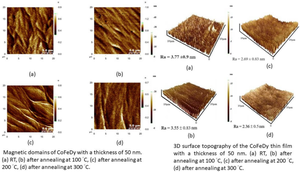
The impact of film thickness and annealing temperature on the structural, electrical, magnetic, and mechanical properties of cobalt–iron–dysprosium (Co40Fe40Dy20 ) thin films deposited on Si(100) substrates have been investigated. X-ray diffraction (XRD) analysis confirmed the film's crystalline microstructure, featuring dysprosium oxide, Dy2O3(440), and cobalt oxide, Co2O3(422) and Co2O3(511), crystallographic phases. Surface energy measurements indicated a noticeable reduction in surface energy following annealing treatments, which could be ascribed to the alleviation of residual stress and enhanced atomic arrangement, resulting in a more stable film structure with reduced surface energy. The film exhibited a decreasing trend in hardness with increasing thickness, and film resistivity was significantly responsive to alterations in thickness and annealing temperature. Notably, the Co40Fe40Dy20 film demonstrated exceptional characteristics, featuring a high saturation magnetization (Ms) of 675 emu/cm3 and a low coercivity (Hc) of 9.5 Oe. Further analysis of magnetic domains and hysteresis loops revealed that larger and brighter domains were associated with higher Hc. To sum up, the surface roughness of CoFeDy films under various annealing temperatures played a pivotal role in shaping their magnetic, electrical, adhesive, and optical characteristics. An improved low-frequency alternating current magnetic susceptibility (χac) value was achieved by minimizing the pinning effect on domain walls through surface smoothing. Moreover, smoother surfaces displayed heightened carrier conductivity, resulting in a decrease in electrical resistance. On the whole, Co40Fe40Dy20 films exhibited outstanding soft magnetic properties, encompassing high saturation magnetization, low coercivity, exceptional mechanical attributes, and decreased surface energy.
期刊介绍:
The Journal of Electronic Materials (JEM) reports monthly on the science and technology of electronic materials, while examining new applications for semiconductors, magnetic alloys, dielectrics, nanoscale materials, and photonic materials. The journal welcomes articles on methods for preparing and evaluating the chemical, physical, electronic, and optical properties of these materials. Specific areas of interest are materials for state-of-the-art transistors, nanotechnology, electronic packaging, detectors, emitters, metallization, superconductivity, and energy applications.
Review papers on current topics enable individuals in the field of electronics to keep abreast of activities in areas peripheral to their own. JEM also selects papers from conferences such as the Electronic Materials Conference, the U.S. Workshop on the Physics and Chemistry of II-VI Materials, and the International Conference on Thermoelectrics. It benefits both specialists and non-specialists in the electronic materials field.
A journal of The Minerals, Metals & Materials Society.




 京公网安备 11010802042870号
京ICP备2023020795号-1
京公网安备 11010802042870号
京ICP备2023020795号-1

 分享
分享
 求助内容:
求助内容: 应助结果提醒方式:
 扫码关注我们
