Zhenfei Tang , Yunwu Zhang , Zhiyuan Yang , Haifeng Yuan , Tong Wu , Yue Li , Guixiang Zhang , Xingzhi Wang , Bin Chang , Dehui Sun , Hong Liu , Lili Zhao , Weijia Zhou
{"title":"掺铁调节钽酸锂单晶的光吸收和活性位点,用于光催化氮还原","authors":"Zhenfei Tang , Yunwu Zhang , Zhiyuan Yang , Haifeng Yuan , Tong Wu , Yue Li , Guixiang Zhang , Xingzhi Wang , Bin Chang , Dehui Sun , Hong Liu , Lili Zhao , Weijia Zhou","doi":"10.1016/j.cclet.2024.110107","DOIUrl":null,"url":null,"abstract":"<div><div>In contrast to research on active sites in nanomaterials, lithium tantalate single crystals, known for their exceptional optical properties and long-range ordered lattice structure, present a promising avenue for in-depth exploration of photocatalytic reaction systems with fewer constraints imposed by surface chemistry. Typically, the isotropy of a specific facet provides a perfect support for studying heteroatom doping. Herein, this work delves into the intrinsic catalytic sites for photocatalytic nitrogen fixation in iron-doped lithium tantalate single crystals. The presence of iron not only modifies the electronic structure of lithium tantalate, improving its light absorption capacity, but also functions as an active site for the nitrogen adsorption and activation. The photocatalytic ammonia production rate of the iron-doped lithium tantalate in pure water is maximum 26.95 µg cm<sup>−2</sup> h<sup>−1</sup>, which is three times higher than that of undoped lithium tantalate. The combination of first-principles simulations with <em>in situ</em> characterizations confirms that iron doping promotes the rate-determining step and changes the pathway of hydrogenation to associative alternating. This study provides a new perspective on in-depth investigation of intrinsic catalytic active sites in photocatalysis and other catalytic processes.</div></div>","PeriodicalId":10088,"journal":{"name":"Chinese Chemical Letters","volume":"36 3","pages":"Article 110107"},"PeriodicalIF":8.9000,"publicationDate":"2025-03-01","publicationTypes":"Journal Article","fieldsOfStudy":null,"isOpenAccess":false,"openAccessPdf":"","citationCount":"0","resultStr":"{\"title\":\"Iron-doping regulated light absorption and active sites in LiTaO3 single crystal for photocatalytic nitrogen reduction\",\"authors\":\"Zhenfei Tang , Yunwu Zhang , Zhiyuan Yang , Haifeng Yuan , Tong Wu , Yue Li , Guixiang Zhang , Xingzhi Wang , Bin Chang , Dehui Sun , Hong Liu , Lili Zhao , Weijia Zhou\",\"doi\":\"10.1016/j.cclet.2024.110107\",\"DOIUrl\":null,\"url\":null,\"abstract\":\"<div><div>In contrast to research on active sites in nanomaterials, lithium tantalate single crystals, known for their exceptional optical properties and long-range ordered lattice structure, present a promising avenue for in-depth exploration of photocatalytic reaction systems with fewer constraints imposed by surface chemistry. Typically, the isotropy of a specific facet provides a perfect support for studying heteroatom doping. Herein, this work delves into the intrinsic catalytic sites for photocatalytic nitrogen fixation in iron-doped lithium tantalate single crystals. The presence of iron not only modifies the electronic structure of lithium tantalate, improving its light absorption capacity, but also functions as an active site for the nitrogen adsorption and activation. The photocatalytic ammonia production rate of the iron-doped lithium tantalate in pure water is maximum 26.95 µg cm<sup>−2</sup> h<sup>−1</sup>, which is three times higher than that of undoped lithium tantalate. The combination of first-principles simulations with <em>in situ</em> characterizations confirms that iron doping promotes the rate-determining step and changes the pathway of hydrogenation to associative alternating. This study provides a new perspective on in-depth investigation of intrinsic catalytic active sites in photocatalysis and other catalytic processes.</div></div>\",\"PeriodicalId\":10088,\"journal\":{\"name\":\"Chinese Chemical Letters\",\"volume\":\"36 3\",\"pages\":\"Article 110107\"},\"PeriodicalIF\":8.9000,\"publicationDate\":\"2025-03-01\",\"publicationTypes\":\"Journal Article\",\"fieldsOfStudy\":null,\"isOpenAccess\":false,\"openAccessPdf\":\"\",\"citationCount\":\"0\",\"resultStr\":null,\"platform\":\"Semanticscholar\",\"paperid\":null,\"PeriodicalName\":\"Chinese Chemical Letters\",\"FirstCategoryId\":\"92\",\"ListUrlMain\":\"https://www.sciencedirect.com/science/article/pii/S1001841724006260\",\"RegionNum\":1,\"RegionCategory\":\"化学\",\"ArticlePicture\":[],\"TitleCN\":null,\"AbstractTextCN\":null,\"PMCID\":null,\"EPubDate\":\"2024/6/12 0:00:00\",\"PubModel\":\"Epub\",\"JCR\":\"Q1\",\"JCRName\":\"CHEMISTRY, MULTIDISCIPLINARY\",\"Score\":null,\"Total\":0}","platform":"Semanticscholar","paperid":null,"PeriodicalName":"Chinese Chemical Letters","FirstCategoryId":"92","ListUrlMain":"https://www.sciencedirect.com/science/article/pii/S1001841724006260","RegionNum":1,"RegionCategory":"化学","ArticlePicture":[],"TitleCN":null,"AbstractTextCN":null,"PMCID":null,"EPubDate":"2024/6/12 0:00:00","PubModel":"Epub","JCR":"Q1","JCRName":"CHEMISTRY, MULTIDISCIPLINARY","Score":null,"Total":0}
Iron-doping regulated light absorption and active sites in LiTaO3 single crystal for photocatalytic nitrogen reduction
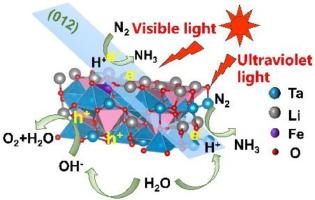
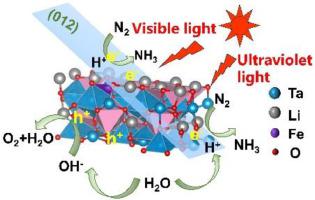
In contrast to research on active sites in nanomaterials, lithium tantalate single crystals, known for their exceptional optical properties and long-range ordered lattice structure, present a promising avenue for in-depth exploration of photocatalytic reaction systems with fewer constraints imposed by surface chemistry. Typically, the isotropy of a specific facet provides a perfect support for studying heteroatom doping. Herein, this work delves into the intrinsic catalytic sites for photocatalytic nitrogen fixation in iron-doped lithium tantalate single crystals. The presence of iron not only modifies the electronic structure of lithium tantalate, improving its light absorption capacity, but also functions as an active site for the nitrogen adsorption and activation. The photocatalytic ammonia production rate of the iron-doped lithium tantalate in pure water is maximum 26.95 µg cm−2 h−1, which is three times higher than that of undoped lithium tantalate. The combination of first-principles simulations with in situ characterizations confirms that iron doping promotes the rate-determining step and changes the pathway of hydrogenation to associative alternating. This study provides a new perspective on in-depth investigation of intrinsic catalytic active sites in photocatalysis and other catalytic processes.
期刊介绍:
Chinese Chemical Letters (CCL) (ISSN 1001-8417) was founded in July 1990. The journal publishes preliminary accounts in the whole field of chemistry, including inorganic chemistry, organic chemistry, analytical chemistry, physical chemistry, polymer chemistry, applied chemistry, etc.Chinese Chemical Letters does not accept articles previously published or scheduled to be published. To verify originality, your article may be checked by the originality detection service CrossCheck.




 京公网安备 11010802042870号
京ICP备2023020795号-1
京公网安备 11010802042870号
京ICP备2023020795号-1

 分享
分享
 求助内容:
求助内容: 应助结果提醒方式:
 扫码关注我们
