{"title":"揭示结晶度在二氧化钛与氨基氧自由基介质的光生空穴传输行为中的关键作用","authors":"","doi":"10.1016/j.jiec.2024.06.004","DOIUrl":null,"url":null,"abstract":"<div><div>Integrating aminoxyl radical mediators (ARMs) with titanium dioxide (TiO<sub>2</sub>) based photoelectrochemical (PEC) processes presents a promising approach for achieving mild and sustainable chemical transformations. However, a comprehensive understanding of the interaction between ARMs and PEC processes remains elusive. This study investigates the PEC behavior of photoelectrodes fabricated from single- and polycrystalline TiO<sub>2</sub> in the presence of a representative ARM, 4-acetamido-2,2,6,6-tetramethylpiperidine 1-oxyl radical, in acetonitrile. Interestingly, we observe contrasting PEC behavior: photocurrent enhancement for single-crystalline TiO<sub>2</sub> and photocurrent suppression for polycrystalline TiO<sub>2</sub><span>. We attribute this difference to subtle variations in surface properties arising from the material’s crystallinity<span>. Photoelectrochemical impedance spectroscopy (PEIS) is employed to gain deeper insights into the influence of surface defects on charge transfer and recombination mechanisms. The PEIS results suggest that an anomalous hole transfer mechanism mediated by surface trap states governs the PEC performance of polycrystalline TiO</span></span><sub>2</sub>.</div></div>","PeriodicalId":363,"journal":{"name":"Journal of Industrial and Engineering Chemistry","volume":"140 ","pages":"Pages 190-195"},"PeriodicalIF":7.1000,"publicationDate":"2024-12-25","publicationTypes":"Journal Article","fieldsOfStudy":null,"isOpenAccess":false,"openAccessPdf":"","citationCount":"0","resultStr":"{\"title\":\"Unveiling the critical role of crystallinity in photogenerated hole transfer behavior of TiO2 with an aminoxyl radical mediator\",\"authors\":\"\",\"doi\":\"10.1016/j.jiec.2024.06.004\",\"DOIUrl\":null,\"url\":null,\"abstract\":\"<div><div>Integrating aminoxyl radical mediators (ARMs) with titanium dioxide (TiO<sub>2</sub>) based photoelectrochemical (PEC) processes presents a promising approach for achieving mild and sustainable chemical transformations. However, a comprehensive understanding of the interaction between ARMs and PEC processes remains elusive. This study investigates the PEC behavior of photoelectrodes fabricated from single- and polycrystalline TiO<sub>2</sub> in the presence of a representative ARM, 4-acetamido-2,2,6,6-tetramethylpiperidine 1-oxyl radical, in acetonitrile. Interestingly, we observe contrasting PEC behavior: photocurrent enhancement for single-crystalline TiO<sub>2</sub> and photocurrent suppression for polycrystalline TiO<sub>2</sub><span>. We attribute this difference to subtle variations in surface properties arising from the material’s crystallinity<span>. Photoelectrochemical impedance spectroscopy (PEIS) is employed to gain deeper insights into the influence of surface defects on charge transfer and recombination mechanisms. The PEIS results suggest that an anomalous hole transfer mechanism mediated by surface trap states governs the PEC performance of polycrystalline TiO</span></span><sub>2</sub>.</div></div>\",\"PeriodicalId\":363,\"journal\":{\"name\":\"Journal of Industrial and Engineering Chemistry\",\"volume\":\"140 \",\"pages\":\"Pages 190-195\"},\"PeriodicalIF\":7.1000,\"publicationDate\":\"2024-12-25\",\"publicationTypes\":\"Journal Article\",\"fieldsOfStudy\":null,\"isOpenAccess\":false,\"openAccessPdf\":\"\",\"citationCount\":\"0\",\"resultStr\":null,\"platform\":\"Semanticscholar\",\"paperid\":null,\"PeriodicalName\":\"Journal of Industrial and Engineering Chemistry\",\"FirstCategoryId\":\"5\",\"ListUrlMain\":\"https://www.sciencedirect.com/science/article/pii/S1226086X24003769\",\"RegionNum\":3,\"RegionCategory\":\"工程技术\",\"ArticlePicture\":[],\"TitleCN\":null,\"AbstractTextCN\":null,\"PMCID\":null,\"EPubDate\":\"2024/6/10 0:00:00\",\"PubModel\":\"Epub\",\"JCR\":\"Q1\",\"JCRName\":\"CHEMISTRY, MULTIDISCIPLINARY\",\"Score\":null,\"Total\":0}","platform":"Semanticscholar","paperid":null,"PeriodicalName":"Journal of Industrial and Engineering Chemistry","FirstCategoryId":"5","ListUrlMain":"https://www.sciencedirect.com/science/article/pii/S1226086X24003769","RegionNum":3,"RegionCategory":"工程技术","ArticlePicture":[],"TitleCN":null,"AbstractTextCN":null,"PMCID":null,"EPubDate":"2024/6/10 0:00:00","PubModel":"Epub","JCR":"Q1","JCRName":"CHEMISTRY, MULTIDISCIPLINARY","Score":null,"Total":0}
Unveiling the critical role of crystallinity in photogenerated hole transfer behavior of TiO2 with an aminoxyl radical mediator
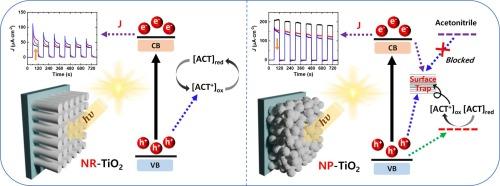
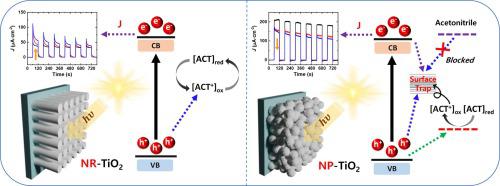
Integrating aminoxyl radical mediators (ARMs) with titanium dioxide (TiO2) based photoelectrochemical (PEC) processes presents a promising approach for achieving mild and sustainable chemical transformations. However, a comprehensive understanding of the interaction between ARMs and PEC processes remains elusive. This study investigates the PEC behavior of photoelectrodes fabricated from single- and polycrystalline TiO2 in the presence of a representative ARM, 4-acetamido-2,2,6,6-tetramethylpiperidine 1-oxyl radical, in acetonitrile. Interestingly, we observe contrasting PEC behavior: photocurrent enhancement for single-crystalline TiO2 and photocurrent suppression for polycrystalline TiO2. We attribute this difference to subtle variations in surface properties arising from the material’s crystallinity. Photoelectrochemical impedance spectroscopy (PEIS) is employed to gain deeper insights into the influence of surface defects on charge transfer and recombination mechanisms. The PEIS results suggest that an anomalous hole transfer mechanism mediated by surface trap states governs the PEC performance of polycrystalline TiO2.
期刊介绍:
Journal of Industrial and Engineering Chemistry is published monthly in English by the Korean Society of Industrial and Engineering Chemistry. JIEC brings together multidisciplinary interests in one journal and is to disseminate information on all aspects of research and development in industrial and engineering chemistry. Contributions in the form of research articles, short communications, notes and reviews are considered for publication. The editors welcome original contributions that have not been and are not to be published elsewhere. Instruction to authors and a manuscript submissions form are printed at the end of each issue. Bulk reprints of individual articles can be ordered. This publication is partially supported by Korea Research Foundation and the Korean Federation of Science and Technology Societies.




 京公网安备 11010802042870号
京ICP备2023020795号-1
京公网安备 11010802042870号
京ICP备2023020795号-1

 分享
分享
 求助内容:
求助内容: 应助结果提醒方式:
 扫码关注我们
