Jinqi Yang , Xiaoxiang Hu , Yuanyuan Zhang , Lingyu Zhao , Chunlin Yue , Yuan Cao , Yangyang Zhang , Zhenwen Zhao
{"title":"基于超高效液相色谱-电喷雾串联质谱(UHPLC-ESI-MS)结合分子动力学模拟,直接观察与蛋白质结合的天然产物","authors":"Jinqi Yang , Xiaoxiang Hu , Yuanyuan Zhang , Lingyu Zhao , Chunlin Yue , Yuan Cao , Yangyang Zhang , Zhenwen Zhao","doi":"10.1016/j.cclet.2024.110128","DOIUrl":null,"url":null,"abstract":"<div><div>The bioactive constituents found in natural products (NPs) are crucial in protein-ligand interactions and drug discovery. However, it is difficult to identify ligand molecules from complex NPs that specifically bind to target protein, which often requires time-consuming and labor-intensive processes such as isolation and enrichment. To address this issue, in this study we developed a method that combines ultra-high performance liquid chromatography-electrospray ionization-mass spectrometry (UHPLC-ESI-MS) with molecular dynamics (MD) simulation to identify and observe, rapidly and efficiently, the bioactive components in NPs that bind to specific protein target. In this method, a specific protein target was introduced online using a three-way valve to form a protein-ligand complex. The complex was then detected in real time using high-resolution MS to identify potential ligands. Based on our method, only 10 molecules from green tea (a representative natural product), including the commonly reported epigallocatechin gallate (EGCG) and epicatechin gallate (ECG), as well as the previously unreported eepicatechin (4β→8)-epigallocatechin 3-<em>O</em>-gallate (EC-EGCG) and eepiafzelechin 3-<em>O</em>-gallate-(4β→8)-epigallocatechin 3-<em>O</em>-gallate (EFG-EGCG), were screened out, which could form complexes with Aβ<sub>1–42</sub> (a representative protein target), and could be potential ligands of Aβ<sub>1–42</sub>. Among of them, EC-EGCG demonstrated the highest binding free energy with Aβ<sub>1–42</sub> (−68.54 ± 3.82 kcal/mol). On the other side, even though the caffeine had the highest signal among green tea extracts, it was not observed to form a complex with Aβ<sub>1–42</sub>. Compared to other methods such as affinity selection mass spectrometry (ASMS) and native MS, our method is easy to operate and interpret the data. Undoubtedly, it provides a new methodology for potential drug discovery in NPs, and will accelerate the research on screening ligands for specific proteins from complex NPs.</div></div>","PeriodicalId":10088,"journal":{"name":"Chinese Chemical Letters","volume":"36 5","pages":"Article 110128"},"PeriodicalIF":8.9000,"publicationDate":"2025-05-01","publicationTypes":"Journal Article","fieldsOfStudy":null,"isOpenAccess":false,"openAccessPdf":"","citationCount":"0","resultStr":"{\"title\":\"Direct observation of natural products bound to protein based on UHPLC-ESI-MS combined with molecular dynamics simulation\",\"authors\":\"Jinqi Yang , Xiaoxiang Hu , Yuanyuan Zhang , Lingyu Zhao , Chunlin Yue , Yuan Cao , Yangyang Zhang , Zhenwen Zhao\",\"doi\":\"10.1016/j.cclet.2024.110128\",\"DOIUrl\":null,\"url\":null,\"abstract\":\"<div><div>The bioactive constituents found in natural products (NPs) are crucial in protein-ligand interactions and drug discovery. However, it is difficult to identify ligand molecules from complex NPs that specifically bind to target protein, which often requires time-consuming and labor-intensive processes such as isolation and enrichment. To address this issue, in this study we developed a method that combines ultra-high performance liquid chromatography-electrospray ionization-mass spectrometry (UHPLC-ESI-MS) with molecular dynamics (MD) simulation to identify and observe, rapidly and efficiently, the bioactive components in NPs that bind to specific protein target. In this method, a specific protein target was introduced online using a three-way valve to form a protein-ligand complex. The complex was then detected in real time using high-resolution MS to identify potential ligands. Based on our method, only 10 molecules from green tea (a representative natural product), including the commonly reported epigallocatechin gallate (EGCG) and epicatechin gallate (ECG), as well as the previously unreported eepicatechin (4β→8)-epigallocatechin 3-<em>O</em>-gallate (EC-EGCG) and eepiafzelechin 3-<em>O</em>-gallate-(4β→8)-epigallocatechin 3-<em>O</em>-gallate (EFG-EGCG), were screened out, which could form complexes with Aβ<sub>1–42</sub> (a representative protein target), and could be potential ligands of Aβ<sub>1–42</sub>. Among of them, EC-EGCG demonstrated the highest binding free energy with Aβ<sub>1–42</sub> (−68.54 ± 3.82 kcal/mol). On the other side, even though the caffeine had the highest signal among green tea extracts, it was not observed to form a complex with Aβ<sub>1–42</sub>. Compared to other methods such as affinity selection mass spectrometry (ASMS) and native MS, our method is easy to operate and interpret the data. Undoubtedly, it provides a new methodology for potential drug discovery in NPs, and will accelerate the research on screening ligands for specific proteins from complex NPs.</div></div>\",\"PeriodicalId\":10088,\"journal\":{\"name\":\"Chinese Chemical Letters\",\"volume\":\"36 5\",\"pages\":\"Article 110128\"},\"PeriodicalIF\":8.9000,\"publicationDate\":\"2025-05-01\",\"publicationTypes\":\"Journal Article\",\"fieldsOfStudy\":null,\"isOpenAccess\":false,\"openAccessPdf\":\"\",\"citationCount\":\"0\",\"resultStr\":null,\"platform\":\"Semanticscholar\",\"paperid\":null,\"PeriodicalName\":\"Chinese Chemical Letters\",\"FirstCategoryId\":\"92\",\"ListUrlMain\":\"https://www.sciencedirect.com/science/article/pii/S1001841724006478\",\"RegionNum\":1,\"RegionCategory\":\"化学\",\"ArticlePicture\":[],\"TitleCN\":null,\"AbstractTextCN\":null,\"PMCID\":null,\"EPubDate\":\"2024/6/14 0:00:00\",\"PubModel\":\"Epub\",\"JCR\":\"Q1\",\"JCRName\":\"CHEMISTRY, MULTIDISCIPLINARY\",\"Score\":null,\"Total\":0}","platform":"Semanticscholar","paperid":null,"PeriodicalName":"Chinese Chemical Letters","FirstCategoryId":"92","ListUrlMain":"https://www.sciencedirect.com/science/article/pii/S1001841724006478","RegionNum":1,"RegionCategory":"化学","ArticlePicture":[],"TitleCN":null,"AbstractTextCN":null,"PMCID":null,"EPubDate":"2024/6/14 0:00:00","PubModel":"Epub","JCR":"Q1","JCRName":"CHEMISTRY, MULTIDISCIPLINARY","Score":null,"Total":0}
引用次数: 0
摘要
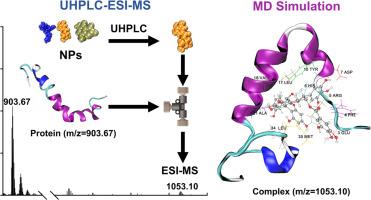
在天然产物(NPs)中发现的生物活性成分在蛋白质-配体相互作用和药物发现中至关重要。然而,很难从复杂的NPs中识别特异性结合靶蛋白的配体分子,这通常需要耗时和劳动密集型的过程,如分离和富集。为了解决这一问题,本研究开发了一种结合超高效液相色谱-电喷雾电离-质谱(UHPLC-ESI-MS)和分子动力学(MD)模拟的方法,以快速有效地鉴定和观察NPs中与特定蛋白质靶点结合的生物活性成分。在这种方法中,使用三通阀在线引入特定的蛋白质靶点,形成蛋白质-配体复合物。然后使用高分辨率质谱实时检测该复合物以识别潜在的配体。基于我们的方法,从绿茶(代表性天然产物)中筛选出10个分子,包括通常报道的表没食子儿茶素没食子酸酯(EGCG)和表没食子儿茶素没食子酸酯(ECG),以及之前未报道的表儿茶素(4β→8)-表没食子儿茶素3- o -没食子酸酯(EC-EGCG)和表没食子儿茶素3- o -没食子酸酯-(4β→8)-表没食子儿茶素3- o -没食子酸酯(eg -EGCG),这些分子可以与a β1 - 42(代表性蛋白靶点)形成配合物,可能是a β1 - 42的潜在配体。其中,EC-EGCG与a - β1 - 42的结合自由能最高(−68.54 ± 3.82 kcal/mol)。另一方面,尽管咖啡因在绿茶提取物中具有最高的信号,但没有观察到它与a β1 - 42形成复合物。与亲和选择质谱法(affinity selection mass spectrometry, asm)和天然质谱法(MS)相比,本方法操作简便,数据解释方便。毫无疑问,它为潜在的NPs药物发现提供了一种新的方法,并将加速从复杂NPs中筛选特定蛋白质配体的研究。
Direct observation of natural products bound to protein based on UHPLC-ESI-MS combined with molecular dynamics simulation
The bioactive constituents found in natural products (NPs) are crucial in protein-ligand interactions and drug discovery. However, it is difficult to identify ligand molecules from complex NPs that specifically bind to target protein, which often requires time-consuming and labor-intensive processes such as isolation and enrichment. To address this issue, in this study we developed a method that combines ultra-high performance liquid chromatography-electrospray ionization-mass spectrometry (UHPLC-ESI-MS) with molecular dynamics (MD) simulation to identify and observe, rapidly and efficiently, the bioactive components in NPs that bind to specific protein target. In this method, a specific protein target was introduced online using a three-way valve to form a protein-ligand complex. The complex was then detected in real time using high-resolution MS to identify potential ligands. Based on our method, only 10 molecules from green tea (a representative natural product), including the commonly reported epigallocatechin gallate (EGCG) and epicatechin gallate (ECG), as well as the previously unreported eepicatechin (4β→8)-epigallocatechin 3-O-gallate (EC-EGCG) and eepiafzelechin 3-O-gallate-(4β→8)-epigallocatechin 3-O-gallate (EFG-EGCG), were screened out, which could form complexes with Aβ1–42 (a representative protein target), and could be potential ligands of Aβ1–42. Among of them, EC-EGCG demonstrated the highest binding free energy with Aβ1–42 (−68.54 ± 3.82 kcal/mol). On the other side, even though the caffeine had the highest signal among green tea extracts, it was not observed to form a complex with Aβ1–42. Compared to other methods such as affinity selection mass spectrometry (ASMS) and native MS, our method is easy to operate and interpret the data. Undoubtedly, it provides a new methodology for potential drug discovery in NPs, and will accelerate the research on screening ligands for specific proteins from complex NPs.
期刊介绍:
Chinese Chemical Letters (CCL) (ISSN 1001-8417) was founded in July 1990. The journal publishes preliminary accounts in the whole field of chemistry, including inorganic chemistry, organic chemistry, analytical chemistry, physical chemistry, polymer chemistry, applied chemistry, etc.Chinese Chemical Letters does not accept articles previously published or scheduled to be published. To verify originality, your article may be checked by the originality detection service CrossCheck.




 京公网安备 11010802042870号
京ICP备2023020795号-1
京公网安备 11010802042870号
京ICP备2023020795号-1

 分享
分享
 求助内容:
求助内容: 应助结果提醒方式:
 扫码关注我们
