{"title":"利用过乙基柱[5]炔和柱[6]炔的无孔自适应晶体近乎完美地分离脂环酮和脂环醇","authors":"Jingyu Chen , Sha Wu , Yuhao Wang, Jiong Zhou","doi":"10.1016/j.cclet.2024.110102","DOIUrl":null,"url":null,"abstract":"<div><div>The separation of alicyclic ketones and alicyclic alcohols is one of the challenges in the field of petrochemical industry. However, traditional separation methods suffer from excessive energy consumption, complicated operation, and unsatisfactory separation efficiency for substances with similar boiling points. Herein, we offer an innovative method for the separation of alicyclic ketones and alicyclic alcohols employing nonporous adaptive crystals (NACs) of perethylated pillar[5]arene (EtP5) and perethylated pillar[6]arene (EtP6). NACs of EtP5 cannot adsorb either alicyclic ketones or alicyclic alcohols because of the small cavity size of EtP5. By contrast, NACs of EtP6 can separate cyclopentanone from the vapor mixture of cyclopentanone/cyclopentanol (v:v = 1:1) and cyclohexanone from the vapor mixture of cyclohexanone/cyclohexanol (v:v = 1:1) with purities of 99.1 % and 100 %, respectively. Density functional theory calculations show that the selectivity comes from the thermodynamic stability of the newly formed crystal structure after adsorption of the preferred guest molecule. Moreover, NACs of EtP6 can be reused without losing selectivity and performance.</div></div>","PeriodicalId":10088,"journal":{"name":"Chinese Chemical Letters","volume":"36 4","pages":"Article 110102"},"PeriodicalIF":9.5000,"publicationDate":"2025-04-01","publicationTypes":"Journal Article","fieldsOfStudy":null,"isOpenAccess":false,"openAccessPdf":"","citationCount":"0","resultStr":"{\"title\":\"Near-perfect separation of alicyclic ketones and alicyclic alcohols by nonporous adaptive crystals of perethylated pillar[5]arene and pillar[6]arene\",\"authors\":\"Jingyu Chen , Sha Wu , Yuhao Wang, Jiong Zhou\",\"doi\":\"10.1016/j.cclet.2024.110102\",\"DOIUrl\":null,\"url\":null,\"abstract\":\"<div><div>The separation of alicyclic ketones and alicyclic alcohols is one of the challenges in the field of petrochemical industry. However, traditional separation methods suffer from excessive energy consumption, complicated operation, and unsatisfactory separation efficiency for substances with similar boiling points. Herein, we offer an innovative method for the separation of alicyclic ketones and alicyclic alcohols employing nonporous adaptive crystals (NACs) of perethylated pillar[5]arene (EtP5) and perethylated pillar[6]arene (EtP6). NACs of EtP5 cannot adsorb either alicyclic ketones or alicyclic alcohols because of the small cavity size of EtP5. By contrast, NACs of EtP6 can separate cyclopentanone from the vapor mixture of cyclopentanone/cyclopentanol (v:v = 1:1) and cyclohexanone from the vapor mixture of cyclohexanone/cyclohexanol (v:v = 1:1) with purities of 99.1 % and 100 %, respectively. Density functional theory calculations show that the selectivity comes from the thermodynamic stability of the newly formed crystal structure after adsorption of the preferred guest molecule. Moreover, NACs of EtP6 can be reused without losing selectivity and performance.</div></div>\",\"PeriodicalId\":10088,\"journal\":{\"name\":\"Chinese Chemical Letters\",\"volume\":\"36 4\",\"pages\":\"Article 110102\"},\"PeriodicalIF\":9.5000,\"publicationDate\":\"2025-04-01\",\"publicationTypes\":\"Journal Article\",\"fieldsOfStudy\":null,\"isOpenAccess\":false,\"openAccessPdf\":\"\",\"citationCount\":\"0\",\"resultStr\":null,\"platform\":\"Semanticscholar\",\"paperid\":null,\"PeriodicalName\":\"Chinese Chemical Letters\",\"FirstCategoryId\":\"92\",\"ListUrlMain\":\"https://www.sciencedirect.com/science/article/pii/S1001841724006211\",\"RegionNum\":1,\"RegionCategory\":\"化学\",\"ArticlePicture\":[],\"TitleCN\":null,\"AbstractTextCN\":null,\"PMCID\":null,\"EPubDate\":\"2024/6/7 0:00:00\",\"PubModel\":\"Epub\",\"JCR\":\"Q1\",\"JCRName\":\"CHEMISTRY, MULTIDISCIPLINARY\",\"Score\":null,\"Total\":0}","platform":"Semanticscholar","paperid":null,"PeriodicalName":"Chinese Chemical Letters","FirstCategoryId":"92","ListUrlMain":"https://www.sciencedirect.com/science/article/pii/S1001841724006211","RegionNum":1,"RegionCategory":"化学","ArticlePicture":[],"TitleCN":null,"AbstractTextCN":null,"PMCID":null,"EPubDate":"2024/6/7 0:00:00","PubModel":"Epub","JCR":"Q1","JCRName":"CHEMISTRY, MULTIDISCIPLINARY","Score":null,"Total":0}
Near-perfect separation of alicyclic ketones and alicyclic alcohols by nonporous adaptive crystals of perethylated pillar[5]arene and pillar[6]arene
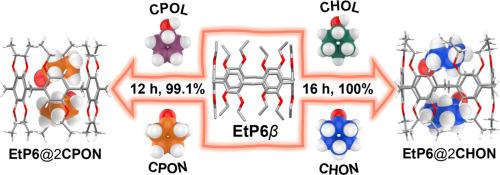
The separation of alicyclic ketones and alicyclic alcohols is one of the challenges in the field of petrochemical industry. However, traditional separation methods suffer from excessive energy consumption, complicated operation, and unsatisfactory separation efficiency for substances with similar boiling points. Herein, we offer an innovative method for the separation of alicyclic ketones and alicyclic alcohols employing nonporous adaptive crystals (NACs) of perethylated pillar[5]arene (EtP5) and perethylated pillar[6]arene (EtP6). NACs of EtP5 cannot adsorb either alicyclic ketones or alicyclic alcohols because of the small cavity size of EtP5. By contrast, NACs of EtP6 can separate cyclopentanone from the vapor mixture of cyclopentanone/cyclopentanol (v:v = 1:1) and cyclohexanone from the vapor mixture of cyclohexanone/cyclohexanol (v:v = 1:1) with purities of 99.1 % and 100 %, respectively. Density functional theory calculations show that the selectivity comes from the thermodynamic stability of the newly formed crystal structure after adsorption of the preferred guest molecule. Moreover, NACs of EtP6 can be reused without losing selectivity and performance.
期刊介绍:
Chinese Chemical Letters (CCL) (ISSN 1001-8417) was founded in July 1990. The journal publishes preliminary accounts in the whole field of chemistry, including inorganic chemistry, organic chemistry, analytical chemistry, physical chemistry, polymer chemistry, applied chemistry, etc.Chinese Chemical Letters does not accept articles previously published or scheduled to be published. To verify originality, your article may be checked by the originality detection service CrossCheck.




 京公网安备 11010802042870号
京ICP备2023020795号-1
京公网安备 11010802042870号
京ICP备2023020795号-1

 分享
分享
 求助内容:
求助内容: 应助结果提醒方式:
 扫码关注我们
