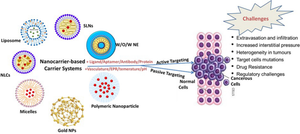
{"title":"利用纳米材料对癌症进行靶向给药:进展与挑战","authors":"Teenu Sharma, Sakshi Gorivale, Priyanka Bhandari","doi":"10.1007/s11051-024-06023-1","DOIUrl":null,"url":null,"abstract":"<div><p>Cancer is considered the world’s deadliest disease, and its underlying pathology is intricate. Though cancer patients have had access to chemotherapeutics since aeons, the traditional treatments sometimes cause discomfort, have unwanted side effects, and are not site-specific. In this regard, several nanomaterials have lately been developed and explored specifically for use in cancer treatment ascribable to their unique optically active, magnetic, and electrical properties owing to nano-sized (1 to 100 nm) particles. Targeting, improved bioavailability, and low toxicity are vital reasons for nanomedicines becoming increasingly popular. Nanoparticles actively and passively target the cancer cells and kill them. Various ligands, including aptamers, biomolecules, peptides and/or antibodies have been in use for active targeting of cancer, while the cell characteristics, like leaky vasculature, angiogenesis etc., of cancer cells facilitate passive targeting. Focusing on nano oncology research investigations and clinical applications, this review traces the development and current state of targeted cancer therapy using nanomaterials. Also, this article furnishes account of challenges hindering the reach of these materials to clinical applications.</p><h3>Graphical Abstract</h3>\n<div><figure><div><div><picture><source><img></source></picture></div></div></figure></div></div>","PeriodicalId":653,"journal":{"name":"Journal of Nanoparticle Research","volume":"26 6","pages":""},"PeriodicalIF":2.6000,"publicationDate":"2024-06-11","publicationTypes":"Journal Article","fieldsOfStudy":null,"isOpenAccess":false,"openAccessPdf":"","citationCount":"0","resultStr":"{\"title\":\"Targeted drug delivery in cancer using nanomaterials: advances and challenges\",\"authors\":\"Teenu Sharma, Sakshi Gorivale, Priyanka Bhandari\",\"doi\":\"10.1007/s11051-024-06023-1\",\"DOIUrl\":null,\"url\":null,\"abstract\":\"<div><p>Cancer is considered the world’s deadliest disease, and its underlying pathology is intricate. Though cancer patients have had access to chemotherapeutics since aeons, the traditional treatments sometimes cause discomfort, have unwanted side effects, and are not site-specific. In this regard, several nanomaterials have lately been developed and explored specifically for use in cancer treatment ascribable to their unique optically active, magnetic, and electrical properties owing to nano-sized (1 to 100 nm) particles. Targeting, improved bioavailability, and low toxicity are vital reasons for nanomedicines becoming increasingly popular. Nanoparticles actively and passively target the cancer cells and kill them. Various ligands, including aptamers, biomolecules, peptides and/or antibodies have been in use for active targeting of cancer, while the cell characteristics, like leaky vasculature, angiogenesis etc., of cancer cells facilitate passive targeting. Focusing on nano oncology research investigations and clinical applications, this review traces the development and current state of targeted cancer therapy using nanomaterials. Also, this article furnishes account of challenges hindering the reach of these materials to clinical applications.</p><h3>Graphical Abstract</h3>\\n<div><figure><div><div><picture><source><img></source></picture></div></div></figure></div></div>\",\"PeriodicalId\":653,\"journal\":{\"name\":\"Journal of Nanoparticle Research\",\"volume\":\"26 6\",\"pages\":\"\"},\"PeriodicalIF\":2.6000,\"publicationDate\":\"2024-06-11\",\"publicationTypes\":\"Journal Article\",\"fieldsOfStudy\":null,\"isOpenAccess\":false,\"openAccessPdf\":\"\",\"citationCount\":\"0\",\"resultStr\":null,\"platform\":\"Semanticscholar\",\"paperid\":null,\"PeriodicalName\":\"Journal of Nanoparticle Research\",\"FirstCategoryId\":\"88\",\"ListUrlMain\":\"https://link.springer.com/article/10.1007/s11051-024-06023-1\",\"RegionNum\":4,\"RegionCategory\":\"材料科学\",\"ArticlePicture\":[],\"TitleCN\":null,\"AbstractTextCN\":null,\"PMCID\":null,\"EPubDate\":\"\",\"PubModel\":\"\",\"JCR\":\"Q3\",\"JCRName\":\"CHEMISTRY, MULTIDISCIPLINARY\",\"Score\":null,\"Total\":0}","platform":"Semanticscholar","paperid":null,"PeriodicalName":"Journal of Nanoparticle Research","FirstCategoryId":"88","ListUrlMain":"https://link.springer.com/article/10.1007/s11051-024-06023-1","RegionNum":4,"RegionCategory":"材料科学","ArticlePicture":[],"TitleCN":null,"AbstractTextCN":null,"PMCID":null,"EPubDate":"","PubModel":"","JCR":"Q3","JCRName":"CHEMISTRY, MULTIDISCIPLINARY","Score":null,"Total":0}
Targeted drug delivery in cancer using nanomaterials: advances and challenges
Cancer is considered the world’s deadliest disease, and its underlying pathology is intricate. Though cancer patients have had access to chemotherapeutics since aeons, the traditional treatments sometimes cause discomfort, have unwanted side effects, and are not site-specific. In this regard, several nanomaterials have lately been developed and explored specifically for use in cancer treatment ascribable to their unique optically active, magnetic, and electrical properties owing to nano-sized (1 to 100 nm) particles. Targeting, improved bioavailability, and low toxicity are vital reasons for nanomedicines becoming increasingly popular. Nanoparticles actively and passively target the cancer cells and kill them. Various ligands, including aptamers, biomolecules, peptides and/or antibodies have been in use for active targeting of cancer, while the cell characteristics, like leaky vasculature, angiogenesis etc., of cancer cells facilitate passive targeting. Focusing on nano oncology research investigations and clinical applications, this review traces the development and current state of targeted cancer therapy using nanomaterials. Also, this article furnishes account of challenges hindering the reach of these materials to clinical applications.
期刊介绍:
The objective of the Journal of Nanoparticle Research is to disseminate knowledge of the physical, chemical and biological phenomena and processes in structures that have at least one lengthscale ranging from molecular to approximately 100 nm (or submicron in some situations), and exhibit improved and novel properties that are a direct result of their small size.
Nanoparticle research is a key component of nanoscience, nanoengineering and nanotechnology.
The focus of the Journal is on the specific concepts, properties, phenomena, and processes related to particles, tubes, layers, macromolecules, clusters and other finite structures of the nanoscale size range. Synthesis, assembly, transport, reactivity, and stability of such structures are considered. Development of in-situ and ex-situ instrumentation for characterization of nanoparticles and their interfaces should be based on new principles for probing properties and phenomena not well understood at the nanometer scale. Modeling and simulation may include atom-based quantum mechanics; molecular dynamics; single-particle, multi-body and continuum based models; fractals; other methods suitable for modeling particle synthesis, assembling and interaction processes. Realization and application of systems, structures and devices with novel functions obtained via precursor nanoparticles is emphasized. Approaches may include gas-, liquid-, solid-, and vacuum-based processes, size reduction, chemical- and bio-self assembly. Contributions include utilization of nanoparticle systems for enhancing a phenomenon or process and particle assembling into hierarchical structures, as well as formulation and the administration of drugs. Synergistic approaches originating from different disciplines and technologies, and interaction between the research providers and users in this field, are encouraged.




 京公网安备 11010802042870号
京ICP备2023020795号-1
京公网安备 11010802042870号
京ICP备2023020795号-1

 分享
分享
 求助内容:
求助内容: 应助结果提醒方式:
 扫码关注我们
