Xiao Zhang , Hui Ni , Xiangming Xu , Long Li , Hailan Kang , Donghan Li
{"title":"纤维素纳米晶体的合成、功能化和利用的最新进展","authors":"Xiao Zhang , Hui Ni , Xiangming Xu , Long Li , Hailan Kang , Donghan Li","doi":"10.1016/j.recm.2024.05.003","DOIUrl":null,"url":null,"abstract":"<div><div>The utilization of cellulose nanocrystals (CNCs), a renewable and eco-friendly nanomaterial, has emerged as the favored option for sustainable fillers. This paper presents diverse methods for CNCs preparation, including acid hydrolysis, oxidation, mechanical method, enzymatic hydrolysis, solvent method and hybrid approach. The strategies for modifying CNCs can be summarized as encompassing physical adsorption through non-covalent bond interactions and chemical modifications via covalent bonding. Moreover, the applications of CNCs in sensing systems, electronic skin devices, packaging materials, electronics industries, stabilizers and cosmetics are discussed with a particular emphasis on their contribution to enhancing polymer matrix properties. Lastly, future prospects for the advancement of CNCs are explored with a focus on its potential impact on sustainability efforts.</div></div>","PeriodicalId":101081,"journal":{"name":"Resources Chemicals and Materials","volume":"4 1","pages":"Article 100073"},"PeriodicalIF":0.0000,"publicationDate":"2025-03-01","publicationTypes":"Journal Article","fieldsOfStudy":null,"isOpenAccess":false,"openAccessPdf":"","citationCount":"0","resultStr":"{\"title\":\"Recent advancements in the synthesis, functionalization, and utilization of cellulose nanocrystals\",\"authors\":\"Xiao Zhang , Hui Ni , Xiangming Xu , Long Li , Hailan Kang , Donghan Li\",\"doi\":\"10.1016/j.recm.2024.05.003\",\"DOIUrl\":null,\"url\":null,\"abstract\":\"<div><div>The utilization of cellulose nanocrystals (CNCs), a renewable and eco-friendly nanomaterial, has emerged as the favored option for sustainable fillers. This paper presents diverse methods for CNCs preparation, including acid hydrolysis, oxidation, mechanical method, enzymatic hydrolysis, solvent method and hybrid approach. The strategies for modifying CNCs can be summarized as encompassing physical adsorption through non-covalent bond interactions and chemical modifications via covalent bonding. Moreover, the applications of CNCs in sensing systems, electronic skin devices, packaging materials, electronics industries, stabilizers and cosmetics are discussed with a particular emphasis on their contribution to enhancing polymer matrix properties. Lastly, future prospects for the advancement of CNCs are explored with a focus on its potential impact on sustainability efforts.</div></div>\",\"PeriodicalId\":101081,\"journal\":{\"name\":\"Resources Chemicals and Materials\",\"volume\":\"4 1\",\"pages\":\"Article 100073\"},\"PeriodicalIF\":0.0000,\"publicationDate\":\"2025-03-01\",\"publicationTypes\":\"Journal Article\",\"fieldsOfStudy\":null,\"isOpenAccess\":false,\"openAccessPdf\":\"\",\"citationCount\":\"0\",\"resultStr\":null,\"platform\":\"Semanticscholar\",\"paperid\":null,\"PeriodicalName\":\"Resources Chemicals and Materials\",\"FirstCategoryId\":\"1085\",\"ListUrlMain\":\"https://www.sciencedirect.com/science/article/pii/S2772443324000187\",\"RegionNum\":0,\"RegionCategory\":null,\"ArticlePicture\":[],\"TitleCN\":null,\"AbstractTextCN\":null,\"PMCID\":null,\"EPubDate\":\"2024/6/12 0:00:00\",\"PubModel\":\"Epub\",\"JCR\":\"\",\"JCRName\":\"\",\"Score\":null,\"Total\":0}","platform":"Semanticscholar","paperid":null,"PeriodicalName":"Resources Chemicals and Materials","FirstCategoryId":"1085","ListUrlMain":"https://www.sciencedirect.com/science/article/pii/S2772443324000187","RegionNum":0,"RegionCategory":null,"ArticlePicture":[],"TitleCN":null,"AbstractTextCN":null,"PMCID":null,"EPubDate":"2024/6/12 0:00:00","PubModel":"Epub","JCR":"","JCRName":"","Score":null,"Total":0}
Recent advancements in the synthesis, functionalization, and utilization of cellulose nanocrystals
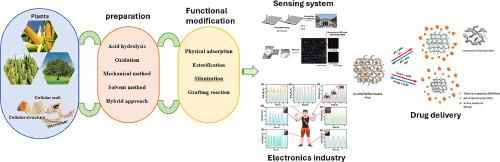
The utilization of cellulose nanocrystals (CNCs), a renewable and eco-friendly nanomaterial, has emerged as the favored option for sustainable fillers. This paper presents diverse methods for CNCs preparation, including acid hydrolysis, oxidation, mechanical method, enzymatic hydrolysis, solvent method and hybrid approach. The strategies for modifying CNCs can be summarized as encompassing physical adsorption through non-covalent bond interactions and chemical modifications via covalent bonding. Moreover, the applications of CNCs in sensing systems, electronic skin devices, packaging materials, electronics industries, stabilizers and cosmetics are discussed with a particular emphasis on their contribution to enhancing polymer matrix properties. Lastly, future prospects for the advancement of CNCs are explored with a focus on its potential impact on sustainability efforts.




 京公网安备 11010802042870号
京ICP备2023020795号-1
京公网安备 11010802042870号
京ICP备2023020795号-1

 分享
分享

 求助内容:
求助内容: 应助结果提醒方式:
 扫码关注我们
