Yanli Ma , Yi He , Jiabin Yang , Pan Dong , Ziyuan Li , Jianzuo Ma , Liming Chen , Weiguo Li
{"title":"纳米晶金属屈服强度建模","authors":"Yanli Ma , Yi He , Jiabin Yang , Pan Dong , Ziyuan Li , Jianzuo Ma , Liming Chen , Weiguo Li","doi":"10.1016/j.ijplas.2024.104039","DOIUrl":null,"url":null,"abstract":"<div><p>The yield strength of nanocrystalline metals is an emphasis for designing and fabricating more reliable and cost-effective devices for application in aircraft and renewable energy systems. Grain size is a major influence factor affecting the variation of yield strength. Both Hall-Petch strengthening and inverse Hall-Petch softening, which focus on the variation of grain size, have always been the main areas of interest. Determining the critical grain size between Hall-Petch strengthening and inverse Hall-Petch softening is a challenge. In this study, a yield criterion for nanocrystalline metals is proposed by considering the dominant mechanism of plasticity yielding, which encompasses both Hall-Petch strengthening and inverse Hall-Petch softening. Subsequently, a new theoretical model for the grain size effect on yield strength is established based on the proposed criterion, which considers the grain size effect on Young's modulus, grain interior energy, and grain boundary energy. Further, taking the grain boundary migration into account to modify the established inverse Hall-Petch model. The established model accurately captures the quantitative relationships between elastic deformation energy and the dominant yielding mechanism, leading to the precise determination of the yield strength of three exemplary metals (bcc, fcc, hcp) across a wide range of grain sizes. In addition, the critical grain size between Hall-Petch strengthening and inverse Hall-Petch softening can be effectively predicted by the established model. By incorporating more detailed considerations and introducing a reference point to effectively capture experimental errors, this work achieves higher prediction accuracy compared to other existing theoretical models. In light of the established model, the analysis of influencing factors is conducted, indicating that the effect of grain boundary migration energy is greater than that of grain boundary energy. This work contributes to a deeper understanding of the plastic deformation mechanism of nanocrystalline metals and provides a new avenue and theoretical guidance for designing more high-strength systems.</p></div>","PeriodicalId":340,"journal":{"name":"International Journal of Plasticity","volume":"179 ","pages":"Article 104039"},"PeriodicalIF":12.8000,"publicationDate":"2024-08-01","publicationTypes":"Journal Article","fieldsOfStudy":null,"isOpenAccess":false,"openAccessPdf":"","citationCount":"0","resultStr":"{\"title\":\"Modeling the yield strength of nanocrystalline metals\",\"authors\":\"Yanli Ma , Yi He , Jiabin Yang , Pan Dong , Ziyuan Li , Jianzuo Ma , Liming Chen , Weiguo Li\",\"doi\":\"10.1016/j.ijplas.2024.104039\",\"DOIUrl\":null,\"url\":null,\"abstract\":\"<div><p>The yield strength of nanocrystalline metals is an emphasis for designing and fabricating more reliable and cost-effective devices for application in aircraft and renewable energy systems. Grain size is a major influence factor affecting the variation of yield strength. Both Hall-Petch strengthening and inverse Hall-Petch softening, which focus on the variation of grain size, have always been the main areas of interest. Determining the critical grain size between Hall-Petch strengthening and inverse Hall-Petch softening is a challenge. In this study, a yield criterion for nanocrystalline metals is proposed by considering the dominant mechanism of plasticity yielding, which encompasses both Hall-Petch strengthening and inverse Hall-Petch softening. Subsequently, a new theoretical model for the grain size effect on yield strength is established based on the proposed criterion, which considers the grain size effect on Young's modulus, grain interior energy, and grain boundary energy. Further, taking the grain boundary migration into account to modify the established inverse Hall-Petch model. The established model accurately captures the quantitative relationships between elastic deformation energy and the dominant yielding mechanism, leading to the precise determination of the yield strength of three exemplary metals (bcc, fcc, hcp) across a wide range of grain sizes. In addition, the critical grain size between Hall-Petch strengthening and inverse Hall-Petch softening can be effectively predicted by the established model. By incorporating more detailed considerations and introducing a reference point to effectively capture experimental errors, this work achieves higher prediction accuracy compared to other existing theoretical models. In light of the established model, the analysis of influencing factors is conducted, indicating that the effect of grain boundary migration energy is greater than that of grain boundary energy. This work contributes to a deeper understanding of the plastic deformation mechanism of nanocrystalline metals and provides a new avenue and theoretical guidance for designing more high-strength systems.</p></div>\",\"PeriodicalId\":340,\"journal\":{\"name\":\"International Journal of Plasticity\",\"volume\":\"179 \",\"pages\":\"Article 104039\"},\"PeriodicalIF\":12.8000,\"publicationDate\":\"2024-08-01\",\"publicationTypes\":\"Journal Article\",\"fieldsOfStudy\":null,\"isOpenAccess\":false,\"openAccessPdf\":\"\",\"citationCount\":\"0\",\"resultStr\":null,\"platform\":\"Semanticscholar\",\"paperid\":null,\"PeriodicalName\":\"International Journal of Plasticity\",\"FirstCategoryId\":\"88\",\"ListUrlMain\":\"https://www.sciencedirect.com/science/article/pii/S0749641924001669\",\"RegionNum\":1,\"RegionCategory\":\"材料科学\",\"ArticlePicture\":[],\"TitleCN\":null,\"AbstractTextCN\":null,\"PMCID\":null,\"EPubDate\":\"2024/6/16 0:00:00\",\"PubModel\":\"Epub\",\"JCR\":\"Q1\",\"JCRName\":\"ENGINEERING, MECHANICAL\",\"Score\":null,\"Total\":0}","platform":"Semanticscholar","paperid":null,"PeriodicalName":"International Journal of Plasticity","FirstCategoryId":"88","ListUrlMain":"https://www.sciencedirect.com/science/article/pii/S0749641924001669","RegionNum":1,"RegionCategory":"材料科学","ArticlePicture":[],"TitleCN":null,"AbstractTextCN":null,"PMCID":null,"EPubDate":"2024/6/16 0:00:00","PubModel":"Epub","JCR":"Q1","JCRName":"ENGINEERING, MECHANICAL","Score":null,"Total":0}
Modeling the yield strength of nanocrystalline metals
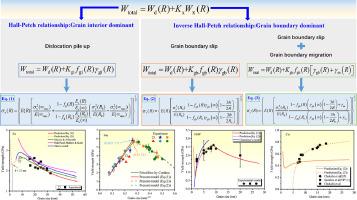
The yield strength of nanocrystalline metals is an emphasis for designing and fabricating more reliable and cost-effective devices for application in aircraft and renewable energy systems. Grain size is a major influence factor affecting the variation of yield strength. Both Hall-Petch strengthening and inverse Hall-Petch softening, which focus on the variation of grain size, have always been the main areas of interest. Determining the critical grain size between Hall-Petch strengthening and inverse Hall-Petch softening is a challenge. In this study, a yield criterion for nanocrystalline metals is proposed by considering the dominant mechanism of plasticity yielding, which encompasses both Hall-Petch strengthening and inverse Hall-Petch softening. Subsequently, a new theoretical model for the grain size effect on yield strength is established based on the proposed criterion, which considers the grain size effect on Young's modulus, grain interior energy, and grain boundary energy. Further, taking the grain boundary migration into account to modify the established inverse Hall-Petch model. The established model accurately captures the quantitative relationships between elastic deformation energy and the dominant yielding mechanism, leading to the precise determination of the yield strength of three exemplary metals (bcc, fcc, hcp) across a wide range of grain sizes. In addition, the critical grain size between Hall-Petch strengthening and inverse Hall-Petch softening can be effectively predicted by the established model. By incorporating more detailed considerations and introducing a reference point to effectively capture experimental errors, this work achieves higher prediction accuracy compared to other existing theoretical models. In light of the established model, the analysis of influencing factors is conducted, indicating that the effect of grain boundary migration energy is greater than that of grain boundary energy. This work contributes to a deeper understanding of the plastic deformation mechanism of nanocrystalline metals and provides a new avenue and theoretical guidance for designing more high-strength systems.
期刊介绍:
International Journal of Plasticity aims to present original research encompassing all facets of plastic deformation, damage, and fracture behavior in both isotropic and anisotropic solids. This includes exploring the thermodynamics of plasticity and fracture, continuum theory, and macroscopic as well as microscopic phenomena.
Topics of interest span the plastic behavior of single crystals and polycrystalline metals, ceramics, rocks, soils, composites, nanocrystalline and microelectronics materials, shape memory alloys, ferroelectric ceramics, thin films, and polymers. Additionally, the journal covers plasticity aspects of failure and fracture mechanics. Contributions involving significant experimental, numerical, or theoretical advancements that enhance the understanding of the plastic behavior of solids are particularly valued. Papers addressing the modeling of finite nonlinear elastic deformation, bearing similarities to the modeling of plastic deformation, are also welcomed.




 京公网安备 11010802042870号
京ICP备2023020795号-1
京公网安备 11010802042870号
京ICP备2023020795号-1

 分享
分享
 求助内容:
求助内容: 应助结果提醒方式:
 扫码关注我们
