{"title":"预后营养指数作为食管鳞状细胞癌患者接受新辅助免疫化疗后发生术后并发症的预后指标","authors":"Wenbin Zou, Wan Kuang, Chun Cai, Yan Qian","doi":"10.2147/CMAR.S465501","DOIUrl":null,"url":null,"abstract":"<p><strong>Background & aims: </strong>The objective of this study was to evaluate the prognostic nutritional index (PNI) as a predictor of short-term postoperative complications in esophageal squamous cell carcinoma patients undergoing neoadjuvant immunochemotherapy.</p><p><strong>Methods: </strong>Clinical data were collected from 77 patients undergoing radical esophageal cancer surgery after neoadjuvant immunochemotherapy at Tongji Hospital from January 2022 to January 2023. The receiver operating characteristic curve (ROC) was utilized to establish the optimal cut-off point for the PNI. Subsequently, patients were stratified into low and high PNI groups according to this cut-off point, and comparisons were made between the two groups in terms of clinical data and postoperative complications.</p><p><strong>Results: </strong>Out of the 77 patients included in the study, 31 were categorized in the low PNI group and 46 in the high PNI group, with a defined cutoff point of 47.38. Significant statistical variances were noted in the occurrence rates of general complications (P < 0.001), pulmonary infections (P < 0.001), and anastomotic fistula (P = 0.034) between the two groups. The low PNI group displayed elevated rates of these complications in comparison to the high PNI group.</p><p><strong>Conclusion: </strong>The research findings indicate that preoperative nutritional assessment using the PNI can effectively predict short-term postoperative complications in esophageal squamous cell carcinoma patients who have undergone neoadjuvant therapy. Furthermore, the results suggest that implementing nutritional interventions for patients with moderate-to-severe malnutrition, as indicated by preoperative PNI evaluation, may help reduce the incidence of postoperative complications.</p>","PeriodicalId":9479,"journal":{"name":"Cancer Management and Research","volume":"16 ","pages":"643-650"},"PeriodicalIF":2.6000,"publicationDate":"2024-06-21","publicationTypes":"Journal Article","fieldsOfStudy":null,"isOpenAccess":false,"openAccessPdf":"https://www.ncbi.nlm.nih.gov/pmc/articles/PMC11197999/pdf/","citationCount":"0","resultStr":"{\"title\":\"Prognostic Nutritional Index as a Prognostic Indicator for the Occurrence of Postoperative Complications in Patients with Esophageal Squamous Cell Carcinoma Following Neoadjuvant Immunochemotherapy.\",\"authors\":\"Wenbin Zou, Wan Kuang, Chun Cai, Yan Qian\",\"doi\":\"10.2147/CMAR.S465501\",\"DOIUrl\":null,\"url\":null,\"abstract\":\"<p><strong>Background & aims: </strong>The objective of this study was to evaluate the prognostic nutritional index (PNI) as a predictor of short-term postoperative complications in esophageal squamous cell carcinoma patients undergoing neoadjuvant immunochemotherapy.</p><p><strong>Methods: </strong>Clinical data were collected from 77 patients undergoing radical esophageal cancer surgery after neoadjuvant immunochemotherapy at Tongji Hospital from January 2022 to January 2023. The receiver operating characteristic curve (ROC) was utilized to establish the optimal cut-off point for the PNI. Subsequently, patients were stratified into low and high PNI groups according to this cut-off point, and comparisons were made between the two groups in terms of clinical data and postoperative complications.</p><p><strong>Results: </strong>Out of the 77 patients included in the study, 31 were categorized in the low PNI group and 46 in the high PNI group, with a defined cutoff point of 47.38. Significant statistical variances were noted in the occurrence rates of general complications (P < 0.001), pulmonary infections (P < 0.001), and anastomotic fistula (P = 0.034) between the two groups. The low PNI group displayed elevated rates of these complications in comparison to the high PNI group.</p><p><strong>Conclusion: </strong>The research findings indicate that preoperative nutritional assessment using the PNI can effectively predict short-term postoperative complications in esophageal squamous cell carcinoma patients who have undergone neoadjuvant therapy. Furthermore, the results suggest that implementing nutritional interventions for patients with moderate-to-severe malnutrition, as indicated by preoperative PNI evaluation, may help reduce the incidence of postoperative complications.</p>\",\"PeriodicalId\":9479,\"journal\":{\"name\":\"Cancer Management and Research\",\"volume\":\"16 \",\"pages\":\"643-650\"},\"PeriodicalIF\":2.6000,\"publicationDate\":\"2024-06-21\",\"publicationTypes\":\"Journal Article\",\"fieldsOfStudy\":null,\"isOpenAccess\":false,\"openAccessPdf\":\"https://www.ncbi.nlm.nih.gov/pmc/articles/PMC11197999/pdf/\",\"citationCount\":\"0\",\"resultStr\":null,\"platform\":\"Semanticscholar\",\"paperid\":null,\"PeriodicalName\":\"Cancer Management and Research\",\"FirstCategoryId\":\"3\",\"ListUrlMain\":\"https://doi.org/10.2147/CMAR.S465501\",\"RegionNum\":4,\"RegionCategory\":\"医学\",\"ArticlePicture\":[],\"TitleCN\":null,\"AbstractTextCN\":null,\"PMCID\":null,\"EPubDate\":\"2024/1/1 0:00:00\",\"PubModel\":\"eCollection\",\"JCR\":\"Q3\",\"JCRName\":\"ONCOLOGY\",\"Score\":null,\"Total\":0}","platform":"Semanticscholar","paperid":null,"PeriodicalName":"Cancer Management and Research","FirstCategoryId":"3","ListUrlMain":"https://doi.org/10.2147/CMAR.S465501","RegionNum":4,"RegionCategory":"医学","ArticlePicture":[],"TitleCN":null,"AbstractTextCN":null,"PMCID":null,"EPubDate":"2024/1/1 0:00:00","PubModel":"eCollection","JCR":"Q3","JCRName":"ONCOLOGY","Score":null,"Total":0}
Prognostic Nutritional Index as a Prognostic Indicator for the Occurrence of Postoperative Complications in Patients with Esophageal Squamous Cell Carcinoma Following Neoadjuvant Immunochemotherapy.
Background & aims: The objective of this study was to evaluate the prognostic nutritional index (PNI) as a predictor of short-term postoperative complications in esophageal squamous cell carcinoma patients undergoing neoadjuvant immunochemotherapy.
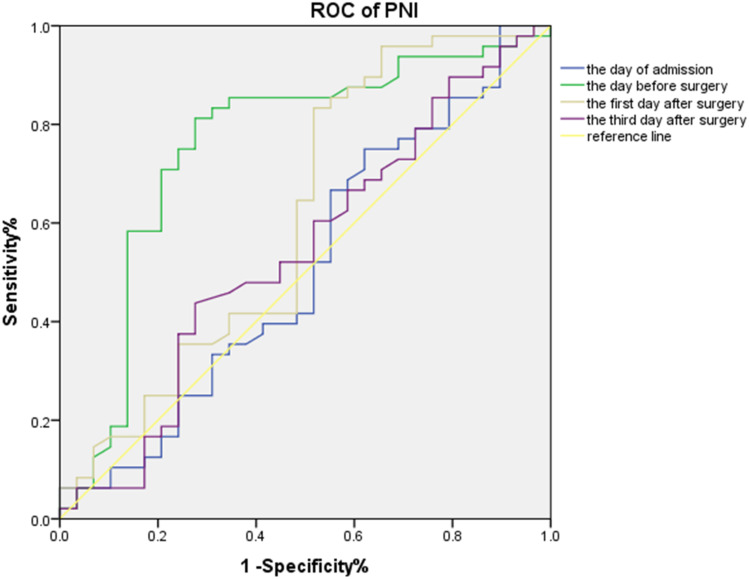
Methods: Clinical data were collected from 77 patients undergoing radical esophageal cancer surgery after neoadjuvant immunochemotherapy at Tongji Hospital from January 2022 to January 2023. The receiver operating characteristic curve (ROC) was utilized to establish the optimal cut-off point for the PNI. Subsequently, patients were stratified into low and high PNI groups according to this cut-off point, and comparisons were made between the two groups in terms of clinical data and postoperative complications.
Results: Out of the 77 patients included in the study, 31 were categorized in the low PNI group and 46 in the high PNI group, with a defined cutoff point of 47.38. Significant statistical variances were noted in the occurrence rates of general complications (P < 0.001), pulmonary infections (P < 0.001), and anastomotic fistula (P = 0.034) between the two groups. The low PNI group displayed elevated rates of these complications in comparison to the high PNI group.
Conclusion: The research findings indicate that preoperative nutritional assessment using the PNI can effectively predict short-term postoperative complications in esophageal squamous cell carcinoma patients who have undergone neoadjuvant therapy. Furthermore, the results suggest that implementing nutritional interventions for patients with moderate-to-severe malnutrition, as indicated by preoperative PNI evaluation, may help reduce the incidence of postoperative complications.
期刊介绍:
Cancer Management and Research is an international, peer reviewed, open access journal focusing on cancer research and the optimal use of preventative and integrated treatment interventions to achieve improved outcomes, enhanced survival, and quality of life for cancer patients. Specific topics covered in the journal include:
◦Epidemiology, detection and screening
◦Cellular research and biomarkers
◦Identification of biotargets and agents with novel mechanisms of action
◦Optimal clinical use of existing anticancer agents, including combination therapies
◦Radiation and surgery
◦Palliative care
◦Patient adherence, quality of life, satisfaction
The journal welcomes submitted papers covering original research, basic science, clinical & epidemiological studies, reviews & evaluations, guidelines, expert opinion and commentary, and case series that shed novel insights on a disease or disease subtype.





 京公网安备 11010802042870号
京ICP备2023020795号-1
京公网安备 11010802042870号
京ICP备2023020795号-1

 分享
分享
 求助内容:
求助内容: 应助结果提醒方式:
 扫码关注我们
