Kristie Lao, Hugo W. F. Mak, Valerie Chiang, Mukesh Kumar, Billy K. C. Chow, Philip H. Li
{"title":"与马斯相关的G蛋白偶联受体-X2和趋化因子(C-C Motif)配体2与治疗无效的中国慢性自发性荨麻疹患者的疾病活动有关","authors":"Kristie Lao, Hugo W. F. Mak, Valerie Chiang, Mukesh Kumar, Billy K. C. Chow, Philip H. Li","doi":"10.1111/cea.14531","DOIUrl":null,"url":null,"abstract":"<p>Chronic spontaneous urticaria (CSU) often remains under-treated and significantly impacts quality of life [<span>1-3</span>]. The mainstay of treatment involves use of various mast cell-targeting medications, aiming for complete disease control [<span>1, 4</span>]. Although the use of patient-reported outcomes such as the weekly Urticaria Activity Score (UAS7) have been advocated, more objective biomarkers are needed [<span>1, 4, 5</span>]. Recent evidence have implicated the role of Mas-related G-protein coupled receptor-X2 (MRGPRX2) in CSU pathogenesis, with levels reported to correlate with disease severity [<span>6, 7</span>]. Blood tests such as MRGPRX2 are attractive biomarkers, given their ease of measurement and availability of commercial assays. However, to the best of our knowledge, studies correlating MRGPRX2 with CSU has not been validated beyond Korean patients [<span>6</span>]. Therefore, we conducted this study on a Chinese cohort to investigate the extended validity of serum MRGPRX2 as a biomarker, as well as its relationship with chemokine (C–C motif) ligand 2 (CCL-2), another potential biomarker reported to play a major role in CSU pathogenesis [<span>8</span>].</p><p>We enrolled newly diagnosed CSU patients referred to the Urticaria Clinic of the Hospital Authority Hong Kong West Cluster between 1 January 2023 and 31 July 2023. All patients were diagnosed according to the regional and international recommendations [<span>1, 4</span>]. Patient demographics, baseline characteristics, medication history and UAS7 were collected by standardised questionnaires with simultaneous bloods taken at first visit. To align with previous studies, UAS7 ≥28 and <28 patients were classified as ‘severe’ and ‘nonsevere’, respectively [<span>1</span>]. Treatment-naïve was defined by patients not taking any regular CSU medications for at least 1 month prior to enrolment. Serum MRGPRX2 levels were measured using an enzyme-linked immunosorbent assay (ELISA) kit (MyBioSource, Inc., San Diego, CA, USA), and CCL2 levels were measured using Human CCL-2/MCP-1 instant ELISA kit (Thermo Fisher Scientific, MA, USA). No reference range was available for MRGPRX2, whereas CCL-2 levels ≥250 pg/mL were considered elevated based on previous studies. Statistical analyses were performed using IBM SPSS v22 (SPSS Inc., Chicago, IL, USA). Mann–Whitney <i>U</i> tests were used to determine the relation between baseline MRGPRX2 levels of severe and nonsevere patients; chi-squared tests were used to determine the relationship between CSU disease activity and CCL-2 levels; Pearson correlations were used to determine correlation between MRGPRX2 with UAS7 and CCL-2. Cut-off for significance levels for all tests were <i>p</i> < 0.05. Written informed consent was obtained from all study subjects. The study was approved by the Institutional Review Board of the University of Hong Kong/Hospital Authority Hong Kong West Cluster.</p><p>A total of 95 patients were recruited, of which 47 (49%) were treatment-naïve. 75 (79%) and 20 (21%) of patients had severe and nonsevere disease at recruitment, respectively. Median age was 53 (19–20) years and the male: female ratio was 1:6.3. Overall, patients with severe disease had higher serum MRGPRX2 levels (severe: 41.06 ± 26.98; nonsevere: 26.64 ± 15.91 <i>p</i> = 0.011). Similarly, more patients with severe disease had elevated CCL-2 levels (70.0% vs 42.7%, <i>p</i> = 0.030) compared with nonsevere patients. Subgroup analysis demonstrated that MRGPRX2 was only significantly higher among treatment-naïve patients (severe: 58.15 ± 38.53, nonsevere: 25.91 ± 15.07; <i>p</i> = 0.034), rather than those on regular CSU medications (severe: 36.79 ± 22.98, nonsevere: 27.64 ± 17.15, <i>p</i> = 0.092). In contrast, differences in CCL2 did not reach statistical significance when analysing treatment-naïve patients (100.0% vs 58.1%, <i>p</i> = 0.283). Overall, serum MRGPX2 levels also showed significant correlation with CCL-2; but subgroup analysis revealed this correlation only remained significant among treatment-naïve patients as opposed to patients on regular CSU treatment (Figure 1 and https://osf.io/mz29q).</p><p>Our study supports that both MRGPRX2 and CCL-2 may be potential biomarkers for CSU. We found that both serum markers were also strongly intercorrelated, but only among treatment-naïve patients. Similarly, MRGPRX2 was only significantly different among treatment-naïve patients, rather than those on regular CSU treatment. Alike other secreted substances, we postulate that medications used in the treatment of CSU (such as H1-antihistamines, mast cell stabilisers, anti-IgE biologics etc.) may interfere with mast cell degranulation/exocytosis of MRGPRX2-containing vesicles, therefore affecting measurable serum MRGPX2 levels among patients on treatment [<span>9</span>]. In contrast, CCL2 has been postulated to be a chemokine secreted by other cell types (such as monocytes) creating a proinflammatory environment in CSU and therefore may be less affected by medications [<span>8</span>].</p><p>There were several limitations to this study. Firstly, was its observational nature and patients were recruited on a consecutive basis, and there remains a possibility of ascertainment bias (e.g., patients with milder disease were more likely to be treatment-naïve). Secondly, as not all patient-reported outcome measures in traditional Chinese had been validated during recruitment, only UAS7 was included in analysis. Third, the cohort size was small and direct correlation between UAS7 or further subgroup analysis could not be performed (e.g., stratifying different treatment modalities, medical comorbidities or CSU subtypes). Fourth, all patients were ethnically Chinese and from a centre in Hong Kong which limits external. Similarly, no reference range was available for MRGPRX2 and there is possibility of inter-individual or -ethnic variability. These limitations highlight the need for further dedicated, prospective and multicentre studies on MRGPX2 and CCL2 among CSU patients.</p><p>We propose that serum MRGPX2 and CCL-2 may be potential biomarkers reflecting CSU severity. It is important to note that, unlike CCL-2, MRGPRX2 may be more useful among treatment-naïve CSU patients (e.g., newly diagnosed CSU patients before treatment or after temporary cessation of medications) for more objective assessment and may also be used to indirectly measure adherence to treatment. The potential complimentary role of both these novel biomarkers warrants further study in larger, longitudinal studies which are currently underway.</p><p>The author takes full responsibility for this article.</p><p>The authors declare no conflicts of interest.</p>","PeriodicalId":10207,"journal":{"name":"Clinical and Experimental Allergy","volume":"55 1","pages":"88-90"},"PeriodicalIF":5.2000,"publicationDate":"2024-06-25","publicationTypes":"Journal Article","fieldsOfStudy":null,"isOpenAccess":false,"openAccessPdf":"https://www.ncbi.nlm.nih.gov/pmc/articles/PMC11707318/pdf/","citationCount":"0","resultStr":"{\"title\":\"Mas-Related G-Protein Coupled Receptor-X2 and Chemokine (C–C Motif) Ligand 2 Correlate With Disease Activity Among Treatment-Naïve Chinese Patients With Chronic Spontaneous Urticaria\",\"authors\":\"Kristie Lao, Hugo W. F. Mak, Valerie Chiang, Mukesh Kumar, Billy K. C. Chow, Philip H. Li\",\"doi\":\"10.1111/cea.14531\",\"DOIUrl\":null,\"url\":null,\"abstract\":\"<p>Chronic spontaneous urticaria (CSU) often remains under-treated and significantly impacts quality of life [<span>1-3</span>]. The mainstay of treatment involves use of various mast cell-targeting medications, aiming for complete disease control [<span>1, 4</span>]. Although the use of patient-reported outcomes such as the weekly Urticaria Activity Score (UAS7) have been advocated, more objective biomarkers are needed [<span>1, 4, 5</span>]. Recent evidence have implicated the role of Mas-related G-protein coupled receptor-X2 (MRGPRX2) in CSU pathogenesis, with levels reported to correlate with disease severity [<span>6, 7</span>]. Blood tests such as MRGPRX2 are attractive biomarkers, given their ease of measurement and availability of commercial assays. However, to the best of our knowledge, studies correlating MRGPRX2 with CSU has not been validated beyond Korean patients [<span>6</span>]. Therefore, we conducted this study on a Chinese cohort to investigate the extended validity of serum MRGPRX2 as a biomarker, as well as its relationship with chemokine (C–C motif) ligand 2 (CCL-2), another potential biomarker reported to play a major role in CSU pathogenesis [<span>8</span>].</p><p>We enrolled newly diagnosed CSU patients referred to the Urticaria Clinic of the Hospital Authority Hong Kong West Cluster between 1 January 2023 and 31 July 2023. All patients were diagnosed according to the regional and international recommendations [<span>1, 4</span>]. Patient demographics, baseline characteristics, medication history and UAS7 were collected by standardised questionnaires with simultaneous bloods taken at first visit. To align with previous studies, UAS7 ≥28 and <28 patients were classified as ‘severe’ and ‘nonsevere’, respectively [<span>1</span>]. Treatment-naïve was defined by patients not taking any regular CSU medications for at least 1 month prior to enrolment. Serum MRGPRX2 levels were measured using an enzyme-linked immunosorbent assay (ELISA) kit (MyBioSource, Inc., San Diego, CA, USA), and CCL2 levels were measured using Human CCL-2/MCP-1 instant ELISA kit (Thermo Fisher Scientific, MA, USA). No reference range was available for MRGPRX2, whereas CCL-2 levels ≥250 pg/mL were considered elevated based on previous studies. Statistical analyses were performed using IBM SPSS v22 (SPSS Inc., Chicago, IL, USA). Mann–Whitney <i>U</i> tests were used to determine the relation between baseline MRGPRX2 levels of severe and nonsevere patients; chi-squared tests were used to determine the relationship between CSU disease activity and CCL-2 levels; Pearson correlations were used to determine correlation between MRGPRX2 with UAS7 and CCL-2. Cut-off for significance levels for all tests were <i>p</i> < 0.05. Written informed consent was obtained from all study subjects. The study was approved by the Institutional Review Board of the University of Hong Kong/Hospital Authority Hong Kong West Cluster.</p><p>A total of 95 patients were recruited, of which 47 (49%) were treatment-naïve. 75 (79%) and 20 (21%) of patients had severe and nonsevere disease at recruitment, respectively. Median age was 53 (19–20) years and the male: female ratio was 1:6.3. Overall, patients with severe disease had higher serum MRGPRX2 levels (severe: 41.06 ± 26.98; nonsevere: 26.64 ± 15.91 <i>p</i> = 0.011). Similarly, more patients with severe disease had elevated CCL-2 levels (70.0% vs 42.7%, <i>p</i> = 0.030) compared with nonsevere patients. Subgroup analysis demonstrated that MRGPRX2 was only significantly higher among treatment-naïve patients (severe: 58.15 ± 38.53, nonsevere: 25.91 ± 15.07; <i>p</i> = 0.034), rather than those on regular CSU medications (severe: 36.79 ± 22.98, nonsevere: 27.64 ± 17.15, <i>p</i> = 0.092). In contrast, differences in CCL2 did not reach statistical significance when analysing treatment-naïve patients (100.0% vs 58.1%, <i>p</i> = 0.283). Overall, serum MRGPX2 levels also showed significant correlation with CCL-2; but subgroup analysis revealed this correlation only remained significant among treatment-naïve patients as opposed to patients on regular CSU treatment (Figure 1 and https://osf.io/mz29q).</p><p>Our study supports that both MRGPRX2 and CCL-2 may be potential biomarkers for CSU. We found that both serum markers were also strongly intercorrelated, but only among treatment-naïve patients. Similarly, MRGPRX2 was only significantly different among treatment-naïve patients, rather than those on regular CSU treatment. Alike other secreted substances, we postulate that medications used in the treatment of CSU (such as H1-antihistamines, mast cell stabilisers, anti-IgE biologics etc.) may interfere with mast cell degranulation/exocytosis of MRGPRX2-containing vesicles, therefore affecting measurable serum MRGPX2 levels among patients on treatment [<span>9</span>]. In contrast, CCL2 has been postulated to be a chemokine secreted by other cell types (such as monocytes) creating a proinflammatory environment in CSU and therefore may be less affected by medications [<span>8</span>].</p><p>There were several limitations to this study. Firstly, was its observational nature and patients were recruited on a consecutive basis, and there remains a possibility of ascertainment bias (e.g., patients with milder disease were more likely to be treatment-naïve). Secondly, as not all patient-reported outcome measures in traditional Chinese had been validated during recruitment, only UAS7 was included in analysis. Third, the cohort size was small and direct correlation between UAS7 or further subgroup analysis could not be performed (e.g., stratifying different treatment modalities, medical comorbidities or CSU subtypes). Fourth, all patients were ethnically Chinese and from a centre in Hong Kong which limits external. Similarly, no reference range was available for MRGPRX2 and there is possibility of inter-individual or -ethnic variability. These limitations highlight the need for further dedicated, prospective and multicentre studies on MRGPX2 and CCL2 among CSU patients.</p><p>We propose that serum MRGPX2 and CCL-2 may be potential biomarkers reflecting CSU severity. It is important to note that, unlike CCL-2, MRGPRX2 may be more useful among treatment-naïve CSU patients (e.g., newly diagnosed CSU patients before treatment or after temporary cessation of medications) for more objective assessment and may also be used to indirectly measure adherence to treatment. The potential complimentary role of both these novel biomarkers warrants further study in larger, longitudinal studies which are currently underway.</p><p>The author takes full responsibility for this article.</p><p>The authors declare no conflicts of interest.</p>\",\"PeriodicalId\":10207,\"journal\":{\"name\":\"Clinical and Experimental Allergy\",\"volume\":\"55 1\",\"pages\":\"88-90\"},\"PeriodicalIF\":5.2000,\"publicationDate\":\"2024-06-25\",\"publicationTypes\":\"Journal Article\",\"fieldsOfStudy\":null,\"isOpenAccess\":false,\"openAccessPdf\":\"https://www.ncbi.nlm.nih.gov/pmc/articles/PMC11707318/pdf/\",\"citationCount\":\"0\",\"resultStr\":null,\"platform\":\"Semanticscholar\",\"paperid\":null,\"PeriodicalName\":\"Clinical and Experimental Allergy\",\"FirstCategoryId\":\"3\",\"ListUrlMain\":\"https://onlinelibrary.wiley.com/doi/10.1111/cea.14531\",\"RegionNum\":2,\"RegionCategory\":\"医学\",\"ArticlePicture\":[],\"TitleCN\":null,\"AbstractTextCN\":null,\"PMCID\":null,\"EPubDate\":\"\",\"PubModel\":\"\",\"JCR\":\"Q1\",\"JCRName\":\"ALLERGY\",\"Score\":null,\"Total\":0}","platform":"Semanticscholar","paperid":null,"PeriodicalName":"Clinical and Experimental Allergy","FirstCategoryId":"3","ListUrlMain":"https://onlinelibrary.wiley.com/doi/10.1111/cea.14531","RegionNum":2,"RegionCategory":"医学","ArticlePicture":[],"TitleCN":null,"AbstractTextCN":null,"PMCID":null,"EPubDate":"","PubModel":"","JCR":"Q1","JCRName":"ALLERGY","Score":null,"Total":0}
引用次数: 0
摘要
慢性自发性荨麻疹(CSU)往往治疗不足,严重影响生活质量[1-3]。治疗主要包括使用各种肥大细胞靶向药物,旨在完全控制疾病[1,4]。虽然已经提倡使用患者报告的结果,如每周荨麻疹活动评分(UAS7),但需要更客观的生物标志物[1,4,5]。最近的证据表明,mas相关g蛋白偶联受体x2 (MRGPRX2)在CSU发病机制中的作用,其水平与疾病严重程度相关[6,7]。考虑到MRGPRX2等血液检测易于测量和商业分析的可用性,它们是有吸引力的生物标志物。然而,据我们所知,MRGPRX2与CSU相关的研究尚未在韩国患者之外得到验证。因此,我们在一个中国队列中进行了这项研究,以研究血清MRGPRX2作为生物标志物的扩展有效性,以及它与趋化因子(C-C基序)配体2 (CCL-2)的关系,CCL-2是另一个潜在的生物标志物,据报道在CSU发病机制[8]中发挥重要作用。我们招募了在2023年1月1日至2023年7月31日期间转介到医院管理局香港西区荨麻疹诊所的新诊断的CSU患者。所有患者均根据区域和国际建议进行诊断[1,4]。通过标准化问卷收集患者人口统计学、基线特征、用药史和UAS7,并在首次就诊时同时采血。为了与以往的研究一致,UAS7≥28和<;28的患者分别被分为“严重”和“非严重”,分别为[1]。Treatment-naïve定义为入组前至少1个月未服用任何常规CSU药物的患者。采用酶联免疫吸附试验(ELISA)试剂盒(MyBioSource, Inc., San Diego, CA, USA)检测血清MRGPRX2水平,采用Human CCL-2/MCP-1即时ELISA试剂盒(Thermo Fisher Scientific, MA, USA)检测CCL2水平。MRGPRX2没有参考范围,而CCL-2≥250 pg/mL根据以往的研究被认为升高。采用IBM SPSS v22 (SPSS Inc., Chicago, IL, USA)进行统计分析。采用Mann-Whitney U检验确定重症和非重症患者MRGPRX2基线水平之间的关系;采用卡方检验确定CSU疾病活动性与CCL-2水平之间的关系;采用Pearson相关性分析MRGPRX2与UAS7、CCL-2的相关性。所有检验的显著性水平的截止值为p <; 0.05。所有研究对象均获得书面知情同意。这项研究已获香港大学/医院管理局香港西区联网院校检讨委员会批准。共招募了95例患者,其中47例(49%)为treatment-naïve。在招募时,分别有75(79%)和20(21%)的患者患有严重和非严重疾病。中位年龄53岁(19-20岁),男女比例为1:6 3。总体而言,重症患者血清MRGPRX2水平较高(重症:41.06±26.98;非重度:26.64±15.91 p = 0.011)。同样,与非重症患者相比,更多重症患者的CCL-2水平升高(70.0% vs 42.7%, p = 0.030)。亚组分析显示,MRGPRX2仅在treatment-naïve患者中显著升高(重症:58.15±38.53,非重症:25.91±15.07;重症:36.79±22.98,非重症:27.64±17.15,p = 0.092)。相比之下,在分析treatment-naïve患者时,CCL2差异无统计学意义(100.0% vs 58.1%, p = 0.283)。总体而言,血清MRGPX2水平也与CCL-2有显著相关性;但亚组分析显示,与常规CSU治疗的患者相比,这种相关性仅在treatment-naïve患者中保持显著(图1和https://osf.io/mz29q).Our研究支持MRGPRX2和CCL-2都可能是CSU的潜在生物标志物。我们发现这两种血清标志物也有很强的相关性,但仅在treatment-naïve患者中。同样,MRGPRX2仅在treatment-naïve患者中有显著差异,而在常规CSU治疗组中无显著差异。与其他分泌物质一样,我们假设用于治疗CSU的药物(如h1 -抗组胺药、肥大细胞稳定剂、抗ige生物制剂等)可能干扰含有mrgprx2囊泡的肥大细胞脱粒/胞外分泌,从而影响治疗bb0患者可测量的血清MRGPX2水平。相比之下,CCL2被认为是一种由其他细胞类型(如单核细胞)分泌的趋化因子,在CSU中产生促炎环境,因此可能受药物影响较小。这项研究有几个局限性。 首先,它是观察性的,患者是连续招募的,仍然存在确定偏差的可能性(例如,病情较轻的患者更有可能是treatment-naïve)。其次,由于并非所有患者报告的繁体中文结局指标在招募期间都得到了验证,因此仅将UAS7纳入分析。第三,队列规模较小,无法进行UAS7或进一步亚组分析之间的直接相关性(例如,对不同的治疗方式、医学合并症或CSU亚型进行分层)。第四,所有患者均为华裔,来自香港一家限制外来人员的中心。同样,没有MRGPRX2的参考范围,可能存在个体间或种族间的差异。这些局限性突出了在CSU患者中对MRGPX2和CCL2进行进一步专门、前瞻性和多中心研究的必要性。我们认为血清MRGPX2和CCL-2可能是反映CSU严重程度的潜在生物标志物。值得注意的是,与CCL-2不同,MRGPRX2可能在treatment-naïve CSU患者(例如,治疗前或暂时停止药物治疗后新诊断的CSU患者)中更有用,用于更客观的评估,也可用于间接衡量治疗依从性。这两种新型生物标志物的潜在互补作用值得在目前正在进行的更大规模的纵向研究中进一步研究。作者对这篇文章负全部责任。作者声明无利益冲突。
Mas-Related G-Protein Coupled Receptor-X2 and Chemokine (C–C Motif) Ligand 2 Correlate With Disease Activity Among Treatment-Naïve Chinese Patients With Chronic Spontaneous Urticaria
Chronic spontaneous urticaria (CSU) often remains under-treated and significantly impacts quality of life [1-3]. The mainstay of treatment involves use of various mast cell-targeting medications, aiming for complete disease control [1, 4]. Although the use of patient-reported outcomes such as the weekly Urticaria Activity Score (UAS7) have been advocated, more objective biomarkers are needed [1, 4, 5]. Recent evidence have implicated the role of Mas-related G-protein coupled receptor-X2 (MRGPRX2) in CSU pathogenesis, with levels reported to correlate with disease severity [6, 7]. Blood tests such as MRGPRX2 are attractive biomarkers, given their ease of measurement and availability of commercial assays. However, to the best of our knowledge, studies correlating MRGPRX2 with CSU has not been validated beyond Korean patients [6]. Therefore, we conducted this study on a Chinese cohort to investigate the extended validity of serum MRGPRX2 as a biomarker, as well as its relationship with chemokine (C–C motif) ligand 2 (CCL-2), another potential biomarker reported to play a major role in CSU pathogenesis [8].
We enrolled newly diagnosed CSU patients referred to the Urticaria Clinic of the Hospital Authority Hong Kong West Cluster between 1 January 2023 and 31 July 2023. All patients were diagnosed according to the regional and international recommendations [1, 4]. Patient demographics, baseline characteristics, medication history and UAS7 were collected by standardised questionnaires with simultaneous bloods taken at first visit. To align with previous studies, UAS7 ≥28 and <28 patients were classified as ‘severe’ and ‘nonsevere’, respectively [1]. Treatment-naïve was defined by patients not taking any regular CSU medications for at least 1 month prior to enrolment. Serum MRGPRX2 levels were measured using an enzyme-linked immunosorbent assay (ELISA) kit (MyBioSource, Inc., San Diego, CA, USA), and CCL2 levels were measured using Human CCL-2/MCP-1 instant ELISA kit (Thermo Fisher Scientific, MA, USA). No reference range was available for MRGPRX2, whereas CCL-2 levels ≥250 pg/mL were considered elevated based on previous studies. Statistical analyses were performed using IBM SPSS v22 (SPSS Inc., Chicago, IL, USA). Mann–Whitney U tests were used to determine the relation between baseline MRGPRX2 levels of severe and nonsevere patients; chi-squared tests were used to determine the relationship between CSU disease activity and CCL-2 levels; Pearson correlations were used to determine correlation between MRGPRX2 with UAS7 and CCL-2. Cut-off for significance levels for all tests were p < 0.05. Written informed consent was obtained from all study subjects. The study was approved by the Institutional Review Board of the University of Hong Kong/Hospital Authority Hong Kong West Cluster.
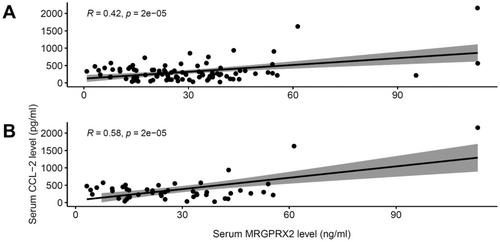
A total of 95 patients were recruited, of which 47 (49%) were treatment-naïve. 75 (79%) and 20 (21%) of patients had severe and nonsevere disease at recruitment, respectively. Median age was 53 (19–20) years and the male: female ratio was 1:6.3. Overall, patients with severe disease had higher serum MRGPRX2 levels (severe: 41.06 ± 26.98; nonsevere: 26.64 ± 15.91 p = 0.011). Similarly, more patients with severe disease had elevated CCL-2 levels (70.0% vs 42.7%, p = 0.030) compared with nonsevere patients. Subgroup analysis demonstrated that MRGPRX2 was only significantly higher among treatment-naïve patients (severe: 58.15 ± 38.53, nonsevere: 25.91 ± 15.07; p = 0.034), rather than those on regular CSU medications (severe: 36.79 ± 22.98, nonsevere: 27.64 ± 17.15, p = 0.092). In contrast, differences in CCL2 did not reach statistical significance when analysing treatment-naïve patients (100.0% vs 58.1%, p = 0.283). Overall, serum MRGPX2 levels also showed significant correlation with CCL-2; but subgroup analysis revealed this correlation only remained significant among treatment-naïve patients as opposed to patients on regular CSU treatment (Figure 1 and https://osf.io/mz29q).
Our study supports that both MRGPRX2 and CCL-2 may be potential biomarkers for CSU. We found that both serum markers were also strongly intercorrelated, but only among treatment-naïve patients. Similarly, MRGPRX2 was only significantly different among treatment-naïve patients, rather than those on regular CSU treatment. Alike other secreted substances, we postulate that medications used in the treatment of CSU (such as H1-antihistamines, mast cell stabilisers, anti-IgE biologics etc.) may interfere with mast cell degranulation/exocytosis of MRGPRX2-containing vesicles, therefore affecting measurable serum MRGPX2 levels among patients on treatment [9]. In contrast, CCL2 has been postulated to be a chemokine secreted by other cell types (such as monocytes) creating a proinflammatory environment in CSU and therefore may be less affected by medications [8].
There were several limitations to this study. Firstly, was its observational nature and patients were recruited on a consecutive basis, and there remains a possibility of ascertainment bias (e.g., patients with milder disease were more likely to be treatment-naïve). Secondly, as not all patient-reported outcome measures in traditional Chinese had been validated during recruitment, only UAS7 was included in analysis. Third, the cohort size was small and direct correlation between UAS7 or further subgroup analysis could not be performed (e.g., stratifying different treatment modalities, medical comorbidities or CSU subtypes). Fourth, all patients were ethnically Chinese and from a centre in Hong Kong which limits external. Similarly, no reference range was available for MRGPRX2 and there is possibility of inter-individual or -ethnic variability. These limitations highlight the need for further dedicated, prospective and multicentre studies on MRGPX2 and CCL2 among CSU patients.
We propose that serum MRGPX2 and CCL-2 may be potential biomarkers reflecting CSU severity. It is important to note that, unlike CCL-2, MRGPRX2 may be more useful among treatment-naïve CSU patients (e.g., newly diagnosed CSU patients before treatment or after temporary cessation of medications) for more objective assessment and may also be used to indirectly measure adherence to treatment. The potential complimentary role of both these novel biomarkers warrants further study in larger, longitudinal studies which are currently underway.
The author takes full responsibility for this article.
期刊介绍:
Clinical & Experimental Allergy strikes an excellent balance between clinical and scientific articles and carries regular reviews and editorials written by leading authorities in their field.
In response to the increasing number of quality submissions, since 1996 the journals size has increased by over 30%. Clinical & Experimental Allergy is essential reading for allergy practitioners and research scientists with an interest in allergic diseases and mechanisms. Truly international in appeal, Clinical & Experimental Allergy publishes clinical and experimental observations in disease in all fields of medicine in which allergic hypersensitivity plays a part.




 京公网安备 11010802042870号
京ICP备2023020795号-1
京公网安备 11010802042870号
京ICP备2023020795号-1

 分享
分享
 求助内容:
求助内容: 应助结果提醒方式:
 扫码关注我们
