Luyao Chen, Wei Hu, Caijin Lei, Teng Zhu, Chengchuang Li, Jie Tang, Guangbin Cheng, Chuan Xiao and Hongwei Yang
{"title":"基于双(4-硝基吡唑)桥接 1,2,4- 三唑的先进四环耐热能量材料","authors":"Luyao Chen, Wei Hu, Caijin Lei, Teng Zhu, Chengchuang Li, Jie Tang, Guangbin Cheng, Chuan Xiao and Hongwei Yang","doi":"10.1039/D4DT01627K","DOIUrl":null,"url":null,"abstract":"<p >In recent years, with the development of deep coal mines and petroleum resources and the expansion of the aerospace industry, the pursuit of heat-resistant energetic materials with high thermal stability and high energy has been increasing. Bis(4-nitropyrazole) was employed as an energy bridge to link 1,2,4-triazole, thereby constructing a sophisticated tetracyclic framework in this study. A tetracyclic heat-resistant explosive 5,5′-(4,4′-dinitro-2<em>H</em>,2′<em>H</em>-[3,3′-bipyrazole]-5,5′-diyl)bis(4<em>H</em>-1,2,4-triazole-3,4-diamine) (<strong>3</strong>) and its derivatives <strong>6–8</strong> with excellent comprehensive performance have been successfully prepared. Particularly noteworthy is that compound <strong>3</strong> has a detonation velocity of 8604 m s<small><sup>−1</sup></small>, which exceeds that of the conventional heat-resistant explosive <strong>HNS</strong> with a velocity of 7164 m s<small><sup>−1</sup></small>. Furthermore, compound <strong>3</strong> has higher thermal stability (<em>T</em><small><sub>d</sub></small> = 340 °C) than <strong>HNS</strong> (<em>T</em><small><sub>d</sub></small> = 318 °C). In addition, the tetracyclic compound <strong>3</strong> also exhibited extraordinarily low sensitivity (IS > 40 J; FS > 360 N). These unique characteristics make it a potential candidate for novel heat-resistant and insensitive energetic materials.</p>","PeriodicalId":71,"journal":{"name":"Dalton Transactions","volume":" 30","pages":" 12641-12648"},"PeriodicalIF":3.3000,"publicationDate":"2024-07-03","publicationTypes":"Journal Article","fieldsOfStudy":null,"isOpenAccess":false,"openAccessPdf":"","citationCount":"0","resultStr":"{\"title\":\"Advanced tetracyclic heat-resistant energetic materials based on bis(4-nitropyrazole) bridged 1,2,4-triazole†\",\"authors\":\"Luyao Chen, Wei Hu, Caijin Lei, Teng Zhu, Chengchuang Li, Jie Tang, Guangbin Cheng, Chuan Xiao and Hongwei Yang\",\"doi\":\"10.1039/D4DT01627K\",\"DOIUrl\":null,\"url\":null,\"abstract\":\"<p >In recent years, with the development of deep coal mines and petroleum resources and the expansion of the aerospace industry, the pursuit of heat-resistant energetic materials with high thermal stability and high energy has been increasing. Bis(4-nitropyrazole) was employed as an energy bridge to link 1,2,4-triazole, thereby constructing a sophisticated tetracyclic framework in this study. A tetracyclic heat-resistant explosive 5,5′-(4,4′-dinitro-2<em>H</em>,2′<em>H</em>-[3,3′-bipyrazole]-5,5′-diyl)bis(4<em>H</em>-1,2,4-triazole-3,4-diamine) (<strong>3</strong>) and its derivatives <strong>6–8</strong> with excellent comprehensive performance have been successfully prepared. Particularly noteworthy is that compound <strong>3</strong> has a detonation velocity of 8604 m s<small><sup>−1</sup></small>, which exceeds that of the conventional heat-resistant explosive <strong>HNS</strong> with a velocity of 7164 m s<small><sup>−1</sup></small>. Furthermore, compound <strong>3</strong> has higher thermal stability (<em>T</em><small><sub>d</sub></small> = 340 °C) than <strong>HNS</strong> (<em>T</em><small><sub>d</sub></small> = 318 °C). In addition, the tetracyclic compound <strong>3</strong> also exhibited extraordinarily low sensitivity (IS > 40 J; FS > 360 N). These unique characteristics make it a potential candidate for novel heat-resistant and insensitive energetic materials.</p>\",\"PeriodicalId\":71,\"journal\":{\"name\":\"Dalton Transactions\",\"volume\":\" 30\",\"pages\":\" 12641-12648\"},\"PeriodicalIF\":3.3000,\"publicationDate\":\"2024-07-03\",\"publicationTypes\":\"Journal Article\",\"fieldsOfStudy\":null,\"isOpenAccess\":false,\"openAccessPdf\":\"\",\"citationCount\":\"0\",\"resultStr\":null,\"platform\":\"Semanticscholar\",\"paperid\":null,\"PeriodicalName\":\"Dalton Transactions\",\"FirstCategoryId\":\"92\",\"ListUrlMain\":\"https://pubs.rsc.org/en/content/articlelanding/2024/dt/d4dt01627k\",\"RegionNum\":3,\"RegionCategory\":\"化学\",\"ArticlePicture\":[],\"TitleCN\":null,\"AbstractTextCN\":null,\"PMCID\":null,\"EPubDate\":\"\",\"PubModel\":\"\",\"JCR\":\"Q2\",\"JCRName\":\"CHEMISTRY, INORGANIC & NUCLEAR\",\"Score\":null,\"Total\":0}","platform":"Semanticscholar","paperid":null,"PeriodicalName":"Dalton Transactions","FirstCategoryId":"92","ListUrlMain":"https://pubs.rsc.org/en/content/articlelanding/2024/dt/d4dt01627k","RegionNum":3,"RegionCategory":"化学","ArticlePicture":[],"TitleCN":null,"AbstractTextCN":null,"PMCID":null,"EPubDate":"","PubModel":"","JCR":"Q2","JCRName":"CHEMISTRY, INORGANIC & NUCLEAR","Score":null,"Total":0}
Advanced tetracyclic heat-resistant energetic materials based on bis(4-nitropyrazole) bridged 1,2,4-triazole†
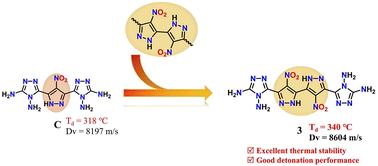
In recent years, with the development of deep coal mines and petroleum resources and the expansion of the aerospace industry, the pursuit of heat-resistant energetic materials with high thermal stability and high energy has been increasing. Bis(4-nitropyrazole) was employed as an energy bridge to link 1,2,4-triazole, thereby constructing a sophisticated tetracyclic framework in this study. A tetracyclic heat-resistant explosive 5,5′-(4,4′-dinitro-2H,2′H-[3,3′-bipyrazole]-5,5′-diyl)bis(4H-1,2,4-triazole-3,4-diamine) (3) and its derivatives 6–8 with excellent comprehensive performance have been successfully prepared. Particularly noteworthy is that compound 3 has a detonation velocity of 8604 m s−1, which exceeds that of the conventional heat-resistant explosive HNS with a velocity of 7164 m s−1. Furthermore, compound 3 has higher thermal stability (Td = 340 °C) than HNS (Td = 318 °C). In addition, the tetracyclic compound 3 also exhibited extraordinarily low sensitivity (IS > 40 J; FS > 360 N). These unique characteristics make it a potential candidate for novel heat-resistant and insensitive energetic materials.
期刊介绍:
Dalton Transactions is a journal for all areas of inorganic chemistry, which encompasses the organometallic, bioinorganic and materials chemistry of the elements, with applications including synthesis, catalysis, energy conversion/storage, electrical devices and medicine. Dalton Transactions welcomes high-quality, original submissions in all of these areas and more, where the advancement of knowledge in inorganic chemistry is significant.




 京公网安备 11010802042870号
京ICP备2023020795号-1
京公网安备 11010802042870号
京ICP备2023020795号-1

 分享
分享
 求助内容:
求助内容: 应助结果提醒方式:
 扫码关注我们
