Jiale Xie, Jiayu Zhang, Sitthichok Kasemthaveechok, Sara López-Resano, Eric Cots, Feliu Maseras, Mónica H. Pérez-Temprano
{"title":"六氟异丙醇辅助单电子转移选择性分子内合成杂环","authors":"Jiale Xie, Jiayu Zhang, Sitthichok Kasemthaveechok, Sara López-Resano, Eric Cots, Feliu Maseras, Mónica H. Pérez-Temprano","doi":"10.1038/s44160-024-00566-w","DOIUrl":null,"url":null,"abstract":"Intramolecular amination of remote aliphatic C–H bonds via hydrogen-atom transfer reactions has become a powerful tool for accessing saturated nitrogen-containing heterocycles. However, the formation of six-membered rings or oxa-heterocycles remains a formidable challenge for Hofmann–Löffler–Freytag reactions. Here we show how by simply combining bench-stable (bis(trifluoroacetoxy)iodo)benzene and hexafluoroisopropanol (HFIP) we can switch from the well-established Hofmann–Löffler–Freytag mechanism to a different versatile reaction pathway that enables selective C(sp3)–H bond functionalization. We have exploited the facile formation of radical cations via single-electron transfer, in the presence or absence of light, to synthesize pyrrolidines and piperidines, including drug-type molecules, along with O-heterocycles. Experimental and computational mechanistic studies support two distinct mechanistic pathways, depending on the electron density of the substrate, in which the HFIP plays a multifunctional role. Saturated heterocycles are prevalent motifs in organic synthesis but their synthesis still presents persistent challenges. Now, a hypervalent iodine(III)-mediated selective intramolecular C(sp3)–H functionalization, facilitated by hexafluoroisopropanol, is reported, which via single-electron transfer provides access to pyrrolidines, piperidines and O-heterocycles in the presence or absence of light.","PeriodicalId":74251,"journal":{"name":"Nature synthesis","volume":"3 8","pages":"1021-1030"},"PeriodicalIF":20.0000,"publicationDate":"2024-07-01","publicationTypes":"Journal Article","fieldsOfStudy":null,"isOpenAccess":false,"openAccessPdf":"https://www.nature.com/articles/s44160-024-00566-w.pdf","citationCount":"0","resultStr":"{\"title\":\"Hexafluoroisopropanol-assisted selective intramolecular synthesis of heterocycles by single-electron transfer\",\"authors\":\"Jiale Xie, Jiayu Zhang, Sitthichok Kasemthaveechok, Sara López-Resano, Eric Cots, Feliu Maseras, Mónica H. Pérez-Temprano\",\"doi\":\"10.1038/s44160-024-00566-w\",\"DOIUrl\":null,\"url\":null,\"abstract\":\"Intramolecular amination of remote aliphatic C–H bonds via hydrogen-atom transfer reactions has become a powerful tool for accessing saturated nitrogen-containing heterocycles. However, the formation of six-membered rings or oxa-heterocycles remains a formidable challenge for Hofmann–Löffler–Freytag reactions. Here we show how by simply combining bench-stable (bis(trifluoroacetoxy)iodo)benzene and hexafluoroisopropanol (HFIP) we can switch from the well-established Hofmann–Löffler–Freytag mechanism to a different versatile reaction pathway that enables selective C(sp3)–H bond functionalization. We have exploited the facile formation of radical cations via single-electron transfer, in the presence or absence of light, to synthesize pyrrolidines and piperidines, including drug-type molecules, along with O-heterocycles. Experimental and computational mechanistic studies support two distinct mechanistic pathways, depending on the electron density of the substrate, in which the HFIP plays a multifunctional role. Saturated heterocycles are prevalent motifs in organic synthesis but their synthesis still presents persistent challenges. Now, a hypervalent iodine(III)-mediated selective intramolecular C(sp3)–H functionalization, facilitated by hexafluoroisopropanol, is reported, which via single-electron transfer provides access to pyrrolidines, piperidines and O-heterocycles in the presence or absence of light.\",\"PeriodicalId\":74251,\"journal\":{\"name\":\"Nature synthesis\",\"volume\":\"3 8\",\"pages\":\"1021-1030\"},\"PeriodicalIF\":20.0000,\"publicationDate\":\"2024-07-01\",\"publicationTypes\":\"Journal Article\",\"fieldsOfStudy\":null,\"isOpenAccess\":false,\"openAccessPdf\":\"https://www.nature.com/articles/s44160-024-00566-w.pdf\",\"citationCount\":\"0\",\"resultStr\":null,\"platform\":\"Semanticscholar\",\"paperid\":null,\"PeriodicalName\":\"Nature synthesis\",\"FirstCategoryId\":\"1085\",\"ListUrlMain\":\"https://www.nature.com/articles/s44160-024-00566-w\",\"RegionNum\":0,\"RegionCategory\":null,\"ArticlePicture\":[],\"TitleCN\":null,\"AbstractTextCN\":null,\"PMCID\":null,\"EPubDate\":\"\",\"PubModel\":\"\",\"JCR\":\"0\",\"JCRName\":\"CHEMISTRY, MULTIDISCIPLINARY\",\"Score\":null,\"Total\":0}","platform":"Semanticscholar","paperid":null,"PeriodicalName":"Nature synthesis","FirstCategoryId":"1085","ListUrlMain":"https://www.nature.com/articles/s44160-024-00566-w","RegionNum":0,"RegionCategory":null,"ArticlePicture":[],"TitleCN":null,"AbstractTextCN":null,"PMCID":null,"EPubDate":"","PubModel":"","JCR":"0","JCRName":"CHEMISTRY, MULTIDISCIPLINARY","Score":null,"Total":0}
Hexafluoroisopropanol-assisted selective intramolecular synthesis of heterocycles by single-electron transfer
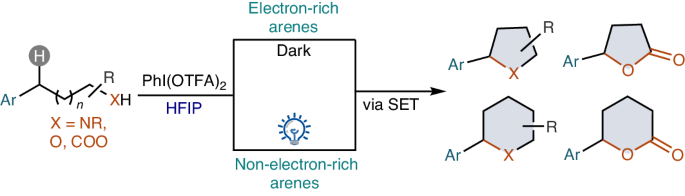
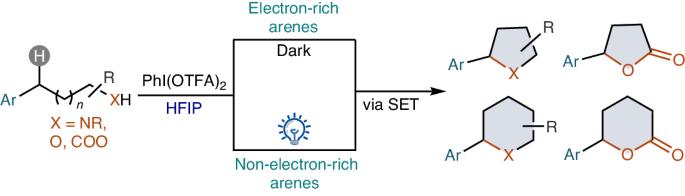
Intramolecular amination of remote aliphatic C–H bonds via hydrogen-atom transfer reactions has become a powerful tool for accessing saturated nitrogen-containing heterocycles. However, the formation of six-membered rings or oxa-heterocycles remains a formidable challenge for Hofmann–Löffler–Freytag reactions. Here we show how by simply combining bench-stable (bis(trifluoroacetoxy)iodo)benzene and hexafluoroisopropanol (HFIP) we can switch from the well-established Hofmann–Löffler–Freytag mechanism to a different versatile reaction pathway that enables selective C(sp3)–H bond functionalization. We have exploited the facile formation of radical cations via single-electron transfer, in the presence or absence of light, to synthesize pyrrolidines and piperidines, including drug-type molecules, along with O-heterocycles. Experimental and computational mechanistic studies support two distinct mechanistic pathways, depending on the electron density of the substrate, in which the HFIP plays a multifunctional role. Saturated heterocycles are prevalent motifs in organic synthesis but their synthesis still presents persistent challenges. Now, a hypervalent iodine(III)-mediated selective intramolecular C(sp3)–H functionalization, facilitated by hexafluoroisopropanol, is reported, which via single-electron transfer provides access to pyrrolidines, piperidines and O-heterocycles in the presence or absence of light.




 京公网安备 11010802042870号
京ICP备2023020795号-1
京公网安备 11010802042870号
京ICP备2023020795号-1

 分享
分享

 求助内容:
求助内容: 应助结果提醒方式:
 扫码关注我们
