{"title":"利用可重构衍射光网络进行复用全光学排列操作","authors":"Guangdong Ma, Xilin Yang, Bijie Bai, Jingxi Li, Yuhang Li, Tianyi Gan, Che-Yung Shen, Yijie Zhang, Yuzhu Li, Çağatay Işıl, Mona Jarrahi, Aydogan Ozcan","doi":"10.1002/lpor.202400238","DOIUrl":null,"url":null,"abstract":"<p>Large-scale and high-dimensional permutation operations are important for various applications in, for example, telecommunications and encryption. Here, all-optical diffractive computing is used to execute a set of high-dimensional permutation operations between an input and output field-of-view through layer rotations in a diffractive optical network. In this reconfigurable multiplexed design , every diffractive layer has four orientations: <span></span><math>\n <semantics>\n <msup>\n <mn>0</mn>\n <mo>∘</mo>\n </msup>\n <annotation>${{0}^\\circ }$</annotation>\n </semantics></math>, <span></span><math>\n <semantics>\n <msup>\n <mn>90</mn>\n <mo>∘</mo>\n </msup>\n <annotation>${{90}^\\circ }$</annotation>\n </semantics></math>, <span></span><math>\n <semantics>\n <msup>\n <mn>180</mn>\n <mo>∘</mo>\n </msup>\n <annotation>${{180}^\\circ }$</annotation>\n </semantics></math>, and <span></span><math>\n <semantics>\n <msup>\n <mn>270</mn>\n <mo>∘</mo>\n </msup>\n <annotation>${{270}^\\circ }$</annotation>\n </semantics></math>. Each unique combination of these layers represents a distinct rotation state, tailored for a specific permutation operation. Therefore, a <i>K</i>-layer rotatable diffractive design can all-optically perform up to <span></span><math>\n <semantics>\n <msup>\n <mn>4</mn>\n <mi>K</mi>\n </msup>\n <annotation>${{4}^K}$</annotation>\n </semantics></math> independent permutation operations. The original input information can be decrypted by applying the specific inverse permutation matrix to output patterns. The feasibility of this reconfigurable multiplexed diffractive design is demonstrated by approximating 256 randomly selected permutation matrices using <span></span><math>\n <semantics>\n <mrow>\n <mi>K</mi>\n <mspace></mspace>\n </mrow>\n <annotation>$K\\ $</annotation>\n </semantics></math>= 4 rotatable diffractive layers. To further enhance its multiplexing capability, input polarization diversity is also utilized. Additionally, this reconfigurable diffractive design is experimentally validated using terahertz radiation and 3D-printed diffractive layers, providing a decent match to numerical results. The presented rotation-multiplexed diffractive processor is particularly useful due to its mechanical reconfigurability, offering multifunctional representation through a single fabrication process.</p>","PeriodicalId":204,"journal":{"name":"Laser & Photonics Reviews","volume":"18 11","pages":""},"PeriodicalIF":10.0000,"publicationDate":"2024-07-04","publicationTypes":"Journal Article","fieldsOfStudy":null,"isOpenAccess":false,"openAccessPdf":"https://onlinelibrary.wiley.com/doi/epdf/10.1002/lpor.202400238","citationCount":"0","resultStr":"{\"title\":\"Multiplexed All-Optical Permutation Operations Using a Reconfigurable Diffractive Optical Network\",\"authors\":\"Guangdong Ma, Xilin Yang, Bijie Bai, Jingxi Li, Yuhang Li, Tianyi Gan, Che-Yung Shen, Yijie Zhang, Yuzhu Li, Çağatay Işıl, Mona Jarrahi, Aydogan Ozcan\",\"doi\":\"10.1002/lpor.202400238\",\"DOIUrl\":null,\"url\":null,\"abstract\":\"<p>Large-scale and high-dimensional permutation operations are important for various applications in, for example, telecommunications and encryption. Here, all-optical diffractive computing is used to execute a set of high-dimensional permutation operations between an input and output field-of-view through layer rotations in a diffractive optical network. In this reconfigurable multiplexed design , every diffractive layer has four orientations: <span></span><math>\\n <semantics>\\n <msup>\\n <mn>0</mn>\\n <mo>∘</mo>\\n </msup>\\n <annotation>${{0}^\\\\circ }$</annotation>\\n </semantics></math>, <span></span><math>\\n <semantics>\\n <msup>\\n <mn>90</mn>\\n <mo>∘</mo>\\n </msup>\\n <annotation>${{90}^\\\\circ }$</annotation>\\n </semantics></math>, <span></span><math>\\n <semantics>\\n <msup>\\n <mn>180</mn>\\n <mo>∘</mo>\\n </msup>\\n <annotation>${{180}^\\\\circ }$</annotation>\\n </semantics></math>, and <span></span><math>\\n <semantics>\\n <msup>\\n <mn>270</mn>\\n <mo>∘</mo>\\n </msup>\\n <annotation>${{270}^\\\\circ }$</annotation>\\n </semantics></math>. Each unique combination of these layers represents a distinct rotation state, tailored for a specific permutation operation. Therefore, a <i>K</i>-layer rotatable diffractive design can all-optically perform up to <span></span><math>\\n <semantics>\\n <msup>\\n <mn>4</mn>\\n <mi>K</mi>\\n </msup>\\n <annotation>${{4}^K}$</annotation>\\n </semantics></math> independent permutation operations. The original input information can be decrypted by applying the specific inverse permutation matrix to output patterns. The feasibility of this reconfigurable multiplexed diffractive design is demonstrated by approximating 256 randomly selected permutation matrices using <span></span><math>\\n <semantics>\\n <mrow>\\n <mi>K</mi>\\n <mspace></mspace>\\n </mrow>\\n <annotation>$K\\\\ $</annotation>\\n </semantics></math>= 4 rotatable diffractive layers. To further enhance its multiplexing capability, input polarization diversity is also utilized. Additionally, this reconfigurable diffractive design is experimentally validated using terahertz radiation and 3D-printed diffractive layers, providing a decent match to numerical results. The presented rotation-multiplexed diffractive processor is particularly useful due to its mechanical reconfigurability, offering multifunctional representation through a single fabrication process.</p>\",\"PeriodicalId\":204,\"journal\":{\"name\":\"Laser & Photonics Reviews\",\"volume\":\"18 11\",\"pages\":\"\"},\"PeriodicalIF\":10.0000,\"publicationDate\":\"2024-07-04\",\"publicationTypes\":\"Journal Article\",\"fieldsOfStudy\":null,\"isOpenAccess\":false,\"openAccessPdf\":\"https://onlinelibrary.wiley.com/doi/epdf/10.1002/lpor.202400238\",\"citationCount\":\"0\",\"resultStr\":null,\"platform\":\"Semanticscholar\",\"paperid\":null,\"PeriodicalName\":\"Laser & Photonics Reviews\",\"FirstCategoryId\":\"101\",\"ListUrlMain\":\"https://onlinelibrary.wiley.com/doi/10.1002/lpor.202400238\",\"RegionNum\":1,\"RegionCategory\":\"物理与天体物理\",\"ArticlePicture\":[],\"TitleCN\":null,\"AbstractTextCN\":null,\"PMCID\":null,\"EPubDate\":\"\",\"PubModel\":\"\",\"JCR\":\"Q1\",\"JCRName\":\"OPTICS\",\"Score\":null,\"Total\":0}","platform":"Semanticscholar","paperid":null,"PeriodicalName":"Laser & Photonics Reviews","FirstCategoryId":"101","ListUrlMain":"https://onlinelibrary.wiley.com/doi/10.1002/lpor.202400238","RegionNum":1,"RegionCategory":"物理与天体物理","ArticlePicture":[],"TitleCN":null,"AbstractTextCN":null,"PMCID":null,"EPubDate":"","PubModel":"","JCR":"Q1","JCRName":"OPTICS","Score":null,"Total":0}
Multiplexed All-Optical Permutation Operations Using a Reconfigurable Diffractive Optical Network
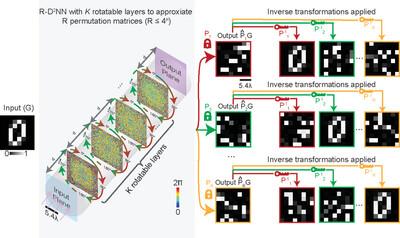
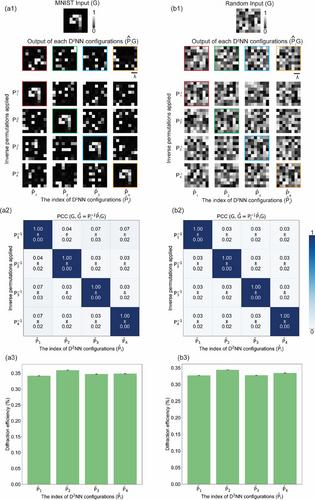
Large-scale and high-dimensional permutation operations are important for various applications in, for example, telecommunications and encryption. Here, all-optical diffractive computing is used to execute a set of high-dimensional permutation operations between an input and output field-of-view through layer rotations in a diffractive optical network. In this reconfigurable multiplexed design , every diffractive layer has four orientations: , , , and . Each unique combination of these layers represents a distinct rotation state, tailored for a specific permutation operation. Therefore, a K-layer rotatable diffractive design can all-optically perform up to independent permutation operations. The original input information can be decrypted by applying the specific inverse permutation matrix to output patterns. The feasibility of this reconfigurable multiplexed diffractive design is demonstrated by approximating 256 randomly selected permutation matrices using = 4 rotatable diffractive layers. To further enhance its multiplexing capability, input polarization diversity is also utilized. Additionally, this reconfigurable diffractive design is experimentally validated using terahertz radiation and 3D-printed diffractive layers, providing a decent match to numerical results. The presented rotation-multiplexed diffractive processor is particularly useful due to its mechanical reconfigurability, offering multifunctional representation through a single fabrication process.
期刊介绍:
Laser & Photonics Reviews is a reputable journal that publishes high-quality Reviews, original Research Articles, and Perspectives in the field of photonics and optics. It covers both theoretical and experimental aspects, including recent groundbreaking research, specific advancements, and innovative applications.
As evidence of its impact and recognition, Laser & Photonics Reviews boasts a remarkable 2022 Impact Factor of 11.0, according to the Journal Citation Reports from Clarivate Analytics (2023). Moreover, it holds impressive rankings in the InCites Journal Citation Reports: in 2021, it was ranked 6th out of 101 in the field of Optics, 15th out of 161 in Applied Physics, and 12th out of 69 in Condensed Matter Physics.
The journal uses the ISSN numbers 1863-8880 for print and 1863-8899 for online publications.




 京公网安备 11010802042870号
京ICP备2023020795号-1
京公网安备 11010802042870号
京ICP备2023020795号-1

 分享
分享

 求助内容:
求助内容: 应助结果提醒方式:
 扫码关注我们
