Guanzhou Chen MBBS, Jiang Xie MBBS, Panhua Li MBBS, Qin Wang BD, Qianwen Ye MBBS, Shouhan Feng MD
{"title":"营养风险指数和癌胚抗原综合评分可预测根治性切除大肠癌的预后。","authors":"Guanzhou Chen MBBS, Jiang Xie MBBS, Panhua Li MBBS, Qin Wang BD, Qianwen Ye MBBS, Shouhan Feng MD","doi":"10.1111/ans.19161","DOIUrl":null,"url":null,"abstract":"<div>\n \n \n <section>\n \n <h3> Background</h3>\n \n <p>Nutritional risk index (NRI) and carcinoembryonic antigen (CEA) are useful prognostic markers in colorectal cancer (CRC); however, the prognostic value of a combination of the NRI and CEA, namely, the NRI and CEA score (NCS), needs further investigation.</p>\n </section>\n \n <section>\n \n <h3> Methods</h3>\n \n <p>Stage I-III CRC patients were collected and then divided into three subgroups by counting the NCS: NCS 1: high NRI with normal CEA; NCS 2: high NRI with elevated CEA or low NRI with normal CEA; and NCS 3: low NRI with elevated CEA. The differences in outcome, counted as disease-free survival (DFS) and overall survival (OS), were tested among the subgroups.</p>\n </section>\n \n <section>\n \n <h3> Results</h3>\n \n <p>A total of 285 patients were enrolled, with 108 in NCS 1, 118 in NCS 2 and 59 in NCS 3. Patient features, including age, tumour deposit, T stage, N stage and TNM stage, were significantly different in the NCS subgroups. Both the DFS (log-rank = 26.06, <i>P</i><0.001) and OS (log-rank = 39.10, <i>P</i><0.001) were significant in different NCS subgroups, even in maximum tumour diameter ≤4 cm cases (DFS: log-rank = 21.42, <i>P</i><0.001; OS: log-rank = 30.95, <i>P</i><0.001), and NCS 1 patients displayed the best outcome compared with the rest of the subgroups. NCS was also found to be an independent risk factor for both DFS and OS.</p>\n </section>\n \n <section>\n \n <h3> Conclusions</h3>\n \n <p>NCS was a useful prognostic indicator in stages I–III CRC patients.</p>\n </section>\n </div>","PeriodicalId":8158,"journal":{"name":"ANZ Journal of Surgery","volume":"94 10","pages":"1818-1822"},"PeriodicalIF":1.5000,"publicationDate":"2024-07-17","publicationTypes":"Journal Article","fieldsOfStudy":null,"isOpenAccess":false,"openAccessPdf":"","citationCount":"0","resultStr":"{\"title\":\"A combined nutritional risk index and carcinoembryonic antigen score predicts the outcome in radically resected colorectal cancer\",\"authors\":\"Guanzhou Chen MBBS, Jiang Xie MBBS, Panhua Li MBBS, Qin Wang BD, Qianwen Ye MBBS, Shouhan Feng MD\",\"doi\":\"10.1111/ans.19161\",\"DOIUrl\":null,\"url\":null,\"abstract\":\"<div>\\n \\n \\n <section>\\n \\n <h3> Background</h3>\\n \\n <p>Nutritional risk index (NRI) and carcinoembryonic antigen (CEA) are useful prognostic markers in colorectal cancer (CRC); however, the prognostic value of a combination of the NRI and CEA, namely, the NRI and CEA score (NCS), needs further investigation.</p>\\n </section>\\n \\n <section>\\n \\n <h3> Methods</h3>\\n \\n <p>Stage I-III CRC patients were collected and then divided into three subgroups by counting the NCS: NCS 1: high NRI with normal CEA; NCS 2: high NRI with elevated CEA or low NRI with normal CEA; and NCS 3: low NRI with elevated CEA. The differences in outcome, counted as disease-free survival (DFS) and overall survival (OS), were tested among the subgroups.</p>\\n </section>\\n \\n <section>\\n \\n <h3> Results</h3>\\n \\n <p>A total of 285 patients were enrolled, with 108 in NCS 1, 118 in NCS 2 and 59 in NCS 3. Patient features, including age, tumour deposit, T stage, N stage and TNM stage, were significantly different in the NCS subgroups. Both the DFS (log-rank = 26.06, <i>P</i><0.001) and OS (log-rank = 39.10, <i>P</i><0.001) were significant in different NCS subgroups, even in maximum tumour diameter ≤4 cm cases (DFS: log-rank = 21.42, <i>P</i><0.001; OS: log-rank = 30.95, <i>P</i><0.001), and NCS 1 patients displayed the best outcome compared with the rest of the subgroups. NCS was also found to be an independent risk factor for both DFS and OS.</p>\\n </section>\\n \\n <section>\\n \\n <h3> Conclusions</h3>\\n \\n <p>NCS was a useful prognostic indicator in stages I–III CRC patients.</p>\\n </section>\\n </div>\",\"PeriodicalId\":8158,\"journal\":{\"name\":\"ANZ Journal of Surgery\",\"volume\":\"94 10\",\"pages\":\"1818-1822\"},\"PeriodicalIF\":1.5000,\"publicationDate\":\"2024-07-17\",\"publicationTypes\":\"Journal Article\",\"fieldsOfStudy\":null,\"isOpenAccess\":false,\"openAccessPdf\":\"\",\"citationCount\":\"0\",\"resultStr\":null,\"platform\":\"Semanticscholar\",\"paperid\":null,\"PeriodicalName\":\"ANZ Journal of Surgery\",\"FirstCategoryId\":\"3\",\"ListUrlMain\":\"https://onlinelibrary.wiley.com/doi/10.1111/ans.19161\",\"RegionNum\":4,\"RegionCategory\":\"医学\",\"ArticlePicture\":[],\"TitleCN\":null,\"AbstractTextCN\":null,\"PMCID\":null,\"EPubDate\":\"\",\"PubModel\":\"\",\"JCR\":\"Q3\",\"JCRName\":\"SURGERY\",\"Score\":null,\"Total\":0}","platform":"Semanticscholar","paperid":null,"PeriodicalName":"ANZ Journal of Surgery","FirstCategoryId":"3","ListUrlMain":"https://onlinelibrary.wiley.com/doi/10.1111/ans.19161","RegionNum":4,"RegionCategory":"医学","ArticlePicture":[],"TitleCN":null,"AbstractTextCN":null,"PMCID":null,"EPubDate":"","PubModel":"","JCR":"Q3","JCRName":"SURGERY","Score":null,"Total":0}
A combined nutritional risk index and carcinoembryonic antigen score predicts the outcome in radically resected colorectal cancer
Background
Nutritional risk index (NRI) and carcinoembryonic antigen (CEA) are useful prognostic markers in colorectal cancer (CRC); however, the prognostic value of a combination of the NRI and CEA, namely, the NRI and CEA score (NCS), needs further investigation.
Methods
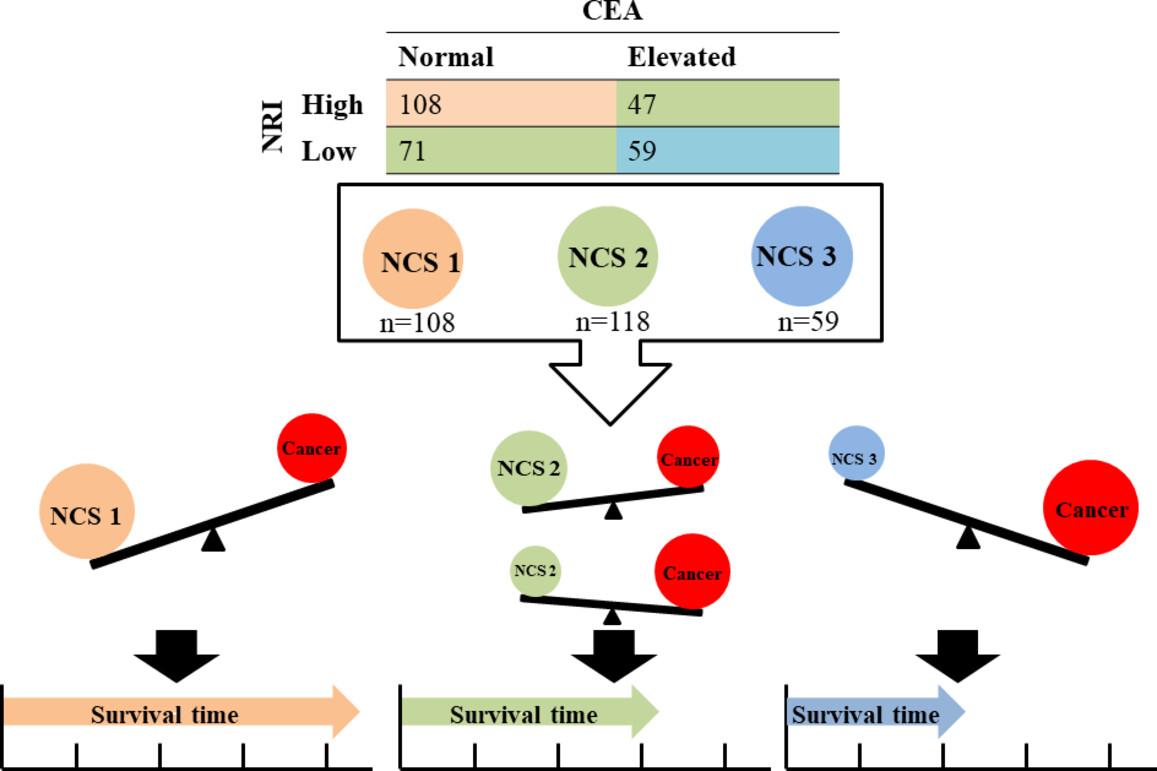
Stage I-III CRC patients were collected and then divided into three subgroups by counting the NCS: NCS 1: high NRI with normal CEA; NCS 2: high NRI with elevated CEA or low NRI with normal CEA; and NCS 3: low NRI with elevated CEA. The differences in outcome, counted as disease-free survival (DFS) and overall survival (OS), were tested among the subgroups.
Results
A total of 285 patients were enrolled, with 108 in NCS 1, 118 in NCS 2 and 59 in NCS 3. Patient features, including age, tumour deposit, T stage, N stage and TNM stage, were significantly different in the NCS subgroups. Both the DFS (log-rank = 26.06, P<0.001) and OS (log-rank = 39.10, P<0.001) were significant in different NCS subgroups, even in maximum tumour diameter ≤4 cm cases (DFS: log-rank = 21.42, P<0.001; OS: log-rank = 30.95, P<0.001), and NCS 1 patients displayed the best outcome compared with the rest of the subgroups. NCS was also found to be an independent risk factor for both DFS and OS.
Conclusions
NCS was a useful prognostic indicator in stages I–III CRC patients.
期刊介绍:
ANZ Journal of Surgery is published by Wiley on behalf of the Royal Australasian College of Surgeons to provide a medium for the publication of peer-reviewed original contributions related to clinical practice and/or research in all fields of surgery and related disciplines. It also provides a programme of continuing education for surgeons. All articles are peer-reviewed by at least two researchers expert in the field of the submitted paper.




 京公网安备 11010802042870号
京ICP备2023020795号-1
京公网安备 11010802042870号
京ICP备2023020795号-1

 分享
分享
 求助内容:
求助内容: 应助结果提醒方式:
 扫码关注我们
