{"title":"球形约束内弹性杆环的变形、形状转换和稳定性","authors":"Meng Wang, Xiying Li, Xin Yi","doi":"10.1016/j.jmps.2024.105771","DOIUrl":null,"url":null,"abstract":"<div><p>Mechanical insight into the packing of slender objects within confinement is essential for understanding how polymers, filaments, or wires organize and rearrange in limited space. Here we combine theoretical modeling, numerical optimization, and experimental studies to reveal spherical packing behavior of thin elastic rod loops of homogeneous or inhomogeneous stiffness. Across varying loop lengths, a rich array of configurations including circle, saddle, figure-eight, and more intricate patterns are identified. A theoretical framework rooted in the local equilibrium of force and moment is proposed for the rod loop deformation, facilitating the determination of internal and contact forces experienced by the rods during deformation. For the confined homogeneous rod loops, their stable and metastable configurations are well described using proposed Euler rotation curves, which offer a concise and effective approach for configuration prediction. Moreover, formulated analysis on the stability and critical force for homogeneous rod loops on great circles of the spherical confinement are performed. For inhomogeneous rod loops with two segments of differing stiffness, the stiffer segment exhibits less deviation from the great circle, while the softer segment undergoes more pronounced deformation. These findings not only enhance our understanding of buckling and post-buckling phenomena but also offer insights into filament patterning within confining environments.</p></div>","PeriodicalId":17331,"journal":{"name":"Journal of The Mechanics and Physics of Solids","volume":"191 ","pages":"Article 105771"},"PeriodicalIF":6.0000,"publicationDate":"2024-10-01","publicationTypes":"Journal Article","fieldsOfStudy":null,"isOpenAccess":false,"openAccessPdf":"","citationCount":"0","resultStr":"{\"title\":\"Deformation, shape transformations, and stability of elastic rod loops within spherical confinement\",\"authors\":\"Meng Wang, Xiying Li, Xin Yi\",\"doi\":\"10.1016/j.jmps.2024.105771\",\"DOIUrl\":null,\"url\":null,\"abstract\":\"<div><p>Mechanical insight into the packing of slender objects within confinement is essential for understanding how polymers, filaments, or wires organize and rearrange in limited space. Here we combine theoretical modeling, numerical optimization, and experimental studies to reveal spherical packing behavior of thin elastic rod loops of homogeneous or inhomogeneous stiffness. Across varying loop lengths, a rich array of configurations including circle, saddle, figure-eight, and more intricate patterns are identified. A theoretical framework rooted in the local equilibrium of force and moment is proposed for the rod loop deformation, facilitating the determination of internal and contact forces experienced by the rods during deformation. For the confined homogeneous rod loops, their stable and metastable configurations are well described using proposed Euler rotation curves, which offer a concise and effective approach for configuration prediction. Moreover, formulated analysis on the stability and critical force for homogeneous rod loops on great circles of the spherical confinement are performed. For inhomogeneous rod loops with two segments of differing stiffness, the stiffer segment exhibits less deviation from the great circle, while the softer segment undergoes more pronounced deformation. These findings not only enhance our understanding of buckling and post-buckling phenomena but also offer insights into filament patterning within confining environments.</p></div>\",\"PeriodicalId\":17331,\"journal\":{\"name\":\"Journal of The Mechanics and Physics of Solids\",\"volume\":\"191 \",\"pages\":\"Article 105771\"},\"PeriodicalIF\":6.0000,\"publicationDate\":\"2024-10-01\",\"publicationTypes\":\"Journal Article\",\"fieldsOfStudy\":null,\"isOpenAccess\":false,\"openAccessPdf\":\"\",\"citationCount\":\"0\",\"resultStr\":null,\"platform\":\"Semanticscholar\",\"paperid\":null,\"PeriodicalName\":\"Journal of The Mechanics and Physics of Solids\",\"FirstCategoryId\":\"5\",\"ListUrlMain\":\"https://www.sciencedirect.com/science/article/pii/S0022509624002370\",\"RegionNum\":2,\"RegionCategory\":\"工程技术\",\"ArticlePicture\":[],\"TitleCN\":null,\"AbstractTextCN\":null,\"PMCID\":null,\"EPubDate\":\"2024/7/8 0:00:00\",\"PubModel\":\"Epub\",\"JCR\":\"Q2\",\"JCRName\":\"MATERIALS SCIENCE, MULTIDISCIPLINARY\",\"Score\":null,\"Total\":0}","platform":"Semanticscholar","paperid":null,"PeriodicalName":"Journal of The Mechanics and Physics of Solids","FirstCategoryId":"5","ListUrlMain":"https://www.sciencedirect.com/science/article/pii/S0022509624002370","RegionNum":2,"RegionCategory":"工程技术","ArticlePicture":[],"TitleCN":null,"AbstractTextCN":null,"PMCID":null,"EPubDate":"2024/7/8 0:00:00","PubModel":"Epub","JCR":"Q2","JCRName":"MATERIALS SCIENCE, MULTIDISCIPLINARY","Score":null,"Total":0}
Deformation, shape transformations, and stability of elastic rod loops within spherical confinement
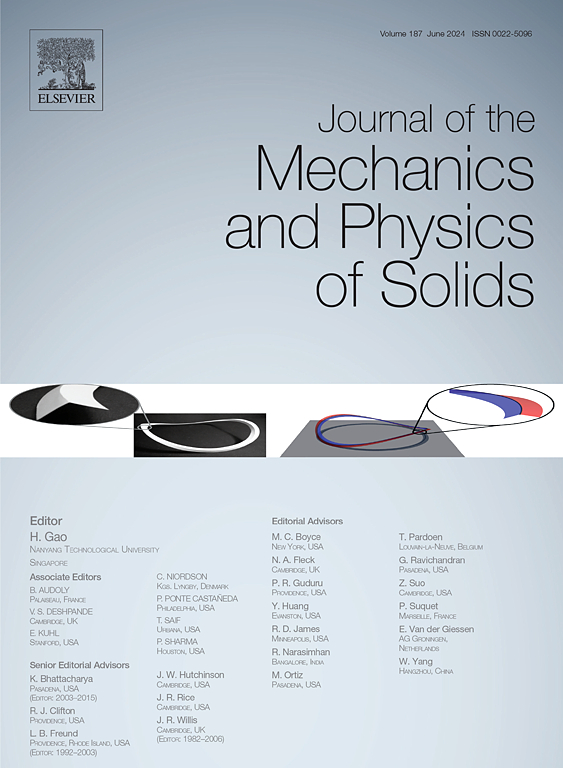
Mechanical insight into the packing of slender objects within confinement is essential for understanding how polymers, filaments, or wires organize and rearrange in limited space. Here we combine theoretical modeling, numerical optimization, and experimental studies to reveal spherical packing behavior of thin elastic rod loops of homogeneous or inhomogeneous stiffness. Across varying loop lengths, a rich array of configurations including circle, saddle, figure-eight, and more intricate patterns are identified. A theoretical framework rooted in the local equilibrium of force and moment is proposed for the rod loop deformation, facilitating the determination of internal and contact forces experienced by the rods during deformation. For the confined homogeneous rod loops, their stable and metastable configurations are well described using proposed Euler rotation curves, which offer a concise and effective approach for configuration prediction. Moreover, formulated analysis on the stability and critical force for homogeneous rod loops on great circles of the spherical confinement are performed. For inhomogeneous rod loops with two segments of differing stiffness, the stiffer segment exhibits less deviation from the great circle, while the softer segment undergoes more pronounced deformation. These findings not only enhance our understanding of buckling and post-buckling phenomena but also offer insights into filament patterning within confining environments.
期刊介绍:
The aim of Journal of The Mechanics and Physics of Solids is to publish research of the highest quality and of lasting significance on the mechanics of solids. The scope is broad, from fundamental concepts in mechanics to the analysis of novel phenomena and applications. Solids are interpreted broadly to include both hard and soft materials as well as natural and synthetic structures. The approach can be theoretical, experimental or computational.This research activity sits within engineering science and the allied areas of applied mathematics, materials science, bio-mechanics, applied physics, and geophysics.
The Journal was founded in 1952 by Rodney Hill, who was its Editor-in-Chief until 1968. The topics of interest to the Journal evolve with developments in the subject but its basic ethos remains the same: to publish research of the highest quality relating to the mechanics of solids. Thus, emphasis is placed on the development of fundamental concepts of mechanics and novel applications of these concepts based on theoretical, experimental or computational approaches, drawing upon the various branches of engineering science and the allied areas within applied mathematics, materials science, structural engineering, applied physics, and geophysics.
The main purpose of the Journal is to foster scientific understanding of the processes of deformation and mechanical failure of all solid materials, both technological and natural, and the connections between these processes and their underlying physical mechanisms. In this sense, the content of the Journal should reflect the current state of the discipline in analysis, experimental observation, and numerical simulation. In the interest of achieving this goal, authors are encouraged to consider the significance of their contributions for the field of mechanics and the implications of their results, in addition to describing the details of their work.




 京公网安备 11010802042870号
京ICP备2023020795号-1
京公网安备 11010802042870号
京ICP备2023020795号-1

 分享
分享
 求助内容:
求助内容: 应助结果提醒方式:
 扫码关注我们
