Mengmeng Yuan , Xiwen Hu , Na Li , Limin Xu , Mengxi Zhu , Xing Pei , Rui Li , Lu Sun , Yupeng Chen , Fei Yu , Huining He
{"title":"以肽-siRNA共轭物为介导的siRNA肾脏靶向递送用于治疗急性肾损伤","authors":"Mengmeng Yuan , Xiwen Hu , Na Li , Limin Xu , Mengxi Zhu , Xing Pei , Rui Li , Lu Sun , Yupeng Chen , Fei Yu , Huining He","doi":"10.1016/j.cclet.2024.110251","DOIUrl":null,"url":null,"abstract":"<div><div>Small interfering RNA (siRNA), a promising revolutionary therapy, faces delivery obstacles due to its poor targeting, strong charge negativity and macromolecular nature. Clinical-approved siRNAs can now only be delivered to the liver mediated by the chemically conjugated <em>N</em>-acetylgalactosamine (GalNAc) ligand, the conjugate can be effectively uptaken into cells through interaction with asialoglycoprotein receptor (ASGPR) highly expressed on liver hepatocytes. To further explore an efficient non-hepatic targeted delivery strategy, in this study, we designed a delivery system that chemically conjugated p53 siRNA to renal tubular cell-targeting peptides for targeting the kidney, which was suitable for industrial transformation. Results showed that peptide-siRNA conjugate could specifically enter renal tubular epithelial cells and silence target genes. In cisplatin-induced acute kidney injury (AKI) mice, peptide-siRNA conjugate blocked the p53-mediated apoptotic pathway and alleviated renal damage. The innovative proposed system to conjugate kidney-targeting peptides with siRNA achieved the efficient kidney-targeted delivery of siRNA and provided a prospective choice for treating AKI.</div></div>","PeriodicalId":10088,"journal":{"name":"Chinese Chemical Letters","volume":"36 6","pages":"Article 110251"},"PeriodicalIF":9.5000,"publicationDate":"2025-06-01","publicationTypes":"Journal Article","fieldsOfStudy":null,"isOpenAccess":false,"openAccessPdf":"","citationCount":"0","resultStr":"{\"title\":\"Kidney targeted delivery of siRNA mediated by peptide-siRNA conjugate for the treatment of acute kidney injury\",\"authors\":\"Mengmeng Yuan , Xiwen Hu , Na Li , Limin Xu , Mengxi Zhu , Xing Pei , Rui Li , Lu Sun , Yupeng Chen , Fei Yu , Huining He\",\"doi\":\"10.1016/j.cclet.2024.110251\",\"DOIUrl\":null,\"url\":null,\"abstract\":\"<div><div>Small interfering RNA (siRNA), a promising revolutionary therapy, faces delivery obstacles due to its poor targeting, strong charge negativity and macromolecular nature. Clinical-approved siRNAs can now only be delivered to the liver mediated by the chemically conjugated <em>N</em>-acetylgalactosamine (GalNAc) ligand, the conjugate can be effectively uptaken into cells through interaction with asialoglycoprotein receptor (ASGPR) highly expressed on liver hepatocytes. To further explore an efficient non-hepatic targeted delivery strategy, in this study, we designed a delivery system that chemically conjugated p53 siRNA to renal tubular cell-targeting peptides for targeting the kidney, which was suitable for industrial transformation. Results showed that peptide-siRNA conjugate could specifically enter renal tubular epithelial cells and silence target genes. In cisplatin-induced acute kidney injury (AKI) mice, peptide-siRNA conjugate blocked the p53-mediated apoptotic pathway and alleviated renal damage. The innovative proposed system to conjugate kidney-targeting peptides with siRNA achieved the efficient kidney-targeted delivery of siRNA and provided a prospective choice for treating AKI.</div></div>\",\"PeriodicalId\":10088,\"journal\":{\"name\":\"Chinese Chemical Letters\",\"volume\":\"36 6\",\"pages\":\"Article 110251\"},\"PeriodicalIF\":9.5000,\"publicationDate\":\"2025-06-01\",\"publicationTypes\":\"Journal Article\",\"fieldsOfStudy\":null,\"isOpenAccess\":false,\"openAccessPdf\":\"\",\"citationCount\":\"0\",\"resultStr\":null,\"platform\":\"Semanticscholar\",\"paperid\":null,\"PeriodicalName\":\"Chinese Chemical Letters\",\"FirstCategoryId\":\"92\",\"ListUrlMain\":\"https://www.sciencedirect.com/science/article/pii/S1001841724007708\",\"RegionNum\":1,\"RegionCategory\":\"化学\",\"ArticlePicture\":[],\"TitleCN\":null,\"AbstractTextCN\":null,\"PMCID\":null,\"EPubDate\":\"2024/7/15 0:00:00\",\"PubModel\":\"Epub\",\"JCR\":\"Q1\",\"JCRName\":\"CHEMISTRY, MULTIDISCIPLINARY\",\"Score\":null,\"Total\":0}","platform":"Semanticscholar","paperid":null,"PeriodicalName":"Chinese Chemical Letters","FirstCategoryId":"92","ListUrlMain":"https://www.sciencedirect.com/science/article/pii/S1001841724007708","RegionNum":1,"RegionCategory":"化学","ArticlePicture":[],"TitleCN":null,"AbstractTextCN":null,"PMCID":null,"EPubDate":"2024/7/15 0:00:00","PubModel":"Epub","JCR":"Q1","JCRName":"CHEMISTRY, MULTIDISCIPLINARY","Score":null,"Total":0}
Kidney targeted delivery of siRNA mediated by peptide-siRNA conjugate for the treatment of acute kidney injury
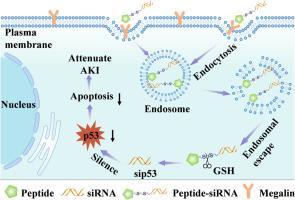
Small interfering RNA (siRNA), a promising revolutionary therapy, faces delivery obstacles due to its poor targeting, strong charge negativity and macromolecular nature. Clinical-approved siRNAs can now only be delivered to the liver mediated by the chemically conjugated N-acetylgalactosamine (GalNAc) ligand, the conjugate can be effectively uptaken into cells through interaction with asialoglycoprotein receptor (ASGPR) highly expressed on liver hepatocytes. To further explore an efficient non-hepatic targeted delivery strategy, in this study, we designed a delivery system that chemically conjugated p53 siRNA to renal tubular cell-targeting peptides for targeting the kidney, which was suitable for industrial transformation. Results showed that peptide-siRNA conjugate could specifically enter renal tubular epithelial cells and silence target genes. In cisplatin-induced acute kidney injury (AKI) mice, peptide-siRNA conjugate blocked the p53-mediated apoptotic pathway and alleviated renal damage. The innovative proposed system to conjugate kidney-targeting peptides with siRNA achieved the efficient kidney-targeted delivery of siRNA and provided a prospective choice for treating AKI.
期刊介绍:
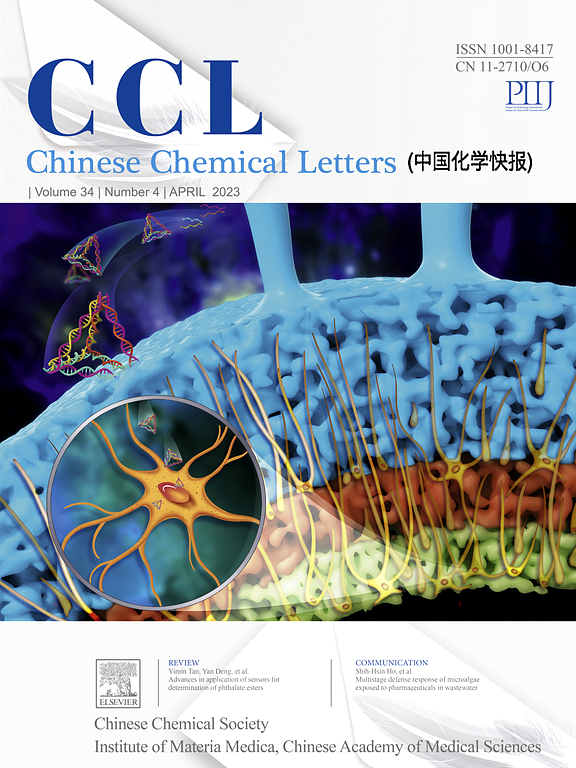
Chinese Chemical Letters (CCL) (ISSN 1001-8417) was founded in July 1990. The journal publishes preliminary accounts in the whole field of chemistry, including inorganic chemistry, organic chemistry, analytical chemistry, physical chemistry, polymer chemistry, applied chemistry, etc.Chinese Chemical Letters does not accept articles previously published or scheduled to be published. To verify originality, your article may be checked by the originality detection service CrossCheck.




 京公网安备 11010802042870号
京ICP备2023020795号-1
京公网安备 11010802042870号
京ICP备2023020795号-1

 分享
分享
 求助内容:
求助内容: 应助结果提醒方式:
 扫码关注我们
