Huakang Zong , Xinyue Li , Yanlin Zhang , Faxun Wang , Xingxing Yu , Guotao Duan , Yuanyuan Luo
{"title":"用于 H2S 传感器的 Pt/Ti3C2 电极材料,检测限低,稳定性高","authors":"Huakang Zong , Xinyue Li , Yanlin Zhang , Faxun Wang , Xingxing Yu , Guotao Duan , Yuanyuan Luo","doi":"10.1016/j.cclet.2024.110195","DOIUrl":null,"url":null,"abstract":"<div><div>Traditional Pt/C electrode materials are prone to corrosion and detachment during H<sub>2</sub>S detection, leading to a decrease in fuel cell-type sensor performance. Here, a high-performance H<sub>2</sub>S sensor based on Pt loaded Ti<sub>3</sub>C<sub>2</sub> electrode material with -O/-OH terminal groups was designed and prepared. Experimental tests showed that the Pt/Ti<sub>3</sub>C<sub>2</sub> sensor has good sensitivity (0.162 μA/ppm) and a very low detection limit to H<sub>2</sub>S (10 ppb). After 90 days of stability testing, the response of the Pt/Ti<sub>3</sub>C<sub>2</sub> sensor shows a smaller decrease of 2% compared to that of the Pt/C sensor (22.9%). Meanwhile, the sensor also has high selectivity and repeatability. The density functional theory (DFT) calculation combined with the experiment results revealed that the improved H<sub>2</sub>S sensing mechanism is attributed to the fact that the strong interaction between Pt and Ti<sub>3</sub>C<sub>2</sub> <em>via</em> the Pt-O-Ti bonding can reduce the formation energy of Pt and Ti<sub>3</sub>C<sub>2</sub>, ultimately prolonging the sensor's service life. Furthermore, the catalytic property of Pt can decrease the adsorption energy and dissociation barrier of H<sub>2</sub>S on Pt/Ti<sub>3</sub>C<sub>2</sub> surface, greatly enhance the ability to generate protons and effectively transfer charges, realizing good sensitivity and high selectivity of the sensor. The sensor works at room temperature, making it very promising in the field of H<sub>2</sub>S detection in future.</div></div>","PeriodicalId":10088,"journal":{"name":"Chinese Chemical Letters","volume":"36 5","pages":"Article 110195"},"PeriodicalIF":8.9000,"publicationDate":"2025-05-01","publicationTypes":"Journal Article","fieldsOfStudy":null,"isOpenAccess":false,"openAccessPdf":"","citationCount":"0","resultStr":"{\"title\":\"Pt/Ti3C2 electrode material used for H2S sensor with low detection limit and high stability\",\"authors\":\"Huakang Zong , Xinyue Li , Yanlin Zhang , Faxun Wang , Xingxing Yu , Guotao Duan , Yuanyuan Luo\",\"doi\":\"10.1016/j.cclet.2024.110195\",\"DOIUrl\":null,\"url\":null,\"abstract\":\"<div><div>Traditional Pt/C electrode materials are prone to corrosion and detachment during H<sub>2</sub>S detection, leading to a decrease in fuel cell-type sensor performance. Here, a high-performance H<sub>2</sub>S sensor based on Pt loaded Ti<sub>3</sub>C<sub>2</sub> electrode material with -O/-OH terminal groups was designed and prepared. Experimental tests showed that the Pt/Ti<sub>3</sub>C<sub>2</sub> sensor has good sensitivity (0.162 μA/ppm) and a very low detection limit to H<sub>2</sub>S (10 ppb). After 90 days of stability testing, the response of the Pt/Ti<sub>3</sub>C<sub>2</sub> sensor shows a smaller decrease of 2% compared to that of the Pt/C sensor (22.9%). Meanwhile, the sensor also has high selectivity and repeatability. The density functional theory (DFT) calculation combined with the experiment results revealed that the improved H<sub>2</sub>S sensing mechanism is attributed to the fact that the strong interaction between Pt and Ti<sub>3</sub>C<sub>2</sub> <em>via</em> the Pt-O-Ti bonding can reduce the formation energy of Pt and Ti<sub>3</sub>C<sub>2</sub>, ultimately prolonging the sensor's service life. Furthermore, the catalytic property of Pt can decrease the adsorption energy and dissociation barrier of H<sub>2</sub>S on Pt/Ti<sub>3</sub>C<sub>2</sub> surface, greatly enhance the ability to generate protons and effectively transfer charges, realizing good sensitivity and high selectivity of the sensor. The sensor works at room temperature, making it very promising in the field of H<sub>2</sub>S detection in future.</div></div>\",\"PeriodicalId\":10088,\"journal\":{\"name\":\"Chinese Chemical Letters\",\"volume\":\"36 5\",\"pages\":\"Article 110195\"},\"PeriodicalIF\":8.9000,\"publicationDate\":\"2025-05-01\",\"publicationTypes\":\"Journal Article\",\"fieldsOfStudy\":null,\"isOpenAccess\":false,\"openAccessPdf\":\"\",\"citationCount\":\"0\",\"resultStr\":null,\"platform\":\"Semanticscholar\",\"paperid\":null,\"PeriodicalName\":\"Chinese Chemical Letters\",\"FirstCategoryId\":\"92\",\"ListUrlMain\":\"https://www.sciencedirect.com/science/article/pii/S1001841724007149\",\"RegionNum\":1,\"RegionCategory\":\"化学\",\"ArticlePicture\":[],\"TitleCN\":null,\"AbstractTextCN\":null,\"PMCID\":null,\"EPubDate\":\"2024/7/1 0:00:00\",\"PubModel\":\"Epub\",\"JCR\":\"Q1\",\"JCRName\":\"CHEMISTRY, MULTIDISCIPLINARY\",\"Score\":null,\"Total\":0}","platform":"Semanticscholar","paperid":null,"PeriodicalName":"Chinese Chemical Letters","FirstCategoryId":"92","ListUrlMain":"https://www.sciencedirect.com/science/article/pii/S1001841724007149","RegionNum":1,"RegionCategory":"化学","ArticlePicture":[],"TitleCN":null,"AbstractTextCN":null,"PMCID":null,"EPubDate":"2024/7/1 0:00:00","PubModel":"Epub","JCR":"Q1","JCRName":"CHEMISTRY, MULTIDISCIPLINARY","Score":null,"Total":0}
引用次数: 0
摘要
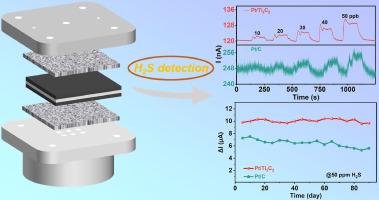
传统的Pt/C电极材料在H2S检测过程中容易腐蚀和脱落,导致燃料电池型传感器性能下降。本文设计并制备了一种基于-O/-OH端基Pt负载Ti3C2电极材料的高性能H2S传感器。实验结果表明,Pt/Ti3C2传感器具有良好的灵敏度(0.162 μA/ppm)和极低的H2S检测限(10 ppb)。经过90天的稳定性测试,Pt/Ti3C2传感器的响应比Pt/C传感器(22.9%)下降了2%。同时,该传感器还具有较高的选择性和重复性。密度泛函理论(DFT)计算结合实验结果表明,改进的H2S传感机制是由于Pt与Ti3C2之间通过Pt- o - ti键形成的强相互作用降低了Pt和Ti3C2的形成能,最终延长了传感器的使用寿命。此外,Pt的催化性能降低了H2S在Pt/Ti3C2表面的吸附能和解离势垒,大大增强了生成质子和有效转移电荷的能力,实现了传感器良好的灵敏度和高选择性。该传感器可在室温下工作,在未来的H2S检测领域具有广阔的应用前景。
Pt/Ti3C2 electrode material used for H2S sensor with low detection limit and high stability
Traditional Pt/C electrode materials are prone to corrosion and detachment during H2S detection, leading to a decrease in fuel cell-type sensor performance. Here, a high-performance H2S sensor based on Pt loaded Ti3C2 electrode material with -O/-OH terminal groups was designed and prepared. Experimental tests showed that the Pt/Ti3C2 sensor has good sensitivity (0.162 μA/ppm) and a very low detection limit to H2S (10 ppb). After 90 days of stability testing, the response of the Pt/Ti3C2 sensor shows a smaller decrease of 2% compared to that of the Pt/C sensor (22.9%). Meanwhile, the sensor also has high selectivity and repeatability. The density functional theory (DFT) calculation combined with the experiment results revealed that the improved H2S sensing mechanism is attributed to the fact that the strong interaction between Pt and Ti3C2via the Pt-O-Ti bonding can reduce the formation energy of Pt and Ti3C2, ultimately prolonging the sensor's service life. Furthermore, the catalytic property of Pt can decrease the adsorption energy and dissociation barrier of H2S on Pt/Ti3C2 surface, greatly enhance the ability to generate protons and effectively transfer charges, realizing good sensitivity and high selectivity of the sensor. The sensor works at room temperature, making it very promising in the field of H2S detection in future.
期刊介绍:
Chinese Chemical Letters (CCL) (ISSN 1001-8417) was founded in July 1990. The journal publishes preliminary accounts in the whole field of chemistry, including inorganic chemistry, organic chemistry, analytical chemistry, physical chemistry, polymer chemistry, applied chemistry, etc.Chinese Chemical Letters does not accept articles previously published or scheduled to be published. To verify originality, your article may be checked by the originality detection service CrossCheck.




 京公网安备 11010802042870号
京ICP备2023020795号-1
京公网安备 11010802042870号
京ICP备2023020795号-1

 分享
分享
 求助内容:
求助内容: 应助结果提醒方式:
 扫码关注我们
