Peidong Zhu , Jiacong Li , Yang Yang , Heng Zhong , Fangming Jin
{"title":"Pd 调制 Co 基催化剂对葡萄糖分子的选择性裂解,在温和条件下高效还原二氧化碳","authors":"Peidong Zhu , Jiacong Li , Yang Yang , Heng Zhong , Fangming Jin","doi":"10.1016/j.scib.2024.07.020","DOIUrl":null,"url":null,"abstract":"<div><div>Combining terrestrial biomass as the reductant with submarine-type hydrothermal environments for CO<sub>2</sub> reduction represents a possible approach for novel energy production systems that sustainably circulate carbon. However, increasing the reductive power of biomass is the main limitation of this potential method. Herein, we demonstrate that Co-doped with small amounts of Pd enhances the reduction of CO<sub>2</sub> by selectively producing an active intermediate from carbohydrates. This catalytic reaction utilized glucose as a reductant to achieve high formate production efficiency (458.6 g kg<sup>−1</sup>) with nearly 100% selectivity with 7.5 wt% Pd<sub>1</sub>Co<sub>20</sub>/<em>γ</em>–Al<sub>2</sub>O<sub>3</sub> at a moderate temperature of 225 °C. The regulation of the electronic structure of the catalytic Co surface by the dopant Pd plays a key role in promoting the C–C bond cleavage of glucose and hydrogen transfer for CO<sub>2</sub> reduction. The findings presented here indicate that biomass can serve as the hydrogen source for CO<sub>2</sub> reduction and provide insight into the potential utilization of CO<sub>2</sub> in sustainable industrial applications.</div></div>","PeriodicalId":421,"journal":{"name":"Science Bulletin","volume":"69 19","pages":"Pages 3055-3065"},"PeriodicalIF":21.1000,"publicationDate":"2024-10-15","publicationTypes":"Journal Article","fieldsOfStudy":null,"isOpenAccess":false,"openAccessPdf":"","citationCount":"0","resultStr":"{\"title\":\"Selective scission of glucose molecule by a Pd-modulated Co-based catalyst for efficient CO2 reduction under mild conditions\",\"authors\":\"Peidong Zhu , Jiacong Li , Yang Yang , Heng Zhong , Fangming Jin\",\"doi\":\"10.1016/j.scib.2024.07.020\",\"DOIUrl\":null,\"url\":null,\"abstract\":\"<div><div>Combining terrestrial biomass as the reductant with submarine-type hydrothermal environments for CO<sub>2</sub> reduction represents a possible approach for novel energy production systems that sustainably circulate carbon. However, increasing the reductive power of biomass is the main limitation of this potential method. Herein, we demonstrate that Co-doped with small amounts of Pd enhances the reduction of CO<sub>2</sub> by selectively producing an active intermediate from carbohydrates. This catalytic reaction utilized glucose as a reductant to achieve high formate production efficiency (458.6 g kg<sup>−1</sup>) with nearly 100% selectivity with 7.5 wt% Pd<sub>1</sub>Co<sub>20</sub>/<em>γ</em>–Al<sub>2</sub>O<sub>3</sub> at a moderate temperature of 225 °C. The regulation of the electronic structure of the catalytic Co surface by the dopant Pd plays a key role in promoting the C–C bond cleavage of glucose and hydrogen transfer for CO<sub>2</sub> reduction. The findings presented here indicate that biomass can serve as the hydrogen source for CO<sub>2</sub> reduction and provide insight into the potential utilization of CO<sub>2</sub> in sustainable industrial applications.</div></div>\",\"PeriodicalId\":421,\"journal\":{\"name\":\"Science Bulletin\",\"volume\":\"69 19\",\"pages\":\"Pages 3055-3065\"},\"PeriodicalIF\":21.1000,\"publicationDate\":\"2024-10-15\",\"publicationTypes\":\"Journal Article\",\"fieldsOfStudy\":null,\"isOpenAccess\":false,\"openAccessPdf\":\"\",\"citationCount\":\"0\",\"resultStr\":null,\"platform\":\"Semanticscholar\",\"paperid\":null,\"PeriodicalName\":\"Science Bulletin\",\"FirstCategoryId\":\"103\",\"ListUrlMain\":\"https://www.sciencedirect.com/science/article/pii/S2095927324004997\",\"RegionNum\":1,\"RegionCategory\":\"综合性期刊\",\"ArticlePicture\":[],\"TitleCN\":null,\"AbstractTextCN\":null,\"PMCID\":null,\"EPubDate\":\"2024/7/15 0:00:00\",\"PubModel\":\"Epub\",\"JCR\":\"Q1\",\"JCRName\":\"MULTIDISCIPLINARY SCIENCES\",\"Score\":null,\"Total\":0}","platform":"Semanticscholar","paperid":null,"PeriodicalName":"Science Bulletin","FirstCategoryId":"103","ListUrlMain":"https://www.sciencedirect.com/science/article/pii/S2095927324004997","RegionNum":1,"RegionCategory":"综合性期刊","ArticlePicture":[],"TitleCN":null,"AbstractTextCN":null,"PMCID":null,"EPubDate":"2024/7/15 0:00:00","PubModel":"Epub","JCR":"Q1","JCRName":"MULTIDISCIPLINARY SCIENCES","Score":null,"Total":0}
引用次数: 0
摘要
将陆地生物质作为还原剂与海底型热液环境相结合来还原二氧化碳,是一种可持续循环碳的新型能源生产系统的可行方法。然而,提高生物质的还原力是这种潜在方法的主要局限。在此,我们证明了掺杂少量钯的钴可通过选择性地从碳水化合物中产生活性中间体来增强二氧化碳的还原能力。该催化反应利用葡萄糖作为还原剂,在 225 °C 的适温条件下,7.5 wt% 的 Pd1Co20/γ-Al2O3 实现了较高的甲酸生产效率(458.6 g kg-1),选择性接近 100%。掺杂剂 Pd 对催化 Co 表面电子结构的调节在促进葡萄糖的 C-C 键裂解和二氧化碳还原的氢转移方面发挥了关键作用。本文的研究结果表明,生物质可以作为二氧化碳还原的氢源,并为二氧化碳在可持续工业应用中的潜在利用提供了启示。
Selective scission of glucose molecule by a Pd-modulated Co-based catalyst for efficient CO2 reduction under mild conditions
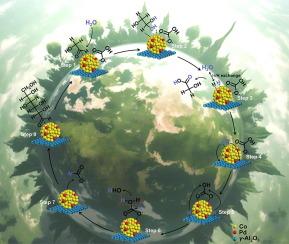
Combining terrestrial biomass as the reductant with submarine-type hydrothermal environments for CO2 reduction represents a possible approach for novel energy production systems that sustainably circulate carbon. However, increasing the reductive power of biomass is the main limitation of this potential method. Herein, we demonstrate that Co-doped with small amounts of Pd enhances the reduction of CO2 by selectively producing an active intermediate from carbohydrates. This catalytic reaction utilized glucose as a reductant to achieve high formate production efficiency (458.6 g kg−1) with nearly 100% selectivity with 7.5 wt% Pd1Co20/γ–Al2O3 at a moderate temperature of 225 °C. The regulation of the electronic structure of the catalytic Co surface by the dopant Pd plays a key role in promoting the C–C bond cleavage of glucose and hydrogen transfer for CO2 reduction. The findings presented here indicate that biomass can serve as the hydrogen source for CO2 reduction and provide insight into the potential utilization of CO2 in sustainable industrial applications.
期刊介绍:
Science Bulletin (Sci. Bull., formerly known as Chinese Science Bulletin) is a multidisciplinary academic journal supervised by the Chinese Academy of Sciences (CAS) and co-sponsored by the CAS and the National Natural Science Foundation of China (NSFC). Sci. Bull. is a semi-monthly international journal publishing high-caliber peer-reviewed research on a broad range of natural sciences and high-tech fields on the basis of its originality, scientific significance and whether it is of general interest. In addition, we are committed to serving the scientific community with immediate, authoritative news and valuable insights into upcoming trends around the globe.




 京公网安备 11010802042870号
京ICP备2023020795号-1
京公网安备 11010802042870号
京ICP备2023020795号-1

 分享
分享
 求助内容:
求助内容: 应助结果提醒方式:
 扫码关注我们
