Qingxiu Xu, Jiaxin Jia, Hang Lin, Dan Liang, Hao Chen, Yin Wang, Xiang Gao, Wang Liao, Guohua Chen, Lihong Yang, Qianlan Zhou, Jun Bai, Zhihai Xie, Lishen Shan, Rongfei Zhu
{"title":"过敏性鼻炎和/或哮喘患者对屋尘螨皮下免疫疗法的全身反应:一项现实生活中的多中心研究。","authors":"Qingxiu Xu, Jiaxin Jia, Hang Lin, Dan Liang, Hao Chen, Yin Wang, Xiang Gao, Wang Liao, Guohua Chen, Lihong Yang, Qianlan Zhou, Jun Bai, Zhihai Xie, Lishen Shan, Rongfei Zhu","doi":"10.1111/all.16254","DOIUrl":null,"url":null,"abstract":"<p>Subcutaneous immunotherapy (SCIT) has demonstrated significant efficacy in treating respiratory allergies, such as reducing allergic symptoms and the need for medication, preventing progression toward asthma, reducing new sensitization, and providing long-term efficacy after treatment cessation. Since it is often associated with systemic reactions (SRs) that can pose potential life-threatening risks, it is crucial to identify and mitigate potential risk factors to prevent SRs during SCIT. Previous studies have highlighted the substantial impact of allergen extract quality on SCIT safety. As commercial allergen products vary in protein content, concentration, and biological activity, the World Allergy Organization (WAO) emphasizes the necessity for each allergen product to possess individual data on clinical efficacy and safety, establishing product-specific evidence-based medical validation.<span><sup>1</sup></span> In China, house dust mite (HDM) stands as the most prevalent allergen triggering respiratory allergies.<span><sup>2</sup></span> NHD (Novo-HELISEN-Depot, NHD, Reinbeck, Germany), a standardized subcutaneous formulation, has been widely employed in China for treating respiratory allergies.</p><p>In this large-scale retrospective multicenter study, we investigated the safety and risk factors for SRs during NHD SCIT in patients diagnosed with HDM-induced allergic rhinitis (AR) and/or asthma according to the Allergic Rhinitis and its Impact on Asthma (ARIA) guidelines and the Global Initiative for Asthma (GINA) guidelines within the Chinese population. Patients who underwent SCIT from April 2015 to December 2023 across six allergy centers in China (Wuhan, Chengdu, Qingdao, Changsha, Shenyang, Foshan) were included. The skin prick test (SPT) results were assessed using the skin index (SI), a ratio of wheal diameter for each allergen to the diameter induced by histamine, with grades “+,” “2+,” “3+,” and “4+” linked to SI values of <0.5, 0.5 ≤ SI <1.0, 1.0 ≤ SI <2.0, and SI ≥2.0, respectively.<span><sup>3</sup></span> High sensitization was defined as a 3+/4+ SPT and/or sIgE level exceeding grade 4 (17.5KU/L). SRs were categorized into five grades based on the WAO Subcutaneous Immunotherapy Systemic Reaction Grading System.<span><sup>4</sup></span> Data were collected from detailed medical records and immunotherapy charts from each allergy center. This study received approval from the independent ethics committee of Tongji Hospital (TJ-IRB202402050). The informed consent was waived.</p><p>We enrolled a total of 3132 patients in this study (Table S1). Among them, 394 SRs in 301 patients were observed in 113,431 injections, yielding an incidence of 0.35% per injection and 9.61% per patient (Table S2), consistent with or even lower than rates reported in similar studies.<span><sup>5</sup></span> The majority (85.28%) of SRs occurred with the highest concentration (No. 3 vial, 5000 TU/mL) (Figure 1A). Most SRs (69.04%) manifested within 30 minutes of postinjection (Figure 1B). SRs were predominantly grade 1 (52.54%), followed by grade 2 (42.13%), grade 3 (4.57%), and grade 4 (0.51%). No grade 5 SRs were reported (Figure 1C). H1 antihistamines (58.38%) and inhaled β2 agonists (44.92%) were common rescue medications for SRs, with adrenaline use in 27.92% of patients with SRs. Notably, the majority (94.67%) of patients with SRs continued SCIT (Figure 1D). Among them, 228 patients experienced one SR, while only one patient encountered five SRs (Figure 1E). The rates of SRs in different subgroups are shown in Table S3.</p><p>Consistent with the previous research,<span><sup>5</sup></span> our findings showed a significantly higher prevalence of SRs in asthma patients (Table 1). Hence, it is imperative to thoroughly assess asthma control pre-injection and closely monitor and follow up post-injection to minimize SR risks. Furthermore, our study identified a disease duration exceeding five years as a risk factor for SRs (Table 1). Therefore, early initiation of immunotherapy is recommended. Our research suggests that early SCIT administration can not only enhance efficacy but also reduce SR risks. Notably, a study by Yang et al.<span><sup>6</sup></span> suggested the safety of HDM SCIT for preschool children, implying the possibility of administering SCIT even to children under five years old.</p><p>Our study aligns with the previous research,<span><sup>5</sup></span> indicating that patients with high sensitization face over eight times the risk of SRs (Table 1). For such patients, we advocate various strategies, including adjusting allergen concentration, premedication, close postinjection supervision, and comprehensive contingency planning.</p><p>In conclusion, our nationwide large-sample study confirms the safety of SCIT using NHD for AR and/or asthma patients in the Chinese population. However, asthma, disease duration exceeding five years, and high sensitization are identified as independent risk factors for SRs. Our research distinguishes itself by providing a product-specific evaluation for SCIT, based on a large-scale real-life multi-center study within the Chinese population. This contributes to the ongoing transition toward evidence-based allergen immunotherapy, a shift underscored by WAO. Standardized procedures, personalized therapy, rigorous assessments, individual adjustments, early detection, and adequate preparedness are essential in reducing SR occurrences during SCIT. It should be noted that our study is retrospective in design, and the risk factors for SRs during SCIT identified may require prospective investigations for verification.</p><p>RZ conceived and designed the project. LS, ZX, JB, JJ, HL, and DL all made contributions to the design of the study. HC, YW, XG, WL, GC, LY, and QZ contributed by collecting the clinical data. QX analyzed the data and wrote the first draft. RZ participated in the statistical analysis and revised the manuscript. All authors provided their final approval of the version to be published.</p><p>None.</p><p>All authors declare that they have no relevant conflicts of interest.</p>","PeriodicalId":122,"journal":{"name":"Allergy","volume":"80 5","pages":"1506-1508"},"PeriodicalIF":11.3000,"publicationDate":"2024-07-26","publicationTypes":"Journal Article","fieldsOfStudy":null,"isOpenAccess":false,"openAccessPdf":"https://onlinelibrary.wiley.com/doi/epdf/10.1111/all.16254","citationCount":"0","resultStr":"{\"title\":\"Systemic reactions to house dust mite subcutaneous immunotherapy in patients with allergic rhinitis and/or asthma: A real-life, multi-center study\",\"authors\":\"Qingxiu Xu, Jiaxin Jia, Hang Lin, Dan Liang, Hao Chen, Yin Wang, Xiang Gao, Wang Liao, Guohua Chen, Lihong Yang, Qianlan Zhou, Jun Bai, Zhihai Xie, Lishen Shan, Rongfei Zhu\",\"doi\":\"10.1111/all.16254\",\"DOIUrl\":null,\"url\":null,\"abstract\":\"<p>Subcutaneous immunotherapy (SCIT) has demonstrated significant efficacy in treating respiratory allergies, such as reducing allergic symptoms and the need for medication, preventing progression toward asthma, reducing new sensitization, and providing long-term efficacy after treatment cessation. Since it is often associated with systemic reactions (SRs) that can pose potential life-threatening risks, it is crucial to identify and mitigate potential risk factors to prevent SRs during SCIT. Previous studies have highlighted the substantial impact of allergen extract quality on SCIT safety. As commercial allergen products vary in protein content, concentration, and biological activity, the World Allergy Organization (WAO) emphasizes the necessity for each allergen product to possess individual data on clinical efficacy and safety, establishing product-specific evidence-based medical validation.<span><sup>1</sup></span> In China, house dust mite (HDM) stands as the most prevalent allergen triggering respiratory allergies.<span><sup>2</sup></span> NHD (Novo-HELISEN-Depot, NHD, Reinbeck, Germany), a standardized subcutaneous formulation, has been widely employed in China for treating respiratory allergies.</p><p>In this large-scale retrospective multicenter study, we investigated the safety and risk factors for SRs during NHD SCIT in patients diagnosed with HDM-induced allergic rhinitis (AR) and/or asthma according to the Allergic Rhinitis and its Impact on Asthma (ARIA) guidelines and the Global Initiative for Asthma (GINA) guidelines within the Chinese population. Patients who underwent SCIT from April 2015 to December 2023 across six allergy centers in China (Wuhan, Chengdu, Qingdao, Changsha, Shenyang, Foshan) were included. The skin prick test (SPT) results were assessed using the skin index (SI), a ratio of wheal diameter for each allergen to the diameter induced by histamine, with grades “+,” “2+,” “3+,” and “4+” linked to SI values of <0.5, 0.5 ≤ SI <1.0, 1.0 ≤ SI <2.0, and SI ≥2.0, respectively.<span><sup>3</sup></span> High sensitization was defined as a 3+/4+ SPT and/or sIgE level exceeding grade 4 (17.5KU/L). SRs were categorized into five grades based on the WAO Subcutaneous Immunotherapy Systemic Reaction Grading System.<span><sup>4</sup></span> Data were collected from detailed medical records and immunotherapy charts from each allergy center. This study received approval from the independent ethics committee of Tongji Hospital (TJ-IRB202402050). The informed consent was waived.</p><p>We enrolled a total of 3132 patients in this study (Table S1). Among them, 394 SRs in 301 patients were observed in 113,431 injections, yielding an incidence of 0.35% per injection and 9.61% per patient (Table S2), consistent with or even lower than rates reported in similar studies.<span><sup>5</sup></span> The majority (85.28%) of SRs occurred with the highest concentration (No. 3 vial, 5000 TU/mL) (Figure 1A). Most SRs (69.04%) manifested within 30 minutes of postinjection (Figure 1B). SRs were predominantly grade 1 (52.54%), followed by grade 2 (42.13%), grade 3 (4.57%), and grade 4 (0.51%). No grade 5 SRs were reported (Figure 1C). H1 antihistamines (58.38%) and inhaled β2 agonists (44.92%) were common rescue medications for SRs, with adrenaline use in 27.92% of patients with SRs. Notably, the majority (94.67%) of patients with SRs continued SCIT (Figure 1D). Among them, 228 patients experienced one SR, while only one patient encountered five SRs (Figure 1E). The rates of SRs in different subgroups are shown in Table S3.</p><p>Consistent with the previous research,<span><sup>5</sup></span> our findings showed a significantly higher prevalence of SRs in asthma patients (Table 1). Hence, it is imperative to thoroughly assess asthma control pre-injection and closely monitor and follow up post-injection to minimize SR risks. Furthermore, our study identified a disease duration exceeding five years as a risk factor for SRs (Table 1). Therefore, early initiation of immunotherapy is recommended. Our research suggests that early SCIT administration can not only enhance efficacy but also reduce SR risks. Notably, a study by Yang et al.<span><sup>6</sup></span> suggested the safety of HDM SCIT for preschool children, implying the possibility of administering SCIT even to children under five years old.</p><p>Our study aligns with the previous research,<span><sup>5</sup></span> indicating that patients with high sensitization face over eight times the risk of SRs (Table 1). For such patients, we advocate various strategies, including adjusting allergen concentration, premedication, close postinjection supervision, and comprehensive contingency planning.</p><p>In conclusion, our nationwide large-sample study confirms the safety of SCIT using NHD for AR and/or asthma patients in the Chinese population. However, asthma, disease duration exceeding five years, and high sensitization are identified as independent risk factors for SRs. Our research distinguishes itself by providing a product-specific evaluation for SCIT, based on a large-scale real-life multi-center study within the Chinese population. This contributes to the ongoing transition toward evidence-based allergen immunotherapy, a shift underscored by WAO. Standardized procedures, personalized therapy, rigorous assessments, individual adjustments, early detection, and adequate preparedness are essential in reducing SR occurrences during SCIT. It should be noted that our study is retrospective in design, and the risk factors for SRs during SCIT identified may require prospective investigations for verification.</p><p>RZ conceived and designed the project. LS, ZX, JB, JJ, HL, and DL all made contributions to the design of the study. HC, YW, XG, WL, GC, LY, and QZ contributed by collecting the clinical data. QX analyzed the data and wrote the first draft. RZ participated in the statistical analysis and revised the manuscript. All authors provided their final approval of the version to be published.</p><p>None.</p><p>All authors declare that they have no relevant conflicts of interest.</p>\",\"PeriodicalId\":122,\"journal\":{\"name\":\"Allergy\",\"volume\":\"80 5\",\"pages\":\"1506-1508\"},\"PeriodicalIF\":11.3000,\"publicationDate\":\"2024-07-26\",\"publicationTypes\":\"Journal Article\",\"fieldsOfStudy\":null,\"isOpenAccess\":false,\"openAccessPdf\":\"https://onlinelibrary.wiley.com/doi/epdf/10.1111/all.16254\",\"citationCount\":\"0\",\"resultStr\":null,\"platform\":\"Semanticscholar\",\"paperid\":null,\"PeriodicalName\":\"Allergy\",\"FirstCategoryId\":\"3\",\"ListUrlMain\":\"https://onlinelibrary.wiley.com/doi/10.1111/all.16254\",\"RegionNum\":1,\"RegionCategory\":\"医学\",\"ArticlePicture\":[],\"TitleCN\":null,\"AbstractTextCN\":null,\"PMCID\":null,\"EPubDate\":\"\",\"PubModel\":\"\",\"JCR\":\"Q1\",\"JCRName\":\"ALLERGY\",\"Score\":null,\"Total\":0}","platform":"Semanticscholar","paperid":null,"PeriodicalName":"Allergy","FirstCategoryId":"3","ListUrlMain":"https://onlinelibrary.wiley.com/doi/10.1111/all.16254","RegionNum":1,"RegionCategory":"医学","ArticlePicture":[],"TitleCN":null,"AbstractTextCN":null,"PMCID":null,"EPubDate":"","PubModel":"","JCR":"Q1","JCRName":"ALLERGY","Score":null,"Total":0}
Systemic reactions to house dust mite subcutaneous immunotherapy in patients with allergic rhinitis and/or asthma: A real-life, multi-center study
Subcutaneous immunotherapy (SCIT) has demonstrated significant efficacy in treating respiratory allergies, such as reducing allergic symptoms and the need for medication, preventing progression toward asthma, reducing new sensitization, and providing long-term efficacy after treatment cessation. Since it is often associated with systemic reactions (SRs) that can pose potential life-threatening risks, it is crucial to identify and mitigate potential risk factors to prevent SRs during SCIT. Previous studies have highlighted the substantial impact of allergen extract quality on SCIT safety. As commercial allergen products vary in protein content, concentration, and biological activity, the World Allergy Organization (WAO) emphasizes the necessity for each allergen product to possess individual data on clinical efficacy and safety, establishing product-specific evidence-based medical validation.1 In China, house dust mite (HDM) stands as the most prevalent allergen triggering respiratory allergies.2 NHD (Novo-HELISEN-Depot, NHD, Reinbeck, Germany), a standardized subcutaneous formulation, has been widely employed in China for treating respiratory allergies.
In this large-scale retrospective multicenter study, we investigated the safety and risk factors for SRs during NHD SCIT in patients diagnosed with HDM-induced allergic rhinitis (AR) and/or asthma according to the Allergic Rhinitis and its Impact on Asthma (ARIA) guidelines and the Global Initiative for Asthma (GINA) guidelines within the Chinese population. Patients who underwent SCIT from April 2015 to December 2023 across six allergy centers in China (Wuhan, Chengdu, Qingdao, Changsha, Shenyang, Foshan) were included. The skin prick test (SPT) results were assessed using the skin index (SI), a ratio of wheal diameter for each allergen to the diameter induced by histamine, with grades “+,” “2+,” “3+,” and “4+” linked to SI values of <0.5, 0.5 ≤ SI <1.0, 1.0 ≤ SI <2.0, and SI ≥2.0, respectively.3 High sensitization was defined as a 3+/4+ SPT and/or sIgE level exceeding grade 4 (17.5KU/L). SRs were categorized into five grades based on the WAO Subcutaneous Immunotherapy Systemic Reaction Grading System.4 Data were collected from detailed medical records and immunotherapy charts from each allergy center. This study received approval from the independent ethics committee of Tongji Hospital (TJ-IRB202402050). The informed consent was waived.
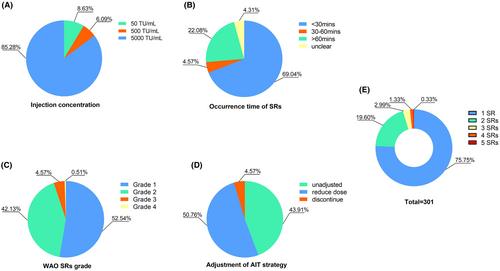
We enrolled a total of 3132 patients in this study (Table S1). Among them, 394 SRs in 301 patients were observed in 113,431 injections, yielding an incidence of 0.35% per injection and 9.61% per patient (Table S2), consistent with or even lower than rates reported in similar studies.5 The majority (85.28%) of SRs occurred with the highest concentration (No. 3 vial, 5000 TU/mL) (Figure 1A). Most SRs (69.04%) manifested within 30 minutes of postinjection (Figure 1B). SRs were predominantly grade 1 (52.54%), followed by grade 2 (42.13%), grade 3 (4.57%), and grade 4 (0.51%). No grade 5 SRs were reported (Figure 1C). H1 antihistamines (58.38%) and inhaled β2 agonists (44.92%) were common rescue medications for SRs, with adrenaline use in 27.92% of patients with SRs. Notably, the majority (94.67%) of patients with SRs continued SCIT (Figure 1D). Among them, 228 patients experienced one SR, while only one patient encountered five SRs (Figure 1E). The rates of SRs in different subgroups are shown in Table S3.
Consistent with the previous research,5 our findings showed a significantly higher prevalence of SRs in asthma patients (Table 1). Hence, it is imperative to thoroughly assess asthma control pre-injection and closely monitor and follow up post-injection to minimize SR risks. Furthermore, our study identified a disease duration exceeding five years as a risk factor for SRs (Table 1). Therefore, early initiation of immunotherapy is recommended. Our research suggests that early SCIT administration can not only enhance efficacy but also reduce SR risks. Notably, a study by Yang et al.6 suggested the safety of HDM SCIT for preschool children, implying the possibility of administering SCIT even to children under five years old.
Our study aligns with the previous research,5 indicating that patients with high sensitization face over eight times the risk of SRs (Table 1). For such patients, we advocate various strategies, including adjusting allergen concentration, premedication, close postinjection supervision, and comprehensive contingency planning.
In conclusion, our nationwide large-sample study confirms the safety of SCIT using NHD for AR and/or asthma patients in the Chinese population. However, asthma, disease duration exceeding five years, and high sensitization are identified as independent risk factors for SRs. Our research distinguishes itself by providing a product-specific evaluation for SCIT, based on a large-scale real-life multi-center study within the Chinese population. This contributes to the ongoing transition toward evidence-based allergen immunotherapy, a shift underscored by WAO. Standardized procedures, personalized therapy, rigorous assessments, individual adjustments, early detection, and adequate preparedness are essential in reducing SR occurrences during SCIT. It should be noted that our study is retrospective in design, and the risk factors for SRs during SCIT identified may require prospective investigations for verification.
RZ conceived and designed the project. LS, ZX, JB, JJ, HL, and DL all made contributions to the design of the study. HC, YW, XG, WL, GC, LY, and QZ contributed by collecting the clinical data. QX analyzed the data and wrote the first draft. RZ participated in the statistical analysis and revised the manuscript. All authors provided their final approval of the version to be published.
None.
All authors declare that they have no relevant conflicts of interest.
期刊介绍:
Allergy is an international and multidisciplinary journal that aims to advance, impact, and communicate all aspects of the discipline of Allergy/Immunology. It publishes original articles, reviews, position papers, guidelines, editorials, news and commentaries, letters to the editors, and correspondences. The journal accepts articles based on their scientific merit and quality.
Allergy seeks to maintain contact between basic and clinical Allergy/Immunology and encourages contributions from contributors and readers from all countries. In addition to its publication, Allergy also provides abstracting and indexing information. Some of the databases that include Allergy abstracts are Abstracts on Hygiene & Communicable Disease, Academic Search Alumni Edition, AgBiotech News & Information, AGRICOLA Database, Biological Abstracts, PubMed Dietary Supplement Subset, and Global Health, among others.




 京公网安备 11010802042870号
京ICP备2023020795号-1
京公网安备 11010802042870号
京ICP备2023020795号-1

 分享
分享
 求助内容:
求助内容: 应助结果提醒方式:
 扫码关注我们
