Felix Beck, Phuong Nguyen, Anne Hoffmann, Lucie Loyal, Andreas Thiel, Marc Melzer, Hannah Apel, Matthias Pierer, Marco Krasselt, Olga Seifert, Anne-Marie Glimm, Tobias Hagemann, Kathrin Rothe, Ulf Wagner
{"title":"类风湿性关节炎中的 CD4+CD8α 低 T 细胞会克隆扩增,并依赖于共刺激。","authors":"Felix Beck, Phuong Nguyen, Anne Hoffmann, Lucie Loyal, Andreas Thiel, Marc Melzer, Hannah Apel, Matthias Pierer, Marco Krasselt, Olga Seifert, Anne-Marie Glimm, Tobias Hagemann, Kathrin Rothe, Ulf Wagner","doi":"10.1002/art.42960","DOIUrl":null,"url":null,"abstract":"<div>\n \n <section>\n \n <h3> Objective</h3>\n \n <p>CD4<sup>+</sup>CD8<sup>+</sup> T cells are increased in patients with rheumatoid arthritis (RA). They are not only associated with joint erosions in established disease but are also present in the preclinical stages of RA. This study aims to further investigate their expansion in the context of T cell clonality in patients with RA, as well as their responsiveness to T cell–targeted treatment.</p>\n </section>\n \n <section>\n \n <h3> Methods</h3>\n \n <p>Single-cell RNA (scRNA) and single-cell T cell receptor (TCR) sequencing data were used to determine coreceptor expression and TCR sequences to assess the clonality of CD4<sup>+</sup>CD8<sup>+</sup> T cells in patients with RA (n = 3) and healthy controls (n = 2). Peripheral CD4<sup>+</sup>CD8<sup>+</sup> T cells and their subpopulations were measured in patients with RA (n = 53), patients with psoriatic arthritis (PsA; n = 52), and healthy donors (n = 50) using flow cytometry. In addition, changes in CD4<sup>+</sup>CD8<sup>+</sup> T cell frequency were prospectively observed in patients with RA receiving therapy with abatacept for 12 weeks.</p>\n </section>\n \n <section>\n \n <h3> Results</h3>\n \n <p>We observed an increase of CD4<sup>+</sup> T cells expressing CD8α in patients with RA, both in comparison to patients with PsA and healthy controls. Clonality analysis revealed that these CD4<sup>+</sup>CD8α<sup>low</sup> T cells are part of large T cell clones, which cluster separately from CD4<sup>+</sup>CD8<sup>−</sup> T cell clones in the scRNA sequencing (scRNA-seq) gene expression analysis. Treatment with abatacept significantly reduced the frequency of peripheral CD4<sup>+</sup>CD8α<sup>low</sup> T cells, and this was linked to reduction in disease activity.</p>\n </section>\n \n <section>\n \n <h3> Conclusion</h3>\n \n <p>In patients with RA, clonal expansion of CD4<sup>+</sup> T cell culminates in the emergence of peripheral CD4<sup>+</sup>CD8α<sup>low</sup> T cells, which are associated with disease activity and diminished upon abatacept treatment and could contribute to disease pathogenesis.</p>\n \n <div>\n <figure>\n <div><picture>\n <source></source></picture><p></p>\n </div>\n </figure>\n </div>\n </section>\n </div>","PeriodicalId":129,"journal":{"name":"Arthritis & Rheumatology","volume":"76 12","pages":"1719-1729"},"PeriodicalIF":9.9000,"publicationDate":"2024-07-25","publicationTypes":"Journal Article","fieldsOfStudy":null,"isOpenAccess":false,"openAccessPdf":"https://onlinelibrary.wiley.com/doi/epdf/10.1002/art.42960","citationCount":"0","resultStr":"{\"title\":\"CD4+CD8αlow T Cell Clonal Expansion Dependent on Costimulation in Patients With Rheumatoid Arthritis\",\"authors\":\"Felix Beck, Phuong Nguyen, Anne Hoffmann, Lucie Loyal, Andreas Thiel, Marc Melzer, Hannah Apel, Matthias Pierer, Marco Krasselt, Olga Seifert, Anne-Marie Glimm, Tobias Hagemann, Kathrin Rothe, Ulf Wagner\",\"doi\":\"10.1002/art.42960\",\"DOIUrl\":null,\"url\":null,\"abstract\":\"<div>\\n \\n <section>\\n \\n <h3> Objective</h3>\\n \\n <p>CD4<sup>+</sup>CD8<sup>+</sup> T cells are increased in patients with rheumatoid arthritis (RA). They are not only associated with joint erosions in established disease but are also present in the preclinical stages of RA. This study aims to further investigate their expansion in the context of T cell clonality in patients with RA, as well as their responsiveness to T cell–targeted treatment.</p>\\n </section>\\n \\n <section>\\n \\n <h3> Methods</h3>\\n \\n <p>Single-cell RNA (scRNA) and single-cell T cell receptor (TCR) sequencing data were used to determine coreceptor expression and TCR sequences to assess the clonality of CD4<sup>+</sup>CD8<sup>+</sup> T cells in patients with RA (n = 3) and healthy controls (n = 2). Peripheral CD4<sup>+</sup>CD8<sup>+</sup> T cells and their subpopulations were measured in patients with RA (n = 53), patients with psoriatic arthritis (PsA; n = 52), and healthy donors (n = 50) using flow cytometry. In addition, changes in CD4<sup>+</sup>CD8<sup>+</sup> T cell frequency were prospectively observed in patients with RA receiving therapy with abatacept for 12 weeks.</p>\\n </section>\\n \\n <section>\\n \\n <h3> Results</h3>\\n \\n <p>We observed an increase of CD4<sup>+</sup> T cells expressing CD8α in patients with RA, both in comparison to patients with PsA and healthy controls. Clonality analysis revealed that these CD4<sup>+</sup>CD8α<sup>low</sup> T cells are part of large T cell clones, which cluster separately from CD4<sup>+</sup>CD8<sup>−</sup> T cell clones in the scRNA sequencing (scRNA-seq) gene expression analysis. Treatment with abatacept significantly reduced the frequency of peripheral CD4<sup>+</sup>CD8α<sup>low</sup> T cells, and this was linked to reduction in disease activity.</p>\\n </section>\\n \\n <section>\\n \\n <h3> Conclusion</h3>\\n \\n <p>In patients with RA, clonal expansion of CD4<sup>+</sup> T cell culminates in the emergence of peripheral CD4<sup>+</sup>CD8α<sup>low</sup> T cells, which are associated with disease activity and diminished upon abatacept treatment and could contribute to disease pathogenesis.</p>\\n \\n <div>\\n <figure>\\n <div><picture>\\n <source></source></picture><p></p>\\n </div>\\n </figure>\\n </div>\\n </section>\\n </div>\",\"PeriodicalId\":129,\"journal\":{\"name\":\"Arthritis & Rheumatology\",\"volume\":\"76 12\",\"pages\":\"1719-1729\"},\"PeriodicalIF\":9.9000,\"publicationDate\":\"2024-07-25\",\"publicationTypes\":\"Journal Article\",\"fieldsOfStudy\":null,\"isOpenAccess\":false,\"openAccessPdf\":\"https://onlinelibrary.wiley.com/doi/epdf/10.1002/art.42960\",\"citationCount\":\"0\",\"resultStr\":null,\"platform\":\"Semanticscholar\",\"paperid\":null,\"PeriodicalName\":\"Arthritis & Rheumatology\",\"FirstCategoryId\":\"3\",\"ListUrlMain\":\"https://acrjournals.onlinelibrary.wiley.com/doi/10.1002/art.42960\",\"RegionNum\":1,\"RegionCategory\":\"医学\",\"ArticlePicture\":[],\"TitleCN\":null,\"AbstractTextCN\":null,\"PMCID\":null,\"EPubDate\":\"\",\"PubModel\":\"\",\"JCR\":\"Q1\",\"JCRName\":\"RHEUMATOLOGY\",\"Score\":null,\"Total\":0}","platform":"Semanticscholar","paperid":null,"PeriodicalName":"Arthritis & Rheumatology","FirstCategoryId":"3","ListUrlMain":"https://acrjournals.onlinelibrary.wiley.com/doi/10.1002/art.42960","RegionNum":1,"RegionCategory":"医学","ArticlePicture":[],"TitleCN":null,"AbstractTextCN":null,"PMCID":null,"EPubDate":"","PubModel":"","JCR":"Q1","JCRName":"RHEUMATOLOGY","Score":null,"Total":0}
引用次数: 0
摘要
目的:类风湿性关节炎(RA)患者体内的 CD4+CD8+ T 细胞增多。它们不仅与已确诊疾病的关节侵蚀有关,而且还存在于 RA 的临床前期。本研究旨在进一步研究它们在 RA 患者 T 细胞克隆性背景下的扩增及其对 T 细胞靶向治疗的反应性:方法:利用单细胞(sc)RNA和scTCR测序数据确定共受体表达和T细胞受体序列,以评估RA患者(3人)和健康对照组(2人)CD4+CD8+ T细胞的克隆性。使用流式细胞术测量了RA患者(53人)、PsA患者(52人)和健康供体(50人)的外周CD4+CD8+ T细胞及其亚群。此外,还对接受阿帕他赛治疗 12 周的 RA 患者的 CD4+CD8+ T 细胞频率变化进行了前瞻性跟踪:结果:我们观察到,与 PsA 患者和健康对照组相比,RA 患者中表达 CD8α 的 CD4+ T 细胞有所增加。克隆性分析显示,这些CD4+CD8α低表达的T细胞是大T细胞克隆的一部分,在scRNA-seq基因表达分析中,它们与CD4+CD8-T细胞克隆分开聚集。阿帕他赛治疗可明显降低外周CD4+CD8α低T细胞的频率,这与疾病活动的减少有关:结论:在RA患者中,CD4+ T细胞克隆的扩增最终导致了外周CD4+CD8α低T细胞的出现,这些细胞与疾病活动有关,并在阿帕他赛治疗后减少,这可能有助于疾病的发病机制。
CD4+CD8αlow T Cell Clonal Expansion Dependent on Costimulation in Patients With Rheumatoid Arthritis
Objective
CD4+CD8+ T cells are increased in patients with rheumatoid arthritis (RA). They are not only associated with joint erosions in established disease but are also present in the preclinical stages of RA. This study aims to further investigate their expansion in the context of T cell clonality in patients with RA, as well as their responsiveness to T cell–targeted treatment.
Methods
Single-cell RNA (scRNA) and single-cell T cell receptor (TCR) sequencing data were used to determine coreceptor expression and TCR sequences to assess the clonality of CD4+CD8+ T cells in patients with RA (n = 3) and healthy controls (n = 2). Peripheral CD4+CD8+ T cells and their subpopulations were measured in patients with RA (n = 53), patients with psoriatic arthritis (PsA; n = 52), and healthy donors (n = 50) using flow cytometry. In addition, changes in CD4+CD8+ T cell frequency were prospectively observed in patients with RA receiving therapy with abatacept for 12 weeks.
Results
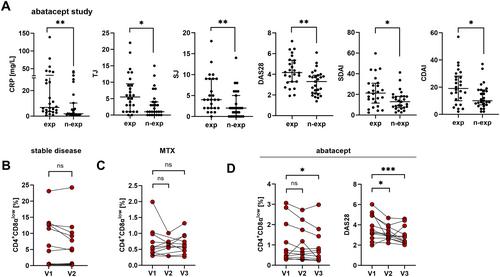
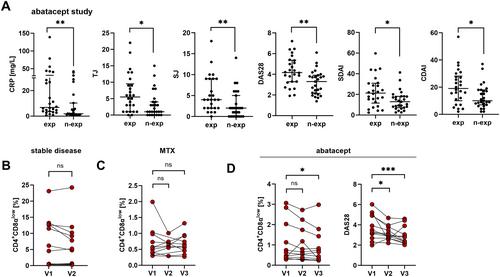
We observed an increase of CD4+ T cells expressing CD8α in patients with RA, both in comparison to patients with PsA and healthy controls. Clonality analysis revealed that these CD4+CD8αlow T cells are part of large T cell clones, which cluster separately from CD4+CD8− T cell clones in the scRNA sequencing (scRNA-seq) gene expression analysis. Treatment with abatacept significantly reduced the frequency of peripheral CD4+CD8αlow T cells, and this was linked to reduction in disease activity.
Conclusion
In patients with RA, clonal expansion of CD4+ T cell culminates in the emergence of peripheral CD4+CD8αlow T cells, which are associated with disease activity and diminished upon abatacept treatment and could contribute to disease pathogenesis.
期刊介绍:
Arthritis & Rheumatology is the official journal of the American College of Rheumatology and focuses on the natural history, pathophysiology, treatment, and outcome of rheumatic diseases. It is a peer-reviewed publication that aims to provide the highest quality basic and clinical research in this field. The journal covers a wide range of investigative areas and also includes review articles, editorials, and educational material for researchers and clinicians. Being recognized as a leading research journal in rheumatology, Arthritis & Rheumatology serves the global community of rheumatology investigators and clinicians.






 京公网安备 11010802042870号
京ICP备2023020795号-1
京公网安备 11010802042870号
京ICP备2023020795号-1

 分享
分享
 求助内容:
求助内容: 应助结果提醒方式:
 扫码关注我们
