{"title":"调整空气富集分子电化学固定的传质方式","authors":"Xiaoyu Du, Huan Wang","doi":"10.1016/j.cclet.2024.110276","DOIUrl":null,"url":null,"abstract":"<div><div>Electrochemical reduction of air-abundant molecules (<em>e.g.</em>, CO<sub>2</sub>, N<sub>2</sub>, and O<sub>2</sub>) offers a sustainable solution to address global energy and environmental challenges, where high current density and energy efficiency are highly desirable. However, commercially-relevant current density will cause dramatic change of cation, solvent, pH, and reactant molecular distribution near electrode, resulting in severe concentration polarization and sluggish reaction kinetics. In this case, mass transfer such as molecule migration pathway in electrolytes, electrodes, and devices need to be rationally designed and systematically optimized. Here this review will present a systematical introduction on regulating mass transfer on electrochemical fixation of air-abundant molecules. We firstly discuss the fundamental mass transport from bulk electrolyte to catalyst surface and within electric double layer (EDL) and review the recent advances in regulating mass transport behaviors and optimizing strategy of mass transfer on the catalytic surface. Then we compare the mass transport differences among different cell architectures combining with innovative prospect for transfer pathway towards breaking natural limitation of gas solubility over electroactive interfaces. It is expected that this review can inspire research on comprehensive understanding of fundamental mass transport mechanism at catalyst/electrolyte interface and shed light on optimizing the catalytical device towards practical application for electrochemical fixation of air-abundant molecules.</div></div>","PeriodicalId":10088,"journal":{"name":"Chinese Chemical Letters","volume":"36 8","pages":"Article 110276"},"PeriodicalIF":9.5000,"publicationDate":"2025-08-01","publicationTypes":"Journal Article","fieldsOfStudy":null,"isOpenAccess":false,"openAccessPdf":"","citationCount":"0","resultStr":"{\"title\":\"Tailoring mass transfer on electrochemical fixation of air-abundant molecules\",\"authors\":\"Xiaoyu Du, Huan Wang\",\"doi\":\"10.1016/j.cclet.2024.110276\",\"DOIUrl\":null,\"url\":null,\"abstract\":\"<div><div>Electrochemical reduction of air-abundant molecules (<em>e.g.</em>, CO<sub>2</sub>, N<sub>2</sub>, and O<sub>2</sub>) offers a sustainable solution to address global energy and environmental challenges, where high current density and energy efficiency are highly desirable. However, commercially-relevant current density will cause dramatic change of cation, solvent, pH, and reactant molecular distribution near electrode, resulting in severe concentration polarization and sluggish reaction kinetics. In this case, mass transfer such as molecule migration pathway in electrolytes, electrodes, and devices need to be rationally designed and systematically optimized. Here this review will present a systematical introduction on regulating mass transfer on electrochemical fixation of air-abundant molecules. We firstly discuss the fundamental mass transport from bulk electrolyte to catalyst surface and within electric double layer (EDL) and review the recent advances in regulating mass transport behaviors and optimizing strategy of mass transfer on the catalytic surface. Then we compare the mass transport differences among different cell architectures combining with innovative prospect for transfer pathway towards breaking natural limitation of gas solubility over electroactive interfaces. It is expected that this review can inspire research on comprehensive understanding of fundamental mass transport mechanism at catalyst/electrolyte interface and shed light on optimizing the catalytical device towards practical application for electrochemical fixation of air-abundant molecules.</div></div>\",\"PeriodicalId\":10088,\"journal\":{\"name\":\"Chinese Chemical Letters\",\"volume\":\"36 8\",\"pages\":\"Article 110276\"},\"PeriodicalIF\":9.5000,\"publicationDate\":\"2025-08-01\",\"publicationTypes\":\"Journal Article\",\"fieldsOfStudy\":null,\"isOpenAccess\":false,\"openAccessPdf\":\"\",\"citationCount\":\"0\",\"resultStr\":null,\"platform\":\"Semanticscholar\",\"paperid\":null,\"PeriodicalName\":\"Chinese Chemical Letters\",\"FirstCategoryId\":\"92\",\"ListUrlMain\":\"https://www.sciencedirect.com/science/article/pii/S1001841724007952\",\"RegionNum\":1,\"RegionCategory\":\"化学\",\"ArticlePicture\":[],\"TitleCN\":null,\"AbstractTextCN\":null,\"PMCID\":null,\"EPubDate\":\"2024/7/16 0:00:00\",\"PubModel\":\"Epub\",\"JCR\":\"Q1\",\"JCRName\":\"CHEMISTRY, MULTIDISCIPLINARY\",\"Score\":null,\"Total\":0}","platform":"Semanticscholar","paperid":null,"PeriodicalName":"Chinese Chemical Letters","FirstCategoryId":"92","ListUrlMain":"https://www.sciencedirect.com/science/article/pii/S1001841724007952","RegionNum":1,"RegionCategory":"化学","ArticlePicture":[],"TitleCN":null,"AbstractTextCN":null,"PMCID":null,"EPubDate":"2024/7/16 0:00:00","PubModel":"Epub","JCR":"Q1","JCRName":"CHEMISTRY, MULTIDISCIPLINARY","Score":null,"Total":0}
Tailoring mass transfer on electrochemical fixation of air-abundant molecules
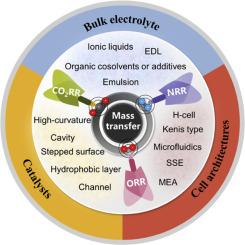
Electrochemical reduction of air-abundant molecules (e.g., CO2, N2, and O2) offers a sustainable solution to address global energy and environmental challenges, where high current density and energy efficiency are highly desirable. However, commercially-relevant current density will cause dramatic change of cation, solvent, pH, and reactant molecular distribution near electrode, resulting in severe concentration polarization and sluggish reaction kinetics. In this case, mass transfer such as molecule migration pathway in electrolytes, electrodes, and devices need to be rationally designed and systematically optimized. Here this review will present a systematical introduction on regulating mass transfer on electrochemical fixation of air-abundant molecules. We firstly discuss the fundamental mass transport from bulk electrolyte to catalyst surface and within electric double layer (EDL) and review the recent advances in regulating mass transport behaviors and optimizing strategy of mass transfer on the catalytic surface. Then we compare the mass transport differences among different cell architectures combining with innovative prospect for transfer pathway towards breaking natural limitation of gas solubility over electroactive interfaces. It is expected that this review can inspire research on comprehensive understanding of fundamental mass transport mechanism at catalyst/electrolyte interface and shed light on optimizing the catalytical device towards practical application for electrochemical fixation of air-abundant molecules.
期刊介绍:
Chinese Chemical Letters (CCL) (ISSN 1001-8417) was founded in July 1990. The journal publishes preliminary accounts in the whole field of chemistry, including inorganic chemistry, organic chemistry, analytical chemistry, physical chemistry, polymer chemistry, applied chemistry, etc.Chinese Chemical Letters does not accept articles previously published or scheduled to be published. To verify originality, your article may be checked by the originality detection service CrossCheck.




 京公网安备 11010802042870号
京ICP备2023020795号-1
京公网安备 11010802042870号
京ICP备2023020795号-1

 分享
分享
 求助内容:
求助内容: 应助结果提醒方式:
 扫码关注我们
