Shanyuan Bi , Jin Zhang , Dengchao Peng, Danhong Cheng, Jianping Zhang, Lupeng Han, Dengsong Zhang
{"title":"蚀刻 ZSM-5 支承氧化锰铈催化剂在低温氮氧化物还原过程中提高了 N2 选择性","authors":"Shanyuan Bi , Jin Zhang , Dengchao Peng, Danhong Cheng, Jianping Zhang, Lupeng Han, Dengsong Zhang","doi":"10.1016/j.cclet.2024.110295","DOIUrl":null,"url":null,"abstract":"<div><div>Developing a high-efficiency catalyst with both superior low-temperature activity and good N<sub>2</sub> selectivity is still challenging for the NH<sub>3</sub> selective catalytic reduction (SCR) of NO<sub>x</sub> from mobile sources. Herein, we demonstrate the improved low-temperature activity and N<sub>2</sub> selectivity by regulating the redox and acidic properties of MnCe oxides supported on etched ZSM-5 supports. The etched ZSM-5 enables the highly dispersed state of MnCeO<sub>x</sub> species and strong interaction between Mn and Ce species, which promotes the reduction of CeO<sub>2</sub>, facilitates electron transfer from Mn to Ce, and generates more Mn<sup>4+</sup> and Ce<sup>3+</sup> species. The strong redox capacity contributes to forming the reactive nitrate species and -NH<sub>2</sub> species from oxidative dehydrogenation of NH<sub>3</sub>. Moreover, the adsorbed NH<sub>3</sub> and -NH<sub>2</sub> species are the reactive intermediates that promote the formation of N<sub>2</sub>. This work demonstrates an effective strategy to enhance the low-temperature activity and N<sub>2</sub> selectivity of SCR catalysts, contributing to the NO<sub>x</sub> control for the low-temperature exhaust gas during the cold-start of diesel vehicles.</div></div>","PeriodicalId":10088,"journal":{"name":"Chinese Chemical Letters","volume":"36 5","pages":"Article 110295"},"PeriodicalIF":8.9000,"publicationDate":"2025-05-01","publicationTypes":"Journal Article","fieldsOfStudy":null,"isOpenAccess":false,"openAccessPdf":"","citationCount":"0","resultStr":"{\"title\":\"Improved N2 selectivity for low-temperature NOx reduction over etched ZSM-5 supported MnCe oxide catalysts\",\"authors\":\"Shanyuan Bi , Jin Zhang , Dengchao Peng, Danhong Cheng, Jianping Zhang, Lupeng Han, Dengsong Zhang\",\"doi\":\"10.1016/j.cclet.2024.110295\",\"DOIUrl\":null,\"url\":null,\"abstract\":\"<div><div>Developing a high-efficiency catalyst with both superior low-temperature activity and good N<sub>2</sub> selectivity is still challenging for the NH<sub>3</sub> selective catalytic reduction (SCR) of NO<sub>x</sub> from mobile sources. Herein, we demonstrate the improved low-temperature activity and N<sub>2</sub> selectivity by regulating the redox and acidic properties of MnCe oxides supported on etched ZSM-5 supports. The etched ZSM-5 enables the highly dispersed state of MnCeO<sub>x</sub> species and strong interaction between Mn and Ce species, which promotes the reduction of CeO<sub>2</sub>, facilitates electron transfer from Mn to Ce, and generates more Mn<sup>4+</sup> and Ce<sup>3+</sup> species. The strong redox capacity contributes to forming the reactive nitrate species and -NH<sub>2</sub> species from oxidative dehydrogenation of NH<sub>3</sub>. Moreover, the adsorbed NH<sub>3</sub> and -NH<sub>2</sub> species are the reactive intermediates that promote the formation of N<sub>2</sub>. This work demonstrates an effective strategy to enhance the low-temperature activity and N<sub>2</sub> selectivity of SCR catalysts, contributing to the NO<sub>x</sub> control for the low-temperature exhaust gas during the cold-start of diesel vehicles.</div></div>\",\"PeriodicalId\":10088,\"journal\":{\"name\":\"Chinese Chemical Letters\",\"volume\":\"36 5\",\"pages\":\"Article 110295\"},\"PeriodicalIF\":8.9000,\"publicationDate\":\"2025-05-01\",\"publicationTypes\":\"Journal Article\",\"fieldsOfStudy\":null,\"isOpenAccess\":false,\"openAccessPdf\":\"\",\"citationCount\":\"0\",\"resultStr\":null,\"platform\":\"Semanticscholar\",\"paperid\":null,\"PeriodicalName\":\"Chinese Chemical Letters\",\"FirstCategoryId\":\"92\",\"ListUrlMain\":\"https://www.sciencedirect.com/science/article/pii/S1001841724008143\",\"RegionNum\":1,\"RegionCategory\":\"化学\",\"ArticlePicture\":[],\"TitleCN\":null,\"AbstractTextCN\":null,\"PMCID\":null,\"EPubDate\":\"2024/7/25 0:00:00\",\"PubModel\":\"Epub\",\"JCR\":\"Q1\",\"JCRName\":\"CHEMISTRY, MULTIDISCIPLINARY\",\"Score\":null,\"Total\":0}","platform":"Semanticscholar","paperid":null,"PeriodicalName":"Chinese Chemical Letters","FirstCategoryId":"92","ListUrlMain":"https://www.sciencedirect.com/science/article/pii/S1001841724008143","RegionNum":1,"RegionCategory":"化学","ArticlePicture":[],"TitleCN":null,"AbstractTextCN":null,"PMCID":null,"EPubDate":"2024/7/25 0:00:00","PubModel":"Epub","JCR":"Q1","JCRName":"CHEMISTRY, MULTIDISCIPLINARY","Score":null,"Total":0}
Improved N2 selectivity for low-temperature NOx reduction over etched ZSM-5 supported MnCe oxide catalysts
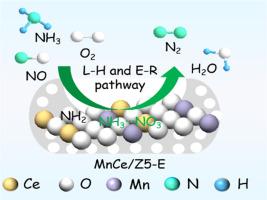
Developing a high-efficiency catalyst with both superior low-temperature activity and good N2 selectivity is still challenging for the NH3 selective catalytic reduction (SCR) of NOx from mobile sources. Herein, we demonstrate the improved low-temperature activity and N2 selectivity by regulating the redox and acidic properties of MnCe oxides supported on etched ZSM-5 supports. The etched ZSM-5 enables the highly dispersed state of MnCeOx species and strong interaction between Mn and Ce species, which promotes the reduction of CeO2, facilitates electron transfer from Mn to Ce, and generates more Mn4+ and Ce3+ species. The strong redox capacity contributes to forming the reactive nitrate species and -NH2 species from oxidative dehydrogenation of NH3. Moreover, the adsorbed NH3 and -NH2 species are the reactive intermediates that promote the formation of N2. This work demonstrates an effective strategy to enhance the low-temperature activity and N2 selectivity of SCR catalysts, contributing to the NOx control for the low-temperature exhaust gas during the cold-start of diesel vehicles.
期刊介绍:
Chinese Chemical Letters (CCL) (ISSN 1001-8417) was founded in July 1990. The journal publishes preliminary accounts in the whole field of chemistry, including inorganic chemistry, organic chemistry, analytical chemistry, physical chemistry, polymer chemistry, applied chemistry, etc.Chinese Chemical Letters does not accept articles previously published or scheduled to be published. To verify originality, your article may be checked by the originality detection service CrossCheck.




 京公网安备 11010802042870号
京ICP备2023020795号-1
京公网安备 11010802042870号
京ICP备2023020795号-1

 分享
分享
 求助内容:
求助内容: 应助结果提醒方式:
 扫码关注我们
