Junjie Wang, Alexander F. Bouwman, Lauriane Vilmin, Arthur H. W. Beusen, Wim J. van Hoek, Xiaochen Liu, Jack J. Middelburg
{"title":"人类世加速了全球内陆水域的氮循环","authors":"Junjie Wang, Alexander F. Bouwman, Lauriane Vilmin, Arthur H. W. Beusen, Wim J. van Hoek, Xiaochen Liu, Jack J. Middelburg","doi":"10.1038/s44221-024-00282-x","DOIUrl":null,"url":null,"abstract":"Inland waters are an important component of the global nitrogen (N) cycle, functioning not only as land-to-sea transporters but also as active biogeochemical reactors. However, the latter role is not well understood regarding mechanisms, quantities or on a global scale. It remains unclear whether, when, how and why global inland-water biogeochemical N cycling has changed. Here we analyse the dynamic global inland-water N cycling processes in the Anthropocene by quantifying the long-term changes in different N forms, including their inputs to inland waters, transformation pathways, retention within inland waters, and river export to oceans. Using a spatially explicit, mechanistic, coupled hydrology and biogeochemistry model, we show that, during 1900–2010, the increase in total nitrogen (TN) river loading (from 27 to 68 Tg yr−1) resulted in an increase in TN export to oceans (from 20 to 42 Tg yr−1), despite an increase in inland-water retention (from 25% to 39%) primarily due to gaseous loss and burial. Moreover, the relative contributions of ammonium (NH4+), nitrate/nitrite (NOx−) and organic nitrogen (ON) changed because of threefold increases in global inland-water mineralization (transforming ON to NH4+) and N burial in sediments, a fourfold increase in nitrification (transforming NH4+ to NOx−) and a sixfold increase in denitrification (transforming NOx− to mainly N2). This Article presents a comprehensive analysis of the dynamic global inland-water N cycling processes using a coupled model of hydrology, nutrient loading and biogeochemical transformation, showing that N export increased more slowly than loading due to increased inland-water retention via enhanced transformation and burial.","PeriodicalId":74252,"journal":{"name":"Nature water","volume":"2 8","pages":"729-740"},"PeriodicalIF":30.7000,"publicationDate":"2024-08-09","publicationTypes":"Journal Article","fieldsOfStudy":null,"isOpenAccess":false,"openAccessPdf":"","citationCount":"0","resultStr":"{\"title\":\"Global inland-water nitrogen cycling has accelerated in the Anthropocene\",\"authors\":\"Junjie Wang, Alexander F. Bouwman, Lauriane Vilmin, Arthur H. W. Beusen, Wim J. van Hoek, Xiaochen Liu, Jack J. Middelburg\",\"doi\":\"10.1038/s44221-024-00282-x\",\"DOIUrl\":null,\"url\":null,\"abstract\":\"Inland waters are an important component of the global nitrogen (N) cycle, functioning not only as land-to-sea transporters but also as active biogeochemical reactors. However, the latter role is not well understood regarding mechanisms, quantities or on a global scale. It remains unclear whether, when, how and why global inland-water biogeochemical N cycling has changed. Here we analyse the dynamic global inland-water N cycling processes in the Anthropocene by quantifying the long-term changes in different N forms, including their inputs to inland waters, transformation pathways, retention within inland waters, and river export to oceans. Using a spatially explicit, mechanistic, coupled hydrology and biogeochemistry model, we show that, during 1900–2010, the increase in total nitrogen (TN) river loading (from 27 to 68 Tg yr−1) resulted in an increase in TN export to oceans (from 20 to 42 Tg yr−1), despite an increase in inland-water retention (from 25% to 39%) primarily due to gaseous loss and burial. Moreover, the relative contributions of ammonium (NH4+), nitrate/nitrite (NOx−) and organic nitrogen (ON) changed because of threefold increases in global inland-water mineralization (transforming ON to NH4+) and N burial in sediments, a fourfold increase in nitrification (transforming NH4+ to NOx−) and a sixfold increase in denitrification (transforming NOx− to mainly N2). This Article presents a comprehensive analysis of the dynamic global inland-water N cycling processes using a coupled model of hydrology, nutrient loading and biogeochemical transformation, showing that N export increased more slowly than loading due to increased inland-water retention via enhanced transformation and burial.\",\"PeriodicalId\":74252,\"journal\":{\"name\":\"Nature water\",\"volume\":\"2 8\",\"pages\":\"729-740\"},\"PeriodicalIF\":30.7000,\"publicationDate\":\"2024-08-09\",\"publicationTypes\":\"Journal Article\",\"fieldsOfStudy\":null,\"isOpenAccess\":false,\"openAccessPdf\":\"\",\"citationCount\":\"0\",\"resultStr\":null,\"platform\":\"Semanticscholar\",\"paperid\":null,\"PeriodicalName\":\"Nature water\",\"FirstCategoryId\":\"1085\",\"ListUrlMain\":\"https://www.nature.com/articles/s44221-024-00282-x\",\"RegionNum\":0,\"RegionCategory\":null,\"ArticlePicture\":[],\"TitleCN\":null,\"AbstractTextCN\":null,\"PMCID\":null,\"EPubDate\":\"\",\"PubModel\":\"\",\"JCR\":\"\",\"JCRName\":\"\",\"Score\":null,\"Total\":0}","platform":"Semanticscholar","paperid":null,"PeriodicalName":"Nature water","FirstCategoryId":"1085","ListUrlMain":"https://www.nature.com/articles/s44221-024-00282-x","RegionNum":0,"RegionCategory":null,"ArticlePicture":[],"TitleCN":null,"AbstractTextCN":null,"PMCID":null,"EPubDate":"","PubModel":"","JCR":"","JCRName":"","Score":null,"Total":0}
Global inland-water nitrogen cycling has accelerated in the Anthropocene
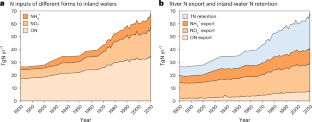
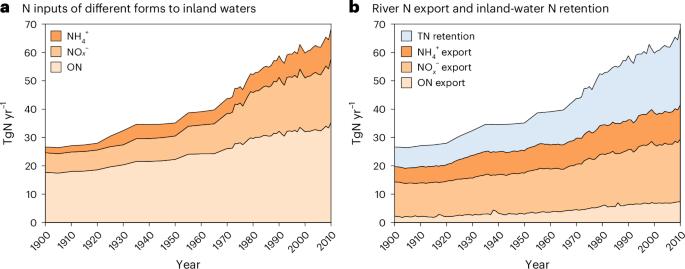
Inland waters are an important component of the global nitrogen (N) cycle, functioning not only as land-to-sea transporters but also as active biogeochemical reactors. However, the latter role is not well understood regarding mechanisms, quantities or on a global scale. It remains unclear whether, when, how and why global inland-water biogeochemical N cycling has changed. Here we analyse the dynamic global inland-water N cycling processes in the Anthropocene by quantifying the long-term changes in different N forms, including their inputs to inland waters, transformation pathways, retention within inland waters, and river export to oceans. Using a spatially explicit, mechanistic, coupled hydrology and biogeochemistry model, we show that, during 1900–2010, the increase in total nitrogen (TN) river loading (from 27 to 68 Tg yr−1) resulted in an increase in TN export to oceans (from 20 to 42 Tg yr−1), despite an increase in inland-water retention (from 25% to 39%) primarily due to gaseous loss and burial. Moreover, the relative contributions of ammonium (NH4+), nitrate/nitrite (NOx−) and organic nitrogen (ON) changed because of threefold increases in global inland-water mineralization (transforming ON to NH4+) and N burial in sediments, a fourfold increase in nitrification (transforming NH4+ to NOx−) and a sixfold increase in denitrification (transforming NOx− to mainly N2). This Article presents a comprehensive analysis of the dynamic global inland-water N cycling processes using a coupled model of hydrology, nutrient loading and biogeochemical transformation, showing that N export increased more slowly than loading due to increased inland-water retention via enhanced transformation and burial.




 京公网安备 11010802042870号
京ICP备2023020795号-1
京公网安备 11010802042870号
京ICP备2023020795号-1

 分享
分享

 求助内容:
求助内容: 应助结果提醒方式:
 扫码关注我们
