{"title":"恶意软件传播下的工业物联网可用性评估:基于随机博弈的扩展可靠性框图方法","authors":"Shoujian Yu;Ouwen Jin;Yizhou Shen;Guowen Wu;Shui Yu;Shigen Shen","doi":"10.1109/TR.2024.3434593","DOIUrl":null,"url":null,"abstract":"The rise of the industrial Internet of Things (IIoT) has enhanced industrial processes through interconnected devices and data exchange, but it also introduces significant security vulnerabilities, such as malware attacks, which threaten system reliability and availability. To address this challenge, we extend the traditional reliability block diagram (RBD) method by integrating stochastic games to evaluate the security and availability of IIoT systems. Our approach constructs a comprehensive Markov transition matrix using additional node states, enabling detailed simulations of malware spread in IIoT networks. By modeling the interactions between malware and IIoT systems through stochastic games, we propose an innovative reinforcement learning algorithm named evaluation-driven Q-learning (EDQL) to solve these complex scenarios. This novel application of EDQL in the realm of availability evaluation is a significant contribution, providing a rare integration of game theory into this field. We also derive the availability of individual IIoT nodes using reliability theory and integrate these insights into the RBD framework. Experimental results demonstrate that the EDQL algorithm significantly outperforms traditional reinforcement learning methods in malware reward. Furthermore, our method effectively evaluates common IIoT topologies and offers practical deployment recommendations, highlighting its practical impact and significance in enhancing IIoT system security and availability.","PeriodicalId":56305,"journal":{"name":"IEEE Transactions on Reliability","volume":"74 3","pages":"4253-4267"},"PeriodicalIF":5.4000,"publicationDate":"2024-08-08","publicationTypes":"Journal Article","fieldsOfStudy":null,"isOpenAccess":false,"openAccessPdf":"","citationCount":"0","resultStr":"{\"title\":\"Availability Evaluation of Industrial Internet of Things Under Malware Propagation: An Extended Reliability Block Diagram Approach Based on Stochastic Games\",\"authors\":\"Shoujian Yu;Ouwen Jin;Yizhou Shen;Guowen Wu;Shui Yu;Shigen Shen\",\"doi\":\"10.1109/TR.2024.3434593\",\"DOIUrl\":null,\"url\":null,\"abstract\":\"The rise of the industrial Internet of Things (IIoT) has enhanced industrial processes through interconnected devices and data exchange, but it also introduces significant security vulnerabilities, such as malware attacks, which threaten system reliability and availability. To address this challenge, we extend the traditional reliability block diagram (RBD) method by integrating stochastic games to evaluate the security and availability of IIoT systems. Our approach constructs a comprehensive Markov transition matrix using additional node states, enabling detailed simulations of malware spread in IIoT networks. By modeling the interactions between malware and IIoT systems through stochastic games, we propose an innovative reinforcement learning algorithm named evaluation-driven Q-learning (EDQL) to solve these complex scenarios. This novel application of EDQL in the realm of availability evaluation is a significant contribution, providing a rare integration of game theory into this field. We also derive the availability of individual IIoT nodes using reliability theory and integrate these insights into the RBD framework. Experimental results demonstrate that the EDQL algorithm significantly outperforms traditional reinforcement learning methods in malware reward. Furthermore, our method effectively evaluates common IIoT topologies and offers practical deployment recommendations, highlighting its practical impact and significance in enhancing IIoT system security and availability.\",\"PeriodicalId\":56305,\"journal\":{\"name\":\"IEEE Transactions on Reliability\",\"volume\":\"74 3\",\"pages\":\"4253-4267\"},\"PeriodicalIF\":5.4000,\"publicationDate\":\"2024-08-08\",\"publicationTypes\":\"Journal Article\",\"fieldsOfStudy\":null,\"isOpenAccess\":false,\"openAccessPdf\":\"\",\"citationCount\":\"0\",\"resultStr\":null,\"platform\":\"Semanticscholar\",\"paperid\":null,\"PeriodicalName\":\"IEEE Transactions on Reliability\",\"FirstCategoryId\":\"94\",\"ListUrlMain\":\"https://ieeexplore.ieee.org/document/10631167/\",\"RegionNum\":2,\"RegionCategory\":\"计算机科学\",\"ArticlePicture\":[],\"TitleCN\":null,\"AbstractTextCN\":null,\"PMCID\":null,\"EPubDate\":\"\",\"PubModel\":\"\",\"JCR\":\"Q1\",\"JCRName\":\"COMPUTER SCIENCE, HARDWARE & ARCHITECTURE\",\"Score\":null,\"Total\":0}","platform":"Semanticscholar","paperid":null,"PeriodicalName":"IEEE Transactions on Reliability","FirstCategoryId":"94","ListUrlMain":"https://ieeexplore.ieee.org/document/10631167/","RegionNum":2,"RegionCategory":"计算机科学","ArticlePicture":[],"TitleCN":null,"AbstractTextCN":null,"PMCID":null,"EPubDate":"","PubModel":"","JCR":"Q1","JCRName":"COMPUTER SCIENCE, HARDWARE & ARCHITECTURE","Score":null,"Total":0}
Availability Evaluation of Industrial Internet of Things Under Malware Propagation: An Extended Reliability Block Diagram Approach Based on Stochastic Games
The rise of the industrial Internet of Things (IIoT) has enhanced industrial processes through interconnected devices and data exchange, but it also introduces significant security vulnerabilities, such as malware attacks, which threaten system reliability and availability. To address this challenge, we extend the traditional reliability block diagram (RBD) method by integrating stochastic games to evaluate the security and availability of IIoT systems. Our approach constructs a comprehensive Markov transition matrix using additional node states, enabling detailed simulations of malware spread in IIoT networks. By modeling the interactions between malware and IIoT systems through stochastic games, we propose an innovative reinforcement learning algorithm named evaluation-driven Q-learning (EDQL) to solve these complex scenarios. This novel application of EDQL in the realm of availability evaluation is a significant contribution, providing a rare integration of game theory into this field. We also derive the availability of individual IIoT nodes using reliability theory and integrate these insights into the RBD framework. Experimental results demonstrate that the EDQL algorithm significantly outperforms traditional reinforcement learning methods in malware reward. Furthermore, our method effectively evaluates common IIoT topologies and offers practical deployment recommendations, highlighting its practical impact and significance in enhancing IIoT system security and availability.
期刊介绍:
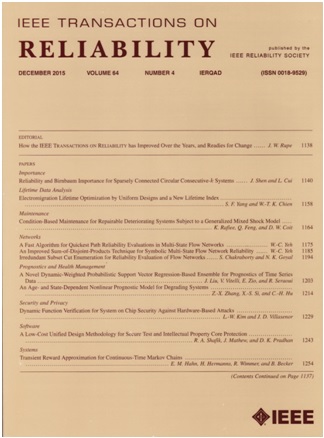
IEEE Transactions on Reliability is a refereed journal for the reliability and allied disciplines including, but not limited to, maintainability, physics of failure, life testing, prognostics, design and manufacture for reliability, reliability for systems of systems, network availability, mission success, warranty, safety, and various measures of effectiveness. Topics eligible for publication range from hardware to software, from materials to systems, from consumer and industrial devices to manufacturing plants, from individual items to networks, from techniques for making things better to ways of predicting and measuring behavior in the field. As an engineering subject that supports new and existing technologies, we constantly expand into new areas of the assurance sciences.




 京公网安备 11010802042870号
京ICP备2023020795号-1
京公网安备 11010802042870号
京ICP备2023020795号-1

 分享
分享
 求助内容:
求助内容: 应助结果提醒方式:
 扫码关注我们
