Edward J. Hardy, Joseph J. Bass, Thomas B. Inns, Mathew Piasecki, Jessica Piasecki, Craig Sale, Robert H. Morris, Jonathan N. Lund, Ken Smith, Daniel J. Wilkinson, Philip J. Atherton, Bethan E. Phillips
{"title":"探索超声波评估小腿不同肌肉废用性萎缩的实用性。","authors":"Edward J. Hardy, Joseph J. Bass, Thomas B. Inns, Mathew Piasecki, Jessica Piasecki, Craig Sale, Robert H. Morris, Jonathan N. Lund, Ken Smith, Daniel J. Wilkinson, Philip J. Atherton, Bethan E. Phillips","doi":"10.1002/jcsm.13583","DOIUrl":null,"url":null,"abstract":"<div>\n \n \n <section>\n \n <h3> Background</h3>\n \n <p>Skeletal muscle is a highly plastic tissue crucial for many functions associated with whole-body health across the life course. Magnetic resonance imaging (MRI) is the current gold standard for measuring skeletal muscle size. However, MRI is expensive, and access to facilities is often limited. B-mode ultrasonography (U/S) has been proposed as a potential alternative to MRI for the assessment of muscle size. However, to date, no work has explored the utility of U/S to assess disuse muscle atrophy (DMA) across muscles with different atrophy susceptibility profiles, an omission which may limit the clinical application of previous work.</p>\n </section>\n \n <section>\n \n <h3> Methods</h3>\n \n <p>To address this significant knowledge gap, 10 young men (22 ± years, 24.1 ± 2.3 kg/m<sup>2</sup>) underwent 15-day unilateral leg immobilization using a knee-brace and air boot. Cross-sectional area (CSA) and muscle thickness (MT) of the tibialis anterior (TA) and medial gastrocnemius (MG) were assessed via U/S before and after immobilization, with CSA and muscle volume assessed via MRI.</p>\n </section>\n \n <section>\n \n <h3> Results</h3>\n \n <p>With both muscles combined, there were good correlations between each U/S and MRI measure, both before (e.g., CSA<sub>MRI</sub> vs. MT<sub>U/S</sub> and CSA<sub>U/S</sub>: <i>r</i> = 0.88 and 0.94, respectively, both <i>P</i> < 0.0001) and after (e.g., VOL<sub>MRI</sub> vs. MT<sub>U/S</sub> and CSA<sub>U/S</sub>: <i>r</i> = 0.90 and 0.96, respectively, both <i>P</i> < 0.0001) immobilization. The relationship between the methods was notably stronger for MG than TA at each time-point (e.g., CSA<sub>MRI</sub> vs. MT<sub>U/S</sub>: MG, <i>r</i> = 0.70, <i>P</i> = 0.0006; TA, <i>r</i> = 0.37, <i>P</i> = 0.10). There was no relationship between the degree of DMA determined by the two methods in either muscle (e.g., TA pre- vs. post-immobilization, VOL<sub>MRI</sub>: 136 ± 6 vs. 133 ± 5, <i>P</i> = 0.08; CSA<sub>U/S</sub>: 6.05 ± 0.3 vs. 5.92 ± 0.4, <i>P</i> = 0.70; relationship between methods: <i>r</i> = 0.12, <i>P</i> = 0.75).</p>\n </section>\n \n <section>\n \n <h3> Conclusions</h3>\n \n <p>Both MT<sub>U/S</sub> and CSA<sub>U/S</sub> provide comparable static measures of lower leg muscle size compared with MRI, albeit with weaker agreement in TA compared to MG. Although both MT<sub>U/S</sub> and CSA<sub>U/S</sub> can discern differences in DMA susceptibility between muscles, neither can reliably assess degree of DMA. Based on the growing recognition of heterogeneous atrophy profiles between muscles, and the topical importance of less commonly studied muscles (i.e., TA for falls prevention in older adults), future research should aim to optimize accessible methods to determine muscle losses across the body.</p>\n </section>\n </div>","PeriodicalId":48911,"journal":{"name":"Journal of Cachexia Sarcopenia and Muscle","volume":"15 6","pages":"2487-2496"},"PeriodicalIF":9.1000,"publicationDate":"2024-08-26","publicationTypes":"Journal Article","fieldsOfStudy":null,"isOpenAccess":false,"openAccessPdf":"https://www.ncbi.nlm.nih.gov/pmc/articles/PMC11634512/pdf/","citationCount":"0","resultStr":"{\"title\":\"Exploring the utility of ultrasound to assess disuse atrophy in different muscles of the lower leg\",\"authors\":\"Edward J. Hardy, Joseph J. Bass, Thomas B. Inns, Mathew Piasecki, Jessica Piasecki, Craig Sale, Robert H. Morris, Jonathan N. Lund, Ken Smith, Daniel J. Wilkinson, Philip J. Atherton, Bethan E. Phillips\",\"doi\":\"10.1002/jcsm.13583\",\"DOIUrl\":null,\"url\":null,\"abstract\":\"<div>\\n \\n \\n <section>\\n \\n <h3> Background</h3>\\n \\n <p>Skeletal muscle is a highly plastic tissue crucial for many functions associated with whole-body health across the life course. Magnetic resonance imaging (MRI) is the current gold standard for measuring skeletal muscle size. However, MRI is expensive, and access to facilities is often limited. B-mode ultrasonography (U/S) has been proposed as a potential alternative to MRI for the assessment of muscle size. However, to date, no work has explored the utility of U/S to assess disuse muscle atrophy (DMA) across muscles with different atrophy susceptibility profiles, an omission which may limit the clinical application of previous work.</p>\\n </section>\\n \\n <section>\\n \\n <h3> Methods</h3>\\n \\n <p>To address this significant knowledge gap, 10 young men (22 ± years, 24.1 ± 2.3 kg/m<sup>2</sup>) underwent 15-day unilateral leg immobilization using a knee-brace and air boot. Cross-sectional area (CSA) and muscle thickness (MT) of the tibialis anterior (TA) and medial gastrocnemius (MG) were assessed via U/S before and after immobilization, with CSA and muscle volume assessed via MRI.</p>\\n </section>\\n \\n <section>\\n \\n <h3> Results</h3>\\n \\n <p>With both muscles combined, there were good correlations between each U/S and MRI measure, both before (e.g., CSA<sub>MRI</sub> vs. MT<sub>U/S</sub> and CSA<sub>U/S</sub>: <i>r</i> = 0.88 and 0.94, respectively, both <i>P</i> < 0.0001) and after (e.g., VOL<sub>MRI</sub> vs. MT<sub>U/S</sub> and CSA<sub>U/S</sub>: <i>r</i> = 0.90 and 0.96, respectively, both <i>P</i> < 0.0001) immobilization. The relationship between the methods was notably stronger for MG than TA at each time-point (e.g., CSA<sub>MRI</sub> vs. MT<sub>U/S</sub>: MG, <i>r</i> = 0.70, <i>P</i> = 0.0006; TA, <i>r</i> = 0.37, <i>P</i> = 0.10). There was no relationship between the degree of DMA determined by the two methods in either muscle (e.g., TA pre- vs. post-immobilization, VOL<sub>MRI</sub>: 136 ± 6 vs. 133 ± 5, <i>P</i> = 0.08; CSA<sub>U/S</sub>: 6.05 ± 0.3 vs. 5.92 ± 0.4, <i>P</i> = 0.70; relationship between methods: <i>r</i> = 0.12, <i>P</i> = 0.75).</p>\\n </section>\\n \\n <section>\\n \\n <h3> Conclusions</h3>\\n \\n <p>Both MT<sub>U/S</sub> and CSA<sub>U/S</sub> provide comparable static measures of lower leg muscle size compared with MRI, albeit with weaker agreement in TA compared to MG. Although both MT<sub>U/S</sub> and CSA<sub>U/S</sub> can discern differences in DMA susceptibility between muscles, neither can reliably assess degree of DMA. Based on the growing recognition of heterogeneous atrophy profiles between muscles, and the topical importance of less commonly studied muscles (i.e., TA for falls prevention in older adults), future research should aim to optimize accessible methods to determine muscle losses across the body.</p>\\n </section>\\n </div>\",\"PeriodicalId\":48911,\"journal\":{\"name\":\"Journal of Cachexia Sarcopenia and Muscle\",\"volume\":\"15 6\",\"pages\":\"2487-2496\"},\"PeriodicalIF\":9.1000,\"publicationDate\":\"2024-08-26\",\"publicationTypes\":\"Journal Article\",\"fieldsOfStudy\":null,\"isOpenAccess\":false,\"openAccessPdf\":\"https://www.ncbi.nlm.nih.gov/pmc/articles/PMC11634512/pdf/\",\"citationCount\":\"0\",\"resultStr\":null,\"platform\":\"Semanticscholar\",\"paperid\":null,\"PeriodicalName\":\"Journal of Cachexia Sarcopenia and Muscle\",\"FirstCategoryId\":\"3\",\"ListUrlMain\":\"https://onlinelibrary.wiley.com/doi/10.1002/jcsm.13583\",\"RegionNum\":1,\"RegionCategory\":\"医学\",\"ArticlePicture\":[],\"TitleCN\":null,\"AbstractTextCN\":null,\"PMCID\":null,\"EPubDate\":\"\",\"PubModel\":\"\",\"JCR\":\"Q1\",\"JCRName\":\"GERIATRICS & GERONTOLOGY\",\"Score\":null,\"Total\":0}","platform":"Semanticscholar","paperid":null,"PeriodicalName":"Journal of Cachexia Sarcopenia and Muscle","FirstCategoryId":"3","ListUrlMain":"https://onlinelibrary.wiley.com/doi/10.1002/jcsm.13583","RegionNum":1,"RegionCategory":"医学","ArticlePicture":[],"TitleCN":null,"AbstractTextCN":null,"PMCID":null,"EPubDate":"","PubModel":"","JCR":"Q1","JCRName":"GERIATRICS & GERONTOLOGY","Score":null,"Total":0}
Exploring the utility of ultrasound to assess disuse atrophy in different muscles of the lower leg
Background
Skeletal muscle is a highly plastic tissue crucial for many functions associated with whole-body health across the life course. Magnetic resonance imaging (MRI) is the current gold standard for measuring skeletal muscle size. However, MRI is expensive, and access to facilities is often limited. B-mode ultrasonography (U/S) has been proposed as a potential alternative to MRI for the assessment of muscle size. However, to date, no work has explored the utility of U/S to assess disuse muscle atrophy (DMA) across muscles with different atrophy susceptibility profiles, an omission which may limit the clinical application of previous work.
Methods
To address this significant knowledge gap, 10 young men (22 ± years, 24.1 ± 2.3 kg/m2) underwent 15-day unilateral leg immobilization using a knee-brace and air boot. Cross-sectional area (CSA) and muscle thickness (MT) of the tibialis anterior (TA) and medial gastrocnemius (MG) were assessed via U/S before and after immobilization, with CSA and muscle volume assessed via MRI.
Results
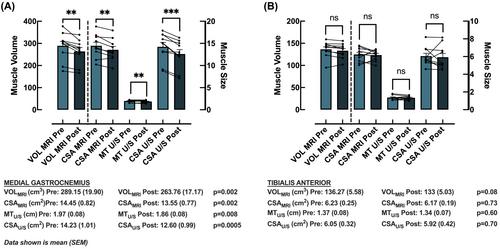
With both muscles combined, there were good correlations between each U/S and MRI measure, both before (e.g., CSAMRI vs. MTU/S and CSAU/S: r = 0.88 and 0.94, respectively, both P < 0.0001) and after (e.g., VOLMRI vs. MTU/S and CSAU/S: r = 0.90 and 0.96, respectively, both P < 0.0001) immobilization. The relationship between the methods was notably stronger for MG than TA at each time-point (e.g., CSAMRI vs. MTU/S: MG, r = 0.70, P = 0.0006; TA, r = 0.37, P = 0.10). There was no relationship between the degree of DMA determined by the two methods in either muscle (e.g., TA pre- vs. post-immobilization, VOLMRI: 136 ± 6 vs. 133 ± 5, P = 0.08; CSAU/S: 6.05 ± 0.3 vs. 5.92 ± 0.4, P = 0.70; relationship between methods: r = 0.12, P = 0.75).
Conclusions
Both MTU/S and CSAU/S provide comparable static measures of lower leg muscle size compared with MRI, albeit with weaker agreement in TA compared to MG. Although both MTU/S and CSAU/S can discern differences in DMA susceptibility between muscles, neither can reliably assess degree of DMA. Based on the growing recognition of heterogeneous atrophy profiles between muscles, and the topical importance of less commonly studied muscles (i.e., TA for falls prevention in older adults), future research should aim to optimize accessible methods to determine muscle losses across the body.
期刊介绍:
The Journal of Cachexia, Sarcopenia and Muscle is a peer-reviewed international journal dedicated to publishing materials related to cachexia and sarcopenia, as well as body composition and its physiological and pathophysiological changes across the lifespan and in response to various illnesses from all fields of life sciences. The journal aims to provide a reliable resource for professionals interested in related research or involved in the clinical care of affected patients, such as those suffering from AIDS, cancer, chronic heart failure, chronic lung disease, liver cirrhosis, chronic kidney failure, rheumatoid arthritis, or sepsis.




 京公网安备 11010802042870号
京ICP备2023020795号-1
京公网安备 11010802042870号
京ICP备2023020795号-1

 分享
分享
 求助内容:
求助内容: 应助结果提醒方式:
 扫码关注我们
