Henri Lu, Brian L. Claggett, Milton Packer, Marc A. Pfeffer, Carolyn S.P. Lam, Michael R. Zile, Akshay S. Desai, Pardeep Jhund, Martin Lefkowitz, John J.V. McMurray, Scott D. Solomon, Muthiah Vaduganathan
{"title":"沙库比特利/缬沙坦可减少心力衰竭患者的贫血和铁剂使用:PARAGON-HF 试验","authors":"Henri Lu, Brian L. Claggett, Milton Packer, Marc A. Pfeffer, Carolyn S.P. Lam, Michael R. Zile, Akshay S. Desai, Pardeep Jhund, Martin Lefkowitz, John J.V. McMurray, Scott D. Solomon, Muthiah Vaduganathan","doi":"10.1002/ejhf.3414","DOIUrl":null,"url":null,"abstract":"<div>\n \n \n <section>\n \n <h3> Aims</h3>\n \n <p>Renin–angiotensin system inhibitors (RASi) have been shown to lower haemoglobin levels, potentially related to reductions in erythropoietin levels and haematopoiesis. We examined whether sacubitril/valsartan might attenuate this effect of RASi alone on incident anaemia in patients with heart failure (HF) with mildly reduced or preserved ejection fraction (HFmrEF/HFpEF).</p>\n </section>\n \n <section>\n \n <h3> Methods and results</h3>\n \n <p>PARAGON-HF was a global, multicentre randomized clinical trial of sacubitril/valsartan versus the RASi valsartan in patients with HF and left ventricular ejection fraction ≥45%. We evaluated haemoglobin trajectory and risks of incident anaemia and new iron therapy initiation during follow-up. Among 4795 participants, 1111 (23.2%) had anaemia at randomization and 5.6% were treated with iron at baseline. Over a median follow-up of 2.9 years, patients with anaemia were at significantly higher risk for total HF hospitalizations and cardiovascular death, compared with those without anaemia (21.6 vs. 11.5 per 100 patient-years; adjusted rate ratio 1.31; 95% confidence interval [CI] 1.12–1.54; <i>p</i> = 0.001). Sacubitril/valsartan slightly slowed the decline in haemoglobin levels by 0.1 g/dl (95% CI 0.0–0.2 g/dl; <i>p =</i> 0.005). Participants treated with sacubitril/valsartan were at significantly lower risk of developing anaemia (30.3% vs. 37.6%; hazard ratio [HR] 0.76; 95% CI 0.68–0.85; <i>p <</i> 0.001) and starting iron therapy (8.1% vs. 10.0%; HR 0.81; 95% CI 0.67–0.97; <i>p</i> = 0.026). Treatment effects of sacubitril/valsartan versus valsartan on total HF hospitalizations and cardiovascular death were consistent among patients across the haemoglobin spectrum (<i>p</i><sub>interaction</sub> = 0.60).</p>\n </section>\n \n <section>\n \n <h3> Conclusions</h3>\n \n <p>Among patients with HFmrEF/HFpEF, treatment with sacubitril/valsartan resulted in modestly smaller declines in haemoglobin, lower rates of incident anaemia, and fewer new initiations of iron therapy compared with RASi.</p>\n \n <p>Clinical Trial Registration: ClinicalTrials.gov ID NCT01920711.</p>\n </section>\n </div>","PeriodicalId":164,"journal":{"name":"European Journal of Heart Failure","volume":"27 1","pages":"85-95"},"PeriodicalIF":10.3000,"publicationDate":"2024-09-01","publicationTypes":"Journal Article","fieldsOfStudy":null,"isOpenAccess":false,"openAccessPdf":"","citationCount":"0","resultStr":"{\"title\":\"Sacubitril/valsartan reduces incident anaemia and iron therapy utilization in heart failure: The PARAGON-HF trial\",\"authors\":\"Henri Lu, Brian L. Claggett, Milton Packer, Marc A. Pfeffer, Carolyn S.P. Lam, Michael R. Zile, Akshay S. Desai, Pardeep Jhund, Martin Lefkowitz, John J.V. McMurray, Scott D. Solomon, Muthiah Vaduganathan\",\"doi\":\"10.1002/ejhf.3414\",\"DOIUrl\":null,\"url\":null,\"abstract\":\"<div>\\n \\n \\n <section>\\n \\n <h3> Aims</h3>\\n \\n <p>Renin–angiotensin system inhibitors (RASi) have been shown to lower haemoglobin levels, potentially related to reductions in erythropoietin levels and haematopoiesis. We examined whether sacubitril/valsartan might attenuate this effect of RASi alone on incident anaemia in patients with heart failure (HF) with mildly reduced or preserved ejection fraction (HFmrEF/HFpEF).</p>\\n </section>\\n \\n <section>\\n \\n <h3> Methods and results</h3>\\n \\n <p>PARAGON-HF was a global, multicentre randomized clinical trial of sacubitril/valsartan versus the RASi valsartan in patients with HF and left ventricular ejection fraction ≥45%. We evaluated haemoglobin trajectory and risks of incident anaemia and new iron therapy initiation during follow-up. Among 4795 participants, 1111 (23.2%) had anaemia at randomization and 5.6% were treated with iron at baseline. Over a median follow-up of 2.9 years, patients with anaemia were at significantly higher risk for total HF hospitalizations and cardiovascular death, compared with those without anaemia (21.6 vs. 11.5 per 100 patient-years; adjusted rate ratio 1.31; 95% confidence interval [CI] 1.12–1.54; <i>p</i> = 0.001). Sacubitril/valsartan slightly slowed the decline in haemoglobin levels by 0.1 g/dl (95% CI 0.0–0.2 g/dl; <i>p =</i> 0.005). Participants treated with sacubitril/valsartan were at significantly lower risk of developing anaemia (30.3% vs. 37.6%; hazard ratio [HR] 0.76; 95% CI 0.68–0.85; <i>p <</i> 0.001) and starting iron therapy (8.1% vs. 10.0%; HR 0.81; 95% CI 0.67–0.97; <i>p</i> = 0.026). Treatment effects of sacubitril/valsartan versus valsartan on total HF hospitalizations and cardiovascular death were consistent among patients across the haemoglobin spectrum (<i>p</i><sub>interaction</sub> = 0.60).</p>\\n </section>\\n \\n <section>\\n \\n <h3> Conclusions</h3>\\n \\n <p>Among patients with HFmrEF/HFpEF, treatment with sacubitril/valsartan resulted in modestly smaller declines in haemoglobin, lower rates of incident anaemia, and fewer new initiations of iron therapy compared with RASi.</p>\\n \\n <p>Clinical Trial Registration: ClinicalTrials.gov ID NCT01920711.</p>\\n </section>\\n </div>\",\"PeriodicalId\":164,\"journal\":{\"name\":\"European Journal of Heart Failure\",\"volume\":\"27 1\",\"pages\":\"85-95\"},\"PeriodicalIF\":10.3000,\"publicationDate\":\"2024-09-01\",\"publicationTypes\":\"Journal Article\",\"fieldsOfStudy\":null,\"isOpenAccess\":false,\"openAccessPdf\":\"\",\"citationCount\":\"0\",\"resultStr\":null,\"platform\":\"Semanticscholar\",\"paperid\":null,\"PeriodicalName\":\"European Journal of Heart Failure\",\"FirstCategoryId\":\"3\",\"ListUrlMain\":\"https://onlinelibrary.wiley.com/doi/10.1002/ejhf.3414\",\"RegionNum\":1,\"RegionCategory\":\"医学\",\"ArticlePicture\":[],\"TitleCN\":null,\"AbstractTextCN\":null,\"PMCID\":null,\"EPubDate\":\"\",\"PubModel\":\"\",\"JCR\":\"Q1\",\"JCRName\":\"CARDIAC & CARDIOVASCULAR SYSTEMS\",\"Score\":null,\"Total\":0}","platform":"Semanticscholar","paperid":null,"PeriodicalName":"European Journal of Heart Failure","FirstCategoryId":"3","ListUrlMain":"https://onlinelibrary.wiley.com/doi/10.1002/ejhf.3414","RegionNum":1,"RegionCategory":"医学","ArticlePicture":[],"TitleCN":null,"AbstractTextCN":null,"PMCID":null,"EPubDate":"","PubModel":"","JCR":"Q1","JCRName":"CARDIAC & CARDIOVASCULAR SYSTEMS","Score":null,"Total":0}
Sacubitril/valsartan reduces incident anaemia and iron therapy utilization in heart failure: The PARAGON-HF trial
Aims
Renin–angiotensin system inhibitors (RASi) have been shown to lower haemoglobin levels, potentially related to reductions in erythropoietin levels and haematopoiesis. We examined whether sacubitril/valsartan might attenuate this effect of RASi alone on incident anaemia in patients with heart failure (HF) with mildly reduced or preserved ejection fraction (HFmrEF/HFpEF).
Methods and results
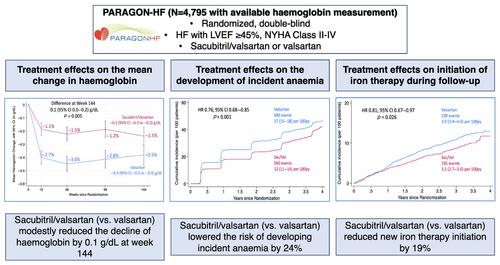
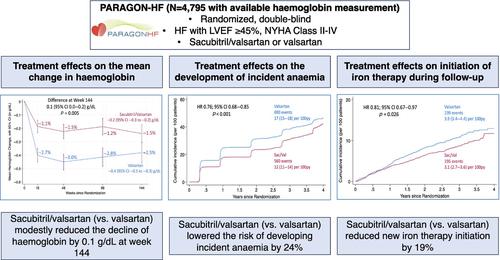
PARAGON-HF was a global, multicentre randomized clinical trial of sacubitril/valsartan versus the RASi valsartan in patients with HF and left ventricular ejection fraction ≥45%. We evaluated haemoglobin trajectory and risks of incident anaemia and new iron therapy initiation during follow-up. Among 4795 participants, 1111 (23.2%) had anaemia at randomization and 5.6% were treated with iron at baseline. Over a median follow-up of 2.9 years, patients with anaemia were at significantly higher risk for total HF hospitalizations and cardiovascular death, compared with those without anaemia (21.6 vs. 11.5 per 100 patient-years; adjusted rate ratio 1.31; 95% confidence interval [CI] 1.12–1.54; p = 0.001). Sacubitril/valsartan slightly slowed the decline in haemoglobin levels by 0.1 g/dl (95% CI 0.0–0.2 g/dl; p = 0.005). Participants treated with sacubitril/valsartan were at significantly lower risk of developing anaemia (30.3% vs. 37.6%; hazard ratio [HR] 0.76; 95% CI 0.68–0.85; p < 0.001) and starting iron therapy (8.1% vs. 10.0%; HR 0.81; 95% CI 0.67–0.97; p = 0.026). Treatment effects of sacubitril/valsartan versus valsartan on total HF hospitalizations and cardiovascular death were consistent among patients across the haemoglobin spectrum (pinteraction = 0.60).
Conclusions
Among patients with HFmrEF/HFpEF, treatment with sacubitril/valsartan resulted in modestly smaller declines in haemoglobin, lower rates of incident anaemia, and fewer new initiations of iron therapy compared with RASi.
Clinical Trial Registration: ClinicalTrials.gov ID NCT01920711.
期刊介绍:
European Journal of Heart Failure is an international journal dedicated to advancing knowledge in the field of heart failure management. The journal publishes reviews and editorials aimed at improving understanding, prevention, investigation, and treatment of heart failure. It covers various disciplines such as molecular and cellular biology, pathology, physiology, electrophysiology, pharmacology, clinical sciences, social sciences, and population sciences. The journal welcomes submissions of manuscripts on basic, clinical, and population sciences, as well as original contributions on nursing, care of the elderly, primary care, health economics, and other related specialist fields. It is published monthly and has a readership that includes cardiologists, emergency room physicians, intensivists, internists, general physicians, cardiac nurses, diabetologists, epidemiologists, basic scientists focusing on cardiovascular research, and those working in rehabilitation. The journal is abstracted and indexed in various databases such as Academic Search, Embase, MEDLINE/PubMed, and Science Citation Index.




 京公网安备 11010802042870号
京ICP备2023020795号-1
京公网安备 11010802042870号
京ICP备2023020795号-1

 分享
分享
 求助内容:
求助内容: 应助结果提醒方式:
 扫码关注我们
