Li Jiang , Cong Yan , Yuan-Ming Zhai , Fei Luo , He Meng , Bo Yin , Kai Zhang , Ming-Bo Yang
{"title":"高强度 PLLA/PVA 生物可降解混合物:接枝共聚物定制结晶和相形态","authors":"Li Jiang , Cong Yan , Yuan-Ming Zhai , Fei Luo , He Meng , Bo Yin , Kai Zhang , Ming-Bo Yang","doi":"10.1016/j.polymer.2024.127606","DOIUrl":null,"url":null,"abstract":"<div><p>Poly(l-lactic acid) (PLLA), recognized as a promising substitute for petroleum-based polymers, has garnered significant attention for its various advantages. However, the practical application of PLLA is limited by its poor toughness. This study introduces a novel approach, using a graft copolymer, poly(vinyl alcohol)-graft-poly(l-lactic acid) (PVA-g-PLLA), synthesized through a \"grafting to\" method to enhance the compatibility of PLLA/PVA blends. It is demonstrated that even though the graft copolymer promotes crystallization, the resultant ternary blends, especially with a mass ratio of 7:3:1, exhibited an 88.7 % elongation at break, representing a 1642 % improvement over pure PLLA and a 576 % increase over binary PLLA/PVA blends. In addition, incorporating PVA-g-PLLA significantly enhanced the toughness of the PLLA/PVA blends without sacrificing strength, thermal stability, or transparency. Remarkably, the Vicat softening temperature of the blends with a 7/3/1.5 ratio increased to about 94.4 °C, substantially higher than the 59.9 °C observed in PLLA/PVA blends. These findings suggest that the newly developed copolymer and the ternary blends hold substantial promise for creating biodegradable materials that do not compromise performance. It suggests a promising future for these materials in various applications where enhanced durability, thermal stability, and environmental sustainability are crucial.</p></div>","PeriodicalId":405,"journal":{"name":"Polymer","volume":"312 ","pages":"Article 127606"},"PeriodicalIF":4.5000,"publicationDate":"2024-10-24","publicationTypes":"Journal Article","fieldsOfStudy":null,"isOpenAccess":false,"openAccessPdf":"","citationCount":"0","resultStr":"{\"title\":\"Highly-toughened PLLA/PVA biodegradable blends: Graft copolymer tailored crystallization and phase morphology\",\"authors\":\"Li Jiang , Cong Yan , Yuan-Ming Zhai , Fei Luo , He Meng , Bo Yin , Kai Zhang , Ming-Bo Yang\",\"doi\":\"10.1016/j.polymer.2024.127606\",\"DOIUrl\":null,\"url\":null,\"abstract\":\"<div><p>Poly(l-lactic acid) (PLLA), recognized as a promising substitute for petroleum-based polymers, has garnered significant attention for its various advantages. However, the practical application of PLLA is limited by its poor toughness. This study introduces a novel approach, using a graft copolymer, poly(vinyl alcohol)-graft-poly(l-lactic acid) (PVA-g-PLLA), synthesized through a \\\"grafting to\\\" method to enhance the compatibility of PLLA/PVA blends. It is demonstrated that even though the graft copolymer promotes crystallization, the resultant ternary blends, especially with a mass ratio of 7:3:1, exhibited an 88.7 % elongation at break, representing a 1642 % improvement over pure PLLA and a 576 % increase over binary PLLA/PVA blends. In addition, incorporating PVA-g-PLLA significantly enhanced the toughness of the PLLA/PVA blends without sacrificing strength, thermal stability, or transparency. Remarkably, the Vicat softening temperature of the blends with a 7/3/1.5 ratio increased to about 94.4 °C, substantially higher than the 59.9 °C observed in PLLA/PVA blends. These findings suggest that the newly developed copolymer and the ternary blends hold substantial promise for creating biodegradable materials that do not compromise performance. It suggests a promising future for these materials in various applications where enhanced durability, thermal stability, and environmental sustainability are crucial.</p></div>\",\"PeriodicalId\":405,\"journal\":{\"name\":\"Polymer\",\"volume\":\"312 \",\"pages\":\"Article 127606\"},\"PeriodicalIF\":4.5000,\"publicationDate\":\"2024-10-24\",\"publicationTypes\":\"Journal Article\",\"fieldsOfStudy\":null,\"isOpenAccess\":false,\"openAccessPdf\":\"\",\"citationCount\":\"0\",\"resultStr\":null,\"platform\":\"Semanticscholar\",\"paperid\":null,\"PeriodicalName\":\"Polymer\",\"FirstCategoryId\":\"92\",\"ListUrlMain\":\"https://www.sciencedirect.com/science/article/pii/S003238612400942X\",\"RegionNum\":2,\"RegionCategory\":\"化学\",\"ArticlePicture\":[],\"TitleCN\":null,\"AbstractTextCN\":null,\"PMCID\":null,\"EPubDate\":\"2024/9/7 0:00:00\",\"PubModel\":\"Epub\",\"JCR\":\"Q2\",\"JCRName\":\"POLYMER SCIENCE\",\"Score\":null,\"Total\":0}","platform":"Semanticscholar","paperid":null,"PeriodicalName":"Polymer","FirstCategoryId":"92","ListUrlMain":"https://www.sciencedirect.com/science/article/pii/S003238612400942X","RegionNum":2,"RegionCategory":"化学","ArticlePicture":[],"TitleCN":null,"AbstractTextCN":null,"PMCID":null,"EPubDate":"2024/9/7 0:00:00","PubModel":"Epub","JCR":"Q2","JCRName":"POLYMER SCIENCE","Score":null,"Total":0}
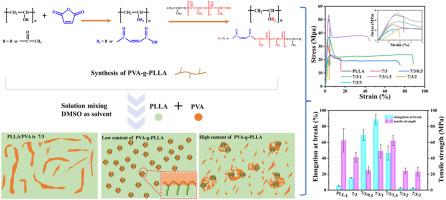
Poly(l-lactic acid) (PLLA), recognized as a promising substitute for petroleum-based polymers, has garnered significant attention for its various advantages. However, the practical application of PLLA is limited by its poor toughness. This study introduces a novel approach, using a graft copolymer, poly(vinyl alcohol)-graft-poly(l-lactic acid) (PVA-g-PLLA), synthesized through a "grafting to" method to enhance the compatibility of PLLA/PVA blends. It is demonstrated that even though the graft copolymer promotes crystallization, the resultant ternary blends, especially with a mass ratio of 7:3:1, exhibited an 88.7 % elongation at break, representing a 1642 % improvement over pure PLLA and a 576 % increase over binary PLLA/PVA blends. In addition, incorporating PVA-g-PLLA significantly enhanced the toughness of the PLLA/PVA blends without sacrificing strength, thermal stability, or transparency. Remarkably, the Vicat softening temperature of the blends with a 7/3/1.5 ratio increased to about 94.4 °C, substantially higher than the 59.9 °C observed in PLLA/PVA blends. These findings suggest that the newly developed copolymer and the ternary blends hold substantial promise for creating biodegradable materials that do not compromise performance. It suggests a promising future for these materials in various applications where enhanced durability, thermal stability, and environmental sustainability are crucial.
期刊介绍:
Polymer is an interdisciplinary journal dedicated to publishing innovative and significant advances in Polymer Physics, Chemistry and Technology. We welcome submissions on polymer hybrids, nanocomposites, characterisation and self-assembly. Polymer also publishes work on the technological application of polymers in energy and optoelectronics.
The main scope is covered but not limited to the following core areas:
Polymer Materials
Nanocomposites and hybrid nanomaterials
Polymer blends, films, fibres, networks and porous materials
Physical Characterization
Characterisation, modelling and simulation* of molecular and materials properties in bulk, solution, and thin films
Polymer Engineering
Advanced multiscale processing methods
Polymer Synthesis, Modification and Self-assembly
Including designer polymer architectures, mechanisms and kinetics, and supramolecular polymerization
Technological Applications
Polymers for energy generation and storage
Polymer membranes for separation technology
Polymers for opto- and microelectronics.




 京公网安备 11010802042870号
京ICP备2023020795号-1
京公网安备 11010802042870号
京ICP备2023020795号-1

 分享
分享
 求助内容:
求助内容: 应助结果提醒方式:
 扫码关注我们
