{"title":"生态系统过程对气候变暖的热适应性","authors":"Jinsong Wang, Shuli Niu","doi":"10.1111/nph.20131","DOIUrl":null,"url":null,"abstract":"<p>Plant phenology has showed complex responses to climate warming, with implications for a wide range of ecosystem functions and services. However, whether the responses of plant phenophases will strengthen or weaken with greater degrees of warming or long-term warming remains a challenge for ecological research. Using a global meta-analysis of 103 experimental warming studies, Lu <i>et al</i>. show that: (1) the response of plant phenology levels off with increasing warming magnitude for herbaceous plants, but not for woody plants; and (2) warming effects on plant phenology also diminish with longer experimental duration, and the slowed rates are regulated by climatic factors. Although previous studies have already found the attenuated leaf-out response to rising warming magnitude in temperate species (Fu <i>et al</i>., <span>2015</span>), the study by Lu <i>et al</i>. provides new evidence for long-term thermal acclimation of different plant phenophases at the global scale. These findings highlight that as climate warming continues; shifts in plant phenology may be less than anticipated.</p><p>In addition to the activities related to these recurring biological events, other ecosystem processes are likely to acclimate to climate warming as well. For example, it is well characterized that plant photosynthesis increases with temperature and reaches an optimum temperature, beyond which photosynthetic rates decline (Sendall <i>et al</i>., <span>2015</span>). Gross primary production (GPP), which is jointly controlled by plant phenology and photosynthesis (Xia <i>et al</i>., <span>2015</span>), generally increases with temperature until it reaches an optimal temperature, beyond which GPP declines at higher temperatures (Fig. 1) (Huang <i>et al</i>., <span>2019</span>; Wang <i>et al</i>., <span>2023</span>). Similarly, recent studies suggest widespread optimum temperatures of respiration at leaves, microbes, and ecosystems to global scales (Niu <i>et al</i>., <span>2024</span>). The widespread thermal optimality of GPP also leads to an optimum temperature of net ecosystem exchange of carbon dioxide world-wide, as revealed by 169 global eddy covariance sites (Niu <i>et al</i>., <span>2012</span>). The optimum temperatures of these carbon fluxes generally increase with environment temperatures (Crous <i>et al</i>., <span>2021</span>; Chen <i>et al</i>., <span>2023</span>; Wang <i>et al</i>., <span>2023</span>), suggesting thermal acclimation of ecosystem carbon cycling (Fig. 1). The thermal optimality and acclimation of these broad ecosystem processes has implications for climate change. For example, the thermal optimality of ecosystem respiration over the globe implies that the previous interpretation of a universal exponential relationship between terrestrial ecosystem respiration and temperature may overestimate the positive feedbacks between climate change and the carbon cycle (Chen <i>et al</i>., <span>2023</span>).</p><p>Thermal acclimation of these ecosystem processes is caused by various mechanisms, such as enzyme deactivation, changes in organism physiology, or a shift in community composition, and can be regulated by temperature-dependent abiotic factors (e.g. soil moisture, nutrient availability, and nonstructural plant carbohydrates). When temperature increases over shorter time scales (e.g. hours, days or seasons), the response of ecosystem processes is predominantly driven by physiological responses. For instance, enzyme activities and metabolic rates may be inhibited at high temperatures (Atkin & Tjoelker, <span>2003</span>), resulting in unimodal temperature responses of ecosystem processes. However, when temperature increases over years or decades, evolutionary adaptation may occur, with less adaptive species being replaced by more thermo-tolerant ones (McGaughran <i>et al</i>., <span>2021</span>). Thus, changes in vegetation or microbial communities under long-term warming may lead to the thermal adaptation of terrestrial ecosystems (Melillo <i>et al</i>., <span>2017</span>). However, the rates at which different life forms respond may vary significantly; for instance, Lu <i>et al</i>. showed that although the phenological responses of both herbaceous and woody plants decreased over time, herbaceous species are more likely to undergo rapid evolutionary adaptation than woody plants due to their higher evolutionary rates.</p><p>Lu <i>et al</i>. also stated that other limiting factors, such as soil water, nutrient availability, and photosynthetic substrates, may become more important and constrain phenological responses to rising temperatures over longer periods. Similarly, a previous study illustrates that the pace of GPP acclimation and adaptation is slower in water-limited regions, as revealed by 326 eddy covariance sites over the globe (Wang <i>et al</i>., <span>2023</span>), suggesting that humid regions will benefit more than dry and warm regions in terms of carbon uptake from vegetation adaptation to future warming. Together, these findings highlight that resource limitations or co-limitation will increasingly govern ecosystem processes in response to long-term climate warming.</p><p>Although there is growing evidence of thermal acclimation in terrestrial ecosystems at different levels of organization in response to warming, the interplay between the acclimation of aboveground and belowground processes, as well as the underlying mechanisms, remains unclear. Previous studies have found that belowground phenology, such as the phenology of roots, microbes and soil fauna often responds asynchronously, when compared to aboveground phenology, in response to warming (Liu <i>et al</i>., <span>2022</span>; Yin <i>et al</i>., <span>2023</span>). Building on findings from Lu <i>et al</i>., it is imperative to conduct whole-ecosystem field experiments with both above- and belowground warming (Fig. 2) in diverse ecosystems to disentangle the degree of thermal acclimation for different organisms (e.g. leaves, roots, soil microbes and fauna) and various ecological processes related to ecosystem functioning and services. These whole-ecosystem warming experiments should provide a crucial step and enrich existing experiments, which mostly focus on the aboveground.</p><p>Such whole-ecosystem warming could provide new insights into a number of critical questions related to the thermal acclimation of terrestrial ecosystems in a warming world. For example, would aboveground and belowground processes (e.g. plant photosynthesis, leaf respiration, root respiration, and microbial respiration) acclimate to warming at the same pace? If not, what factors may explain their differences in the magnitude of thermal acclimation? Lu <i>et al</i>. show that evolutionary adaptation is likely to occur with longer warming, which may account for the decreasing response of plant phenology with time. As experimental duration increases, vegetation and microbial communities, and soil water and nutrient availability are likely to change over time. These changes in biotic and abiotic factors raise even more questions, such as how changes in species composition would modulate the thermal acclimation of terrestrial ecosystems? Would soil water and nutrients be significantly affected by long-term warming and then indirectly limit the thermal responses of terrestrial ecosystems?</p><p>Results from whole-ecosystem warming experiments are likely to reveal emergent patterns and mechanisms of ecosystem responses to warming, which will be highly valuable for benchmarking models. Future advances in this research area should further integrate these field data with models that exclude other covariates to infer causality between temperature and ecosystem responses, as it is difficult to discern the intrinsic effect of warming on land ecosystems in the real world. These data-model integrative studies will greatly reduce modeling uncertainties and accurately capture the warming response of terrestrial ecosystems.</p>","PeriodicalId":214,"journal":{"name":"New Phytologist","volume":"245 2","pages":"437-439"},"PeriodicalIF":8.7000,"publicationDate":"2024-12-18","publicationTypes":"Journal Article","fieldsOfStudy":null,"isOpenAccess":false,"openAccessPdf":"https://onlinelibrary.wiley.com/doi/epdf/10.1111/nph.20131","citationCount":"0","resultStr":"{\"title\":\"Thermal acclimation of ecosystem processes to climate warming\",\"authors\":\"Jinsong Wang, Shuli Niu\",\"doi\":\"10.1111/nph.20131\",\"DOIUrl\":null,\"url\":null,\"abstract\":\"<p>Plant phenology has showed complex responses to climate warming, with implications for a wide range of ecosystem functions and services. However, whether the responses of plant phenophases will strengthen or weaken with greater degrees of warming or long-term warming remains a challenge for ecological research. Using a global meta-analysis of 103 experimental warming studies, Lu <i>et al</i>. show that: (1) the response of plant phenology levels off with increasing warming magnitude for herbaceous plants, but not for woody plants; and (2) warming effects on plant phenology also diminish with longer experimental duration, and the slowed rates are regulated by climatic factors. Although previous studies have already found the attenuated leaf-out response to rising warming magnitude in temperate species (Fu <i>et al</i>., <span>2015</span>), the study by Lu <i>et al</i>. provides new evidence for long-term thermal acclimation of different plant phenophases at the global scale. These findings highlight that as climate warming continues; shifts in plant phenology may be less than anticipated.</p><p>In addition to the activities related to these recurring biological events, other ecosystem processes are likely to acclimate to climate warming as well. For example, it is well characterized that plant photosynthesis increases with temperature and reaches an optimum temperature, beyond which photosynthetic rates decline (Sendall <i>et al</i>., <span>2015</span>). Gross primary production (GPP), which is jointly controlled by plant phenology and photosynthesis (Xia <i>et al</i>., <span>2015</span>), generally increases with temperature until it reaches an optimal temperature, beyond which GPP declines at higher temperatures (Fig. 1) (Huang <i>et al</i>., <span>2019</span>; Wang <i>et al</i>., <span>2023</span>). Similarly, recent studies suggest widespread optimum temperatures of respiration at leaves, microbes, and ecosystems to global scales (Niu <i>et al</i>., <span>2024</span>). The widespread thermal optimality of GPP also leads to an optimum temperature of net ecosystem exchange of carbon dioxide world-wide, as revealed by 169 global eddy covariance sites (Niu <i>et al</i>., <span>2012</span>). The optimum temperatures of these carbon fluxes generally increase with environment temperatures (Crous <i>et al</i>., <span>2021</span>; Chen <i>et al</i>., <span>2023</span>; Wang <i>et al</i>., <span>2023</span>), suggesting thermal acclimation of ecosystem carbon cycling (Fig. 1). The thermal optimality and acclimation of these broad ecosystem processes has implications for climate change. For example, the thermal optimality of ecosystem respiration over the globe implies that the previous interpretation of a universal exponential relationship between terrestrial ecosystem respiration and temperature may overestimate the positive feedbacks between climate change and the carbon cycle (Chen <i>et al</i>., <span>2023</span>).</p><p>Thermal acclimation of these ecosystem processes is caused by various mechanisms, such as enzyme deactivation, changes in organism physiology, or a shift in community composition, and can be regulated by temperature-dependent abiotic factors (e.g. soil moisture, nutrient availability, and nonstructural plant carbohydrates). When temperature increases over shorter time scales (e.g. hours, days or seasons), the response of ecosystem processes is predominantly driven by physiological responses. For instance, enzyme activities and metabolic rates may be inhibited at high temperatures (Atkin & Tjoelker, <span>2003</span>), resulting in unimodal temperature responses of ecosystem processes. However, when temperature increases over years or decades, evolutionary adaptation may occur, with less adaptive species being replaced by more thermo-tolerant ones (McGaughran <i>et al</i>., <span>2021</span>). Thus, changes in vegetation or microbial communities under long-term warming may lead to the thermal adaptation of terrestrial ecosystems (Melillo <i>et al</i>., <span>2017</span>). However, the rates at which different life forms respond may vary significantly; for instance, Lu <i>et al</i>. showed that although the phenological responses of both herbaceous and woody plants decreased over time, herbaceous species are more likely to undergo rapid evolutionary adaptation than woody plants due to their higher evolutionary rates.</p><p>Lu <i>et al</i>. also stated that other limiting factors, such as soil water, nutrient availability, and photosynthetic substrates, may become more important and constrain phenological responses to rising temperatures over longer periods. Similarly, a previous study illustrates that the pace of GPP acclimation and adaptation is slower in water-limited regions, as revealed by 326 eddy covariance sites over the globe (Wang <i>et al</i>., <span>2023</span>), suggesting that humid regions will benefit more than dry and warm regions in terms of carbon uptake from vegetation adaptation to future warming. Together, these findings highlight that resource limitations or co-limitation will increasingly govern ecosystem processes in response to long-term climate warming.</p><p>Although there is growing evidence of thermal acclimation in terrestrial ecosystems at different levels of organization in response to warming, the interplay between the acclimation of aboveground and belowground processes, as well as the underlying mechanisms, remains unclear. Previous studies have found that belowground phenology, such as the phenology of roots, microbes and soil fauna often responds asynchronously, when compared to aboveground phenology, in response to warming (Liu <i>et al</i>., <span>2022</span>; Yin <i>et al</i>., <span>2023</span>). Building on findings from Lu <i>et al</i>., it is imperative to conduct whole-ecosystem field experiments with both above- and belowground warming (Fig. 2) in diverse ecosystems to disentangle the degree of thermal acclimation for different organisms (e.g. leaves, roots, soil microbes and fauna) and various ecological processes related to ecosystem functioning and services. These whole-ecosystem warming experiments should provide a crucial step and enrich existing experiments, which mostly focus on the aboveground.</p><p>Such whole-ecosystem warming could provide new insights into a number of critical questions related to the thermal acclimation of terrestrial ecosystems in a warming world. For example, would aboveground and belowground processes (e.g. plant photosynthesis, leaf respiration, root respiration, and microbial respiration) acclimate to warming at the same pace? If not, what factors may explain their differences in the magnitude of thermal acclimation? Lu <i>et al</i>. show that evolutionary adaptation is likely to occur with longer warming, which may account for the decreasing response of plant phenology with time. As experimental duration increases, vegetation and microbial communities, and soil water and nutrient availability are likely to change over time. These changes in biotic and abiotic factors raise even more questions, such as how changes in species composition would modulate the thermal acclimation of terrestrial ecosystems? Would soil water and nutrients be significantly affected by long-term warming and then indirectly limit the thermal responses of terrestrial ecosystems?</p><p>Results from whole-ecosystem warming experiments are likely to reveal emergent patterns and mechanisms of ecosystem responses to warming, which will be highly valuable for benchmarking models. Future advances in this research area should further integrate these field data with models that exclude other covariates to infer causality between temperature and ecosystem responses, as it is difficult to discern the intrinsic effect of warming on land ecosystems in the real world. These data-model integrative studies will greatly reduce modeling uncertainties and accurately capture the warming response of terrestrial ecosystems.</p>\",\"PeriodicalId\":214,\"journal\":{\"name\":\"New Phytologist\",\"volume\":\"245 2\",\"pages\":\"437-439\"},\"PeriodicalIF\":8.7000,\"publicationDate\":\"2024-12-18\",\"publicationTypes\":\"Journal Article\",\"fieldsOfStudy\":null,\"isOpenAccess\":false,\"openAccessPdf\":\"https://onlinelibrary.wiley.com/doi/epdf/10.1111/nph.20131\",\"citationCount\":\"0\",\"resultStr\":null,\"platform\":\"Semanticscholar\",\"paperid\":null,\"PeriodicalName\":\"New Phytologist\",\"FirstCategoryId\":\"99\",\"ListUrlMain\":\"https://onlinelibrary.wiley.com/doi/10.1111/nph.20131\",\"RegionNum\":1,\"RegionCategory\":\"生物学\",\"ArticlePicture\":[],\"TitleCN\":null,\"AbstractTextCN\":null,\"PMCID\":null,\"EPubDate\":\"2024/9/16 0:00:00\",\"PubModel\":\"Epub\",\"JCR\":\"Q1\",\"JCRName\":\"PLANT SCIENCES\",\"Score\":null,\"Total\":0}","platform":"Semanticscholar","paperid":null,"PeriodicalName":"New Phytologist","FirstCategoryId":"99","ListUrlMain":"https://onlinelibrary.wiley.com/doi/10.1111/nph.20131","RegionNum":1,"RegionCategory":"生物学","ArticlePicture":[],"TitleCN":null,"AbstractTextCN":null,"PMCID":null,"EPubDate":"2024/9/16 0:00:00","PubModel":"Epub","JCR":"Q1","JCRName":"PLANT SCIENCES","Score":null,"Total":0}
Thermal acclimation of ecosystem processes to climate warming
Plant phenology has showed complex responses to climate warming, with implications for a wide range of ecosystem functions and services. However, whether the responses of plant phenophases will strengthen or weaken with greater degrees of warming or long-term warming remains a challenge for ecological research. Using a global meta-analysis of 103 experimental warming studies, Lu et al. show that: (1) the response of plant phenology levels off with increasing warming magnitude for herbaceous plants, but not for woody plants; and (2) warming effects on plant phenology also diminish with longer experimental duration, and the slowed rates are regulated by climatic factors. Although previous studies have already found the attenuated leaf-out response to rising warming magnitude in temperate species (Fu et al., 2015), the study by Lu et al. provides new evidence for long-term thermal acclimation of different plant phenophases at the global scale. These findings highlight that as climate warming continues; shifts in plant phenology may be less than anticipated.
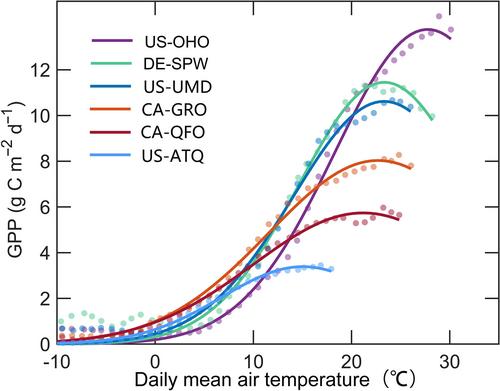
In addition to the activities related to these recurring biological events, other ecosystem processes are likely to acclimate to climate warming as well. For example, it is well characterized that plant photosynthesis increases with temperature and reaches an optimum temperature, beyond which photosynthetic rates decline (Sendall et al., 2015). Gross primary production (GPP), which is jointly controlled by plant phenology and photosynthesis (Xia et al., 2015), generally increases with temperature until it reaches an optimal temperature, beyond which GPP declines at higher temperatures (Fig. 1) (Huang et al., 2019; Wang et al., 2023). Similarly, recent studies suggest widespread optimum temperatures of respiration at leaves, microbes, and ecosystems to global scales (Niu et al., 2024). The widespread thermal optimality of GPP also leads to an optimum temperature of net ecosystem exchange of carbon dioxide world-wide, as revealed by 169 global eddy covariance sites (Niu et al., 2012). The optimum temperatures of these carbon fluxes generally increase with environment temperatures (Crous et al., 2021; Chen et al., 2023; Wang et al., 2023), suggesting thermal acclimation of ecosystem carbon cycling (Fig. 1). The thermal optimality and acclimation of these broad ecosystem processes has implications for climate change. For example, the thermal optimality of ecosystem respiration over the globe implies that the previous interpretation of a universal exponential relationship between terrestrial ecosystem respiration and temperature may overestimate the positive feedbacks between climate change and the carbon cycle (Chen et al., 2023).
Thermal acclimation of these ecosystem processes is caused by various mechanisms, such as enzyme deactivation, changes in organism physiology, or a shift in community composition, and can be regulated by temperature-dependent abiotic factors (e.g. soil moisture, nutrient availability, and nonstructural plant carbohydrates). When temperature increases over shorter time scales (e.g. hours, days or seasons), the response of ecosystem processes is predominantly driven by physiological responses. For instance, enzyme activities and metabolic rates may be inhibited at high temperatures (Atkin & Tjoelker, 2003), resulting in unimodal temperature responses of ecosystem processes. However, when temperature increases over years or decades, evolutionary adaptation may occur, with less adaptive species being replaced by more thermo-tolerant ones (McGaughran et al., 2021). Thus, changes in vegetation or microbial communities under long-term warming may lead to the thermal adaptation of terrestrial ecosystems (Melillo et al., 2017). However, the rates at which different life forms respond may vary significantly; for instance, Lu et al. showed that although the phenological responses of both herbaceous and woody plants decreased over time, herbaceous species are more likely to undergo rapid evolutionary adaptation than woody plants due to their higher evolutionary rates.
Lu et al. also stated that other limiting factors, such as soil water, nutrient availability, and photosynthetic substrates, may become more important and constrain phenological responses to rising temperatures over longer periods. Similarly, a previous study illustrates that the pace of GPP acclimation and adaptation is slower in water-limited regions, as revealed by 326 eddy covariance sites over the globe (Wang et al., 2023), suggesting that humid regions will benefit more than dry and warm regions in terms of carbon uptake from vegetation adaptation to future warming. Together, these findings highlight that resource limitations or co-limitation will increasingly govern ecosystem processes in response to long-term climate warming.
Although there is growing evidence of thermal acclimation in terrestrial ecosystems at different levels of organization in response to warming, the interplay between the acclimation of aboveground and belowground processes, as well as the underlying mechanisms, remains unclear. Previous studies have found that belowground phenology, such as the phenology of roots, microbes and soil fauna often responds asynchronously, when compared to aboveground phenology, in response to warming (Liu et al., 2022; Yin et al., 2023). Building on findings from Lu et al., it is imperative to conduct whole-ecosystem field experiments with both above- and belowground warming (Fig. 2) in diverse ecosystems to disentangle the degree of thermal acclimation for different organisms (e.g. leaves, roots, soil microbes and fauna) and various ecological processes related to ecosystem functioning and services. These whole-ecosystem warming experiments should provide a crucial step and enrich existing experiments, which mostly focus on the aboveground.
Such whole-ecosystem warming could provide new insights into a number of critical questions related to the thermal acclimation of terrestrial ecosystems in a warming world. For example, would aboveground and belowground processes (e.g. plant photosynthesis, leaf respiration, root respiration, and microbial respiration) acclimate to warming at the same pace? If not, what factors may explain their differences in the magnitude of thermal acclimation? Lu et al. show that evolutionary adaptation is likely to occur with longer warming, which may account for the decreasing response of plant phenology with time. As experimental duration increases, vegetation and microbial communities, and soil water and nutrient availability are likely to change over time. These changes in biotic and abiotic factors raise even more questions, such as how changes in species composition would modulate the thermal acclimation of terrestrial ecosystems? Would soil water and nutrients be significantly affected by long-term warming and then indirectly limit the thermal responses of terrestrial ecosystems?
Results from whole-ecosystem warming experiments are likely to reveal emergent patterns and mechanisms of ecosystem responses to warming, which will be highly valuable for benchmarking models. Future advances in this research area should further integrate these field data with models that exclude other covariates to infer causality between temperature and ecosystem responses, as it is difficult to discern the intrinsic effect of warming on land ecosystems in the real world. These data-model integrative studies will greatly reduce modeling uncertainties and accurately capture the warming response of terrestrial ecosystems.
期刊介绍:
New Phytologist is an international electronic journal published 24 times a year. It is owned by the New Phytologist Foundation, a non-profit-making charitable organization dedicated to promoting plant science. The journal publishes excellent, novel, rigorous, and timely research and scholarship in plant science and its applications. The articles cover topics in five sections: Physiology & Development, Environment, Interaction, Evolution, and Transformative Plant Biotechnology. These sections encompass intracellular processes, global environmental change, and encourage cross-disciplinary approaches. The journal recognizes the use of techniques from molecular and cell biology, functional genomics, modeling, and system-based approaches in plant science. Abstracting and Indexing Information for New Phytologist includes Academic Search, AgBiotech News & Information, Agroforestry Abstracts, Biochemistry & Biophysics Citation Index, Botanical Pesticides, CAB Abstracts®, Environment Index, Global Health, and Plant Breeding Abstracts, and others.








 京公网安备 11010802042870号
京ICP备2023020795号-1
京公网安备 11010802042870号
京ICP备2023020795号-1

 分享
分享
 求助内容:
求助内容: 应助结果提醒方式:
 扫码关注我们
