Masataka Umeda, Kohei Karino, Abhigyan Satyam, Nobuya Yoshida, Ryo Hisada, Rhea Bhargava, Theodoros Vichos, Ana Laura Kunzler, Takashi Igawa, Kunihiro Ichinose, Kenta Torigoe, Tomoya Nishino, Takahiro Maeda, Caroline A. Owen, Reza Abdi, Atsushi Kawakami, George C. Tsokos
{"title":"缺氧促进肾小管上皮细胞表达 ADAM9,从而增强 TGF-β1 的活化并促进狼疮性肾炎的组织纤维化","authors":"Masataka Umeda, Kohei Karino, Abhigyan Satyam, Nobuya Yoshida, Ryo Hisada, Rhea Bhargava, Theodoros Vichos, Ana Laura Kunzler, Takashi Igawa, Kunihiro Ichinose, Kenta Torigoe, Tomoya Nishino, Takahiro Maeda, Caroline A. Owen, Reza Abdi, Atsushi Kawakami, George C. Tsokos","doi":"10.1002/art.42987","DOIUrl":null,"url":null,"abstract":"<div>\n \n <section>\n \n <h3> Objective</h3>\n \n <p>Enhanced expression of transforming growth factor (TGF) β in the kidneys of patients with lupus nephritis (LN) can lead to progressive fibrosis, resulting in end-organ damage. ADAM9 activates TGFβ1 by cleaving the latency-associated peptide (LAP). We hypothesized that ADAM9 in the kidney may accelerate fibrogenesis by activating TGFβ1.</p>\n </section>\n \n <section>\n \n <h3> Methods</h3>\n \n <p>We assessed the expression of ADAM9 in the kidneys of mice and humans who were lupus prone. In vitro experiments were conducted using tubular epithelial cells (TECs) isolated from mice and explored the mechanisms responsible for the up-regulation of ADAM9 and the subsequent activation of TGFβ1. To assess the role of ADAM9 in the development of tubular-intestinal fibrosis in individuals with LN, we generated MRL/<i>lpr</i> mice who were <i>Adam9</i> deficient.</p>\n </section>\n \n <section>\n \n <h3> Results</h3>\n \n <p>ADAM9 was highly expressed in tubules from MRL<i>/lpr</i> mice. The transcription factor hypoxia-inducible factor–1α was found to promote the transcription of ADAM9 in TECs. TECs from mice who were <i>Adam9</i> deficient and exposed to the hypoxia mimetic agent dimethyloxalylglycine failed to cleave the LAP to produce bioactive TGFβ1 from latent TGFβ1. Coculture of TECs from mice who were <i>Adam9</i> deficient with fibroblasts in the presence of dimethyloxalylglycine and latent TGFβ1 produced decreased amounts of type I collagen and α–smooth muscle actin (SMA) by fibroblasts. MRL/<i>lpr</i> mice who were <i>Adam9</i> deficient showed reduced interstitial fibrosis. At the translational level, ADAM9 expression in tissues and urine of patients with LN was found to increase.</p>\n </section>\n \n <section>\n \n <h3> Conclusion</h3>\n \n <p>Hypoxia promotes the expression of ADAM9 by TECs, which is responsible for the development of interstitial fibrosis in patients with LN by enhancing the TGFβ1 activation, which promotes fibroblasts to produce collagen and α-SMA.</p>\n \n <div>\n <figure>\n <div><picture>\n <source></source></picture><p></p>\n </div>\n </figure>\n </div>\n </section>\n </div>","PeriodicalId":129,"journal":{"name":"Arthritis & Rheumatology","volume":"77 2","pages":"180-189"},"PeriodicalIF":10.9000,"publicationDate":"2025-01-30","publicationTypes":"Journal Article","fieldsOfStudy":null,"isOpenAccess":false,"openAccessPdf":"","citationCount":"0","resultStr":"{\"title\":\"Hypoxia Promotes the Expression of ADAM9 by Tubular Epithelial Cells, Which Enhances Transforming Growth Factor β1 Activation and Promotes Tissue Fibrosis in Patients With Lupus Nephritis\",\"authors\":\"Masataka Umeda, Kohei Karino, Abhigyan Satyam, Nobuya Yoshida, Ryo Hisada, Rhea Bhargava, Theodoros Vichos, Ana Laura Kunzler, Takashi Igawa, Kunihiro Ichinose, Kenta Torigoe, Tomoya Nishino, Takahiro Maeda, Caroline A. Owen, Reza Abdi, Atsushi Kawakami, George C. Tsokos\",\"doi\":\"10.1002/art.42987\",\"DOIUrl\":null,\"url\":null,\"abstract\":\"<div>\\n \\n <section>\\n \\n <h3> Objective</h3>\\n \\n <p>Enhanced expression of transforming growth factor (TGF) β in the kidneys of patients with lupus nephritis (LN) can lead to progressive fibrosis, resulting in end-organ damage. ADAM9 activates TGFβ1 by cleaving the latency-associated peptide (LAP). We hypothesized that ADAM9 in the kidney may accelerate fibrogenesis by activating TGFβ1.</p>\\n </section>\\n \\n <section>\\n \\n <h3> Methods</h3>\\n \\n <p>We assessed the expression of ADAM9 in the kidneys of mice and humans who were lupus prone. In vitro experiments were conducted using tubular epithelial cells (TECs) isolated from mice and explored the mechanisms responsible for the up-regulation of ADAM9 and the subsequent activation of TGFβ1. To assess the role of ADAM9 in the development of tubular-intestinal fibrosis in individuals with LN, we generated MRL/<i>lpr</i> mice who were <i>Adam9</i> deficient.</p>\\n </section>\\n \\n <section>\\n \\n <h3> Results</h3>\\n \\n <p>ADAM9 was highly expressed in tubules from MRL<i>/lpr</i> mice. The transcription factor hypoxia-inducible factor–1α was found to promote the transcription of ADAM9 in TECs. TECs from mice who were <i>Adam9</i> deficient and exposed to the hypoxia mimetic agent dimethyloxalylglycine failed to cleave the LAP to produce bioactive TGFβ1 from latent TGFβ1. Coculture of TECs from mice who were <i>Adam9</i> deficient with fibroblasts in the presence of dimethyloxalylglycine and latent TGFβ1 produced decreased amounts of type I collagen and α–smooth muscle actin (SMA) by fibroblasts. MRL/<i>lpr</i> mice who were <i>Adam9</i> deficient showed reduced interstitial fibrosis. At the translational level, ADAM9 expression in tissues and urine of patients with LN was found to increase.</p>\\n </section>\\n \\n <section>\\n \\n <h3> Conclusion</h3>\\n \\n <p>Hypoxia promotes the expression of ADAM9 by TECs, which is responsible for the development of interstitial fibrosis in patients with LN by enhancing the TGFβ1 activation, which promotes fibroblasts to produce collagen and α-SMA.</p>\\n \\n <div>\\n <figure>\\n <div><picture>\\n <source></source></picture><p></p>\\n </div>\\n </figure>\\n </div>\\n </section>\\n </div>\",\"PeriodicalId\":129,\"journal\":{\"name\":\"Arthritis & Rheumatology\",\"volume\":\"77 2\",\"pages\":\"180-189\"},\"PeriodicalIF\":10.9000,\"publicationDate\":\"2025-01-30\",\"publicationTypes\":\"Journal Article\",\"fieldsOfStudy\":null,\"isOpenAccess\":false,\"openAccessPdf\":\"\",\"citationCount\":\"0\",\"resultStr\":null,\"platform\":\"Semanticscholar\",\"paperid\":null,\"PeriodicalName\":\"Arthritis & Rheumatology\",\"FirstCategoryId\":\"3\",\"ListUrlMain\":\"https://onlinelibrary.wiley.com/doi/10.1002/art.42987\",\"RegionNum\":1,\"RegionCategory\":\"医学\",\"ArticlePicture\":[],\"TitleCN\":null,\"AbstractTextCN\":null,\"PMCID\":null,\"EPubDate\":\"2024/10/1 0:00:00\",\"PubModel\":\"Epub\",\"JCR\":\"Q1\",\"JCRName\":\"RHEUMATOLOGY\",\"Score\":null,\"Total\":0}","platform":"Semanticscholar","paperid":null,"PeriodicalName":"Arthritis & Rheumatology","FirstCategoryId":"3","ListUrlMain":"https://onlinelibrary.wiley.com/doi/10.1002/art.42987","RegionNum":1,"RegionCategory":"医学","ArticlePicture":[],"TitleCN":null,"AbstractTextCN":null,"PMCID":null,"EPubDate":"2024/10/1 0:00:00","PubModel":"Epub","JCR":"Q1","JCRName":"RHEUMATOLOGY","Score":null,"Total":0}
Hypoxia Promotes the Expression of ADAM9 by Tubular Epithelial Cells, Which Enhances Transforming Growth Factor β1 Activation and Promotes Tissue Fibrosis in Patients With Lupus Nephritis
Objective
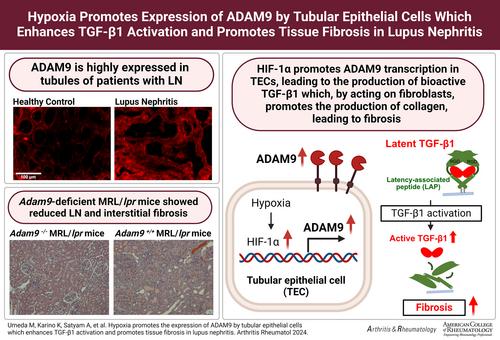
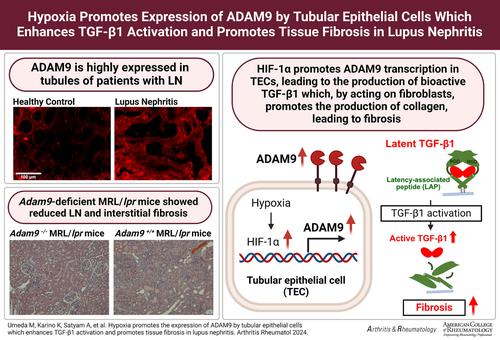
Enhanced expression of transforming growth factor (TGF) β in the kidneys of patients with lupus nephritis (LN) can lead to progressive fibrosis, resulting in end-organ damage. ADAM9 activates TGFβ1 by cleaving the latency-associated peptide (LAP). We hypothesized that ADAM9 in the kidney may accelerate fibrogenesis by activating TGFβ1.
Methods
We assessed the expression of ADAM9 in the kidneys of mice and humans who were lupus prone. In vitro experiments were conducted using tubular epithelial cells (TECs) isolated from mice and explored the mechanisms responsible for the up-regulation of ADAM9 and the subsequent activation of TGFβ1. To assess the role of ADAM9 in the development of tubular-intestinal fibrosis in individuals with LN, we generated MRL/lpr mice who were Adam9 deficient.
Results
ADAM9 was highly expressed in tubules from MRL/lpr mice. The transcription factor hypoxia-inducible factor–1α was found to promote the transcription of ADAM9 in TECs. TECs from mice who were Adam9 deficient and exposed to the hypoxia mimetic agent dimethyloxalylglycine failed to cleave the LAP to produce bioactive TGFβ1 from latent TGFβ1. Coculture of TECs from mice who were Adam9 deficient with fibroblasts in the presence of dimethyloxalylglycine and latent TGFβ1 produced decreased amounts of type I collagen and α–smooth muscle actin (SMA) by fibroblasts. MRL/lpr mice who were Adam9 deficient showed reduced interstitial fibrosis. At the translational level, ADAM9 expression in tissues and urine of patients with LN was found to increase.
Conclusion
Hypoxia promotes the expression of ADAM9 by TECs, which is responsible for the development of interstitial fibrosis in patients with LN by enhancing the TGFβ1 activation, which promotes fibroblasts to produce collagen and α-SMA.
期刊介绍:
Arthritis & Rheumatology is the official journal of the American College of Rheumatology and focuses on the natural history, pathophysiology, treatment, and outcome of rheumatic diseases. It is a peer-reviewed publication that aims to provide the highest quality basic and clinical research in this field. The journal covers a wide range of investigative areas and also includes review articles, editorials, and educational material for researchers and clinicians. Being recognized as a leading research journal in rheumatology, Arthritis & Rheumatology serves the global community of rheumatology investigators and clinicians.







 京公网安备 11010802042870号
京ICP备2023020795号-1
京公网安备 11010802042870号
京ICP备2023020795号-1

 分享
分享
 求助内容:
求助内容: 应助结果提醒方式:
 扫码关注我们
