{"title":"通过基于先进知识图谱的故障诊断模型提高钢铁生产线的可靠性","authors":"Huihui Han;Jian Wang;Xiaowen Wang","doi":"10.1109/TR.2024.3425859","DOIUrl":null,"url":null,"abstract":"Reliability in steel production lines is critical for maintaining operational efficiency, ensuring product quality, and minimizing downtime. The potential failure of any equipment can negatively impact the reliability of steel production lines. Therefore, it is urgent to establish an efficient system for fault diagnosis (FD). We introduce a novel FD model called triple agent-based reinforcement learning (TARL), which comprises the fact extraction (FE) agent, the relation selection (RS) agent, and the entity selection (ES) agent. A top–down construction method is first employed to build a steel production line fault knowledge graph (SteelFaultKG). During the fault reasoning process, the RS agent and ES agent collaborate to identify the correct reasoning path on the SteelFaultKG. However, the initial SteelFaultKG is sparse and incomplete, hindering the RS and ES agents from inferring the correct reasoning path. To mitigate this limitation, the FE agent is introduced to dynamically enrich the SteelFaultKG by generating fact triples from an external corpus. This expansion of action space in SteelFaultKG is instrumental in enhancing the model's reasoning capabilities. Comprehensive experimental results on a steel production line fault-related dataset indicate that the TARL model significantly enhances FD accuracy. This advancement in FD, offered by the TARL model, significantly enhances the operational reliability of steel production lines.","PeriodicalId":56305,"journal":{"name":"IEEE Transactions on Reliability","volume":"74 2","pages":"2880-2892"},"PeriodicalIF":5.7000,"publicationDate":"2024-09-16","publicationTypes":"Journal Article","fieldsOfStudy":null,"isOpenAccess":false,"openAccessPdf":"","citationCount":"0","resultStr":"{\"title\":\"Enhancing Reliability of Steel Production Lines Through Advanced Knowledge Graph-Based Fault Diagnosis Model\",\"authors\":\"Huihui Han;Jian Wang;Xiaowen Wang\",\"doi\":\"10.1109/TR.2024.3425859\",\"DOIUrl\":null,\"url\":null,\"abstract\":\"Reliability in steel production lines is critical for maintaining operational efficiency, ensuring product quality, and minimizing downtime. The potential failure of any equipment can negatively impact the reliability of steel production lines. Therefore, it is urgent to establish an efficient system for fault diagnosis (FD). We introduce a novel FD model called triple agent-based reinforcement learning (TARL), which comprises the fact extraction (FE) agent, the relation selection (RS) agent, and the entity selection (ES) agent. A top–down construction method is first employed to build a steel production line fault knowledge graph (SteelFaultKG). During the fault reasoning process, the RS agent and ES agent collaborate to identify the correct reasoning path on the SteelFaultKG. However, the initial SteelFaultKG is sparse and incomplete, hindering the RS and ES agents from inferring the correct reasoning path. To mitigate this limitation, the FE agent is introduced to dynamically enrich the SteelFaultKG by generating fact triples from an external corpus. This expansion of action space in SteelFaultKG is instrumental in enhancing the model's reasoning capabilities. Comprehensive experimental results on a steel production line fault-related dataset indicate that the TARL model significantly enhances FD accuracy. This advancement in FD, offered by the TARL model, significantly enhances the operational reliability of steel production lines.\",\"PeriodicalId\":56305,\"journal\":{\"name\":\"IEEE Transactions on Reliability\",\"volume\":\"74 2\",\"pages\":\"2880-2892\"},\"PeriodicalIF\":5.7000,\"publicationDate\":\"2024-09-16\",\"publicationTypes\":\"Journal Article\",\"fieldsOfStudy\":null,\"isOpenAccess\":false,\"openAccessPdf\":\"\",\"citationCount\":\"0\",\"resultStr\":null,\"platform\":\"Semanticscholar\",\"paperid\":null,\"PeriodicalName\":\"IEEE Transactions on Reliability\",\"FirstCategoryId\":\"94\",\"ListUrlMain\":\"https://ieeexplore.ieee.org/document/10680717/\",\"RegionNum\":2,\"RegionCategory\":\"计算机科学\",\"ArticlePicture\":[],\"TitleCN\":null,\"AbstractTextCN\":null,\"PMCID\":null,\"EPubDate\":\"\",\"PubModel\":\"\",\"JCR\":\"Q1\",\"JCRName\":\"COMPUTER SCIENCE, HARDWARE & ARCHITECTURE\",\"Score\":null,\"Total\":0}","platform":"Semanticscholar","paperid":null,"PeriodicalName":"IEEE Transactions on Reliability","FirstCategoryId":"94","ListUrlMain":"https://ieeexplore.ieee.org/document/10680717/","RegionNum":2,"RegionCategory":"计算机科学","ArticlePicture":[],"TitleCN":null,"AbstractTextCN":null,"PMCID":null,"EPubDate":"","PubModel":"","JCR":"Q1","JCRName":"COMPUTER SCIENCE, HARDWARE & ARCHITECTURE","Score":null,"Total":0}
Enhancing Reliability of Steel Production Lines Through Advanced Knowledge Graph-Based Fault Diagnosis Model
Reliability in steel production lines is critical for maintaining operational efficiency, ensuring product quality, and minimizing downtime. The potential failure of any equipment can negatively impact the reliability of steel production lines. Therefore, it is urgent to establish an efficient system for fault diagnosis (FD). We introduce a novel FD model called triple agent-based reinforcement learning (TARL), which comprises the fact extraction (FE) agent, the relation selection (RS) agent, and the entity selection (ES) agent. A top–down construction method is first employed to build a steel production line fault knowledge graph (SteelFaultKG). During the fault reasoning process, the RS agent and ES agent collaborate to identify the correct reasoning path on the SteelFaultKG. However, the initial SteelFaultKG is sparse and incomplete, hindering the RS and ES agents from inferring the correct reasoning path. To mitigate this limitation, the FE agent is introduced to dynamically enrich the SteelFaultKG by generating fact triples from an external corpus. This expansion of action space in SteelFaultKG is instrumental in enhancing the model's reasoning capabilities. Comprehensive experimental results on a steel production line fault-related dataset indicate that the TARL model significantly enhances FD accuracy. This advancement in FD, offered by the TARL model, significantly enhances the operational reliability of steel production lines.
期刊介绍:
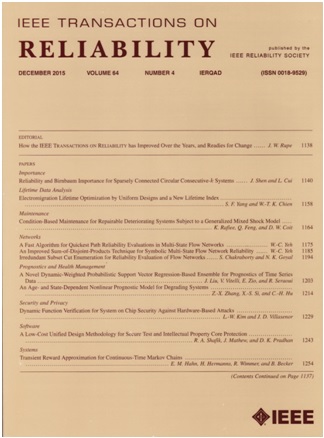
IEEE Transactions on Reliability is a refereed journal for the reliability and allied disciplines including, but not limited to, maintainability, physics of failure, life testing, prognostics, design and manufacture for reliability, reliability for systems of systems, network availability, mission success, warranty, safety, and various measures of effectiveness. Topics eligible for publication range from hardware to software, from materials to systems, from consumer and industrial devices to manufacturing plants, from individual items to networks, from techniques for making things better to ways of predicting and measuring behavior in the field. As an engineering subject that supports new and existing technologies, we constantly expand into new areas of the assurance sciences.




 京公网安备 11010802042870号
京ICP备2023020795号-1
京公网安备 11010802042870号
京ICP备2023020795号-1

 分享
分享
 求助内容:
求助内容: 应助结果提醒方式:
 扫码关注我们
