Lukas Hartl, Michael Schwarz, Benedikt Simbrunner, Mathias Jachs, Peter Wolf, David Josef Maria Bauer, Bernhard Scheiner, Lorenz Balcar, Georg Semmler, Benedikt Silvester Hofer, Nina Dominik, Rodrig Marculescu, Michael Trauner, Mattias Mandorfer, Thomas Reiberger
{"title":"肝硬化中的胰岛素样生长因子-1 与肝功能失调和纤维化有关,并可预测肝脏相关死亡率","authors":"Lukas Hartl, Michael Schwarz, Benedikt Simbrunner, Mathias Jachs, Peter Wolf, David Josef Maria Bauer, Bernhard Scheiner, Lorenz Balcar, Georg Semmler, Benedikt Silvester Hofer, Nina Dominik, Rodrig Marculescu, Michael Trauner, Mattias Mandorfer, Thomas Reiberger","doi":"10.1111/apt.18289","DOIUrl":null,"url":null,"abstract":"<div>\n \n \n <section>\n \n <h3> Background and Aims</h3>\n \n <p>We aimed to characterise insulin-like growth factor-1 (IGF-1) signalling in patients with advanced chronic liver disease (ACLD).</p>\n </section>\n \n <section>\n \n <h3> Methods</h3>\n \n <p>Consecutive patients undergoing hepatic venous pressure gradient [HVPG] measurement were prospectively included. Clinical stages were defined as follows: probable ACLD (pACLD): liver stiffness ≥10 kPa and HVPG ≤5 mmHg, S0: mild PH (HVPG 6–9 mmHg), S1: clinically significant PH (CSPH), S2: CSPH with varices, S3: past variceal bleeding, S4: past/current non-bleeding hepatic decompensation and S5: further decompensation.</p>\n </section>\n \n <section>\n \n <h3> Results</h3>\n \n <p>In total, 269 patients were included; 105 were compensated (pACLD: <i>n</i> = 18; S0: <i>n</i> = 30; S1: <i>n</i> = 20; S2: <i>n</i> = 37), and 164 were decompensated (S3: <i>n</i> = 11; S4: <i>n</i> = 89; S5: <i>n</i> = 64). Median levels of IGF-1 decreased with progressive cirrhosis (from pACLD: 88.5 ng/mL to S5: 51.0 ng/mL; <i>p</i> < 0.001). Patients with CSPH had significantly lower IGF-1 levels (63.5 ng/mL vs. 81.0 ng/mL; <i>p</i> = 0.001). IGF-1 showed an independent negative association with body mass index (BMI; aB: −1.56; <i>p</i> < 0.001), enhanced liver fibrosis (ELF) test (aB: −8.43; <i>p</i> < 0.001), MELD (aB: −1.13; <i>p</i> = 0.042) and age (per 10 years; aB: −6.87; <i>p</i> < 0.001). IGF-1 exhibited an excellent AUROC (0.856) for the prediction of liver-related death at 6 months of follow-up. Lower IGF-1 (per 10 ng/mL) was linked to higher risk of (further) decompensation (0.90; 95% CI: 0.83–0.98; <i>p</i> = 0.016), acute-on-chronic liver failure (ACLF; asHR: 0.80; 95% CI: 0.68–0.93; <i>p</i> = 0.004) and liver-related death (asHR: 0.76; 95% CI: 0.63–0.91; <i>p</i> = 0.004).</p>\n </section>\n \n <section>\n \n <h3> Conclusion</h3>\n \n <p>Decreased levels of IGF-1 reflect impaired hepatic function and fibrogenesis in patients with cirrhosis, which seems particularly relevant in obesity since low IGF-1 was independently linked to high BMI. Lower IGF-1 in cirrhosis predicts decompensation, ACLF and liver-related death.</p>\n </section>\n </div>","PeriodicalId":121,"journal":{"name":"Alimentary Pharmacology & Therapeutics","volume":"61 1","pages":"88-98"},"PeriodicalIF":6.8000,"publicationDate":"2024-09-21","publicationTypes":"Journal Article","fieldsOfStudy":null,"isOpenAccess":false,"openAccessPdf":"https://onlinelibrary.wiley.com/doi/epdf/10.1111/apt.18289","citationCount":"0","resultStr":"{\"title\":\"Insulin-like growth factor-1 in cirrhosis is linked to hepatic dysfunction and fibrogenesis and predicts liver-related mortality\",\"authors\":\"Lukas Hartl, Michael Schwarz, Benedikt Simbrunner, Mathias Jachs, Peter Wolf, David Josef Maria Bauer, Bernhard Scheiner, Lorenz Balcar, Georg Semmler, Benedikt Silvester Hofer, Nina Dominik, Rodrig Marculescu, Michael Trauner, Mattias Mandorfer, Thomas Reiberger\",\"doi\":\"10.1111/apt.18289\",\"DOIUrl\":null,\"url\":null,\"abstract\":\"<div>\\n \\n \\n <section>\\n \\n <h3> Background and Aims</h3>\\n \\n <p>We aimed to characterise insulin-like growth factor-1 (IGF-1) signalling in patients with advanced chronic liver disease (ACLD).</p>\\n </section>\\n \\n <section>\\n \\n <h3> Methods</h3>\\n \\n <p>Consecutive patients undergoing hepatic venous pressure gradient [HVPG] measurement were prospectively included. Clinical stages were defined as follows: probable ACLD (pACLD): liver stiffness ≥10 kPa and HVPG ≤5 mmHg, S0: mild PH (HVPG 6–9 mmHg), S1: clinically significant PH (CSPH), S2: CSPH with varices, S3: past variceal bleeding, S4: past/current non-bleeding hepatic decompensation and S5: further decompensation.</p>\\n </section>\\n \\n <section>\\n \\n <h3> Results</h3>\\n \\n <p>In total, 269 patients were included; 105 were compensated (pACLD: <i>n</i> = 18; S0: <i>n</i> = 30; S1: <i>n</i> = 20; S2: <i>n</i> = 37), and 164 were decompensated (S3: <i>n</i> = 11; S4: <i>n</i> = 89; S5: <i>n</i> = 64). Median levels of IGF-1 decreased with progressive cirrhosis (from pACLD: 88.5 ng/mL to S5: 51.0 ng/mL; <i>p</i> < 0.001). Patients with CSPH had significantly lower IGF-1 levels (63.5 ng/mL vs. 81.0 ng/mL; <i>p</i> = 0.001). IGF-1 showed an independent negative association with body mass index (BMI; aB: −1.56; <i>p</i> < 0.001), enhanced liver fibrosis (ELF) test (aB: −8.43; <i>p</i> < 0.001), MELD (aB: −1.13; <i>p</i> = 0.042) and age (per 10 years; aB: −6.87; <i>p</i> < 0.001). IGF-1 exhibited an excellent AUROC (0.856) for the prediction of liver-related death at 6 months of follow-up. Lower IGF-1 (per 10 ng/mL) was linked to higher risk of (further) decompensation (0.90; 95% CI: 0.83–0.98; <i>p</i> = 0.016), acute-on-chronic liver failure (ACLF; asHR: 0.80; 95% CI: 0.68–0.93; <i>p</i> = 0.004) and liver-related death (asHR: 0.76; 95% CI: 0.63–0.91; <i>p</i> = 0.004).</p>\\n </section>\\n \\n <section>\\n \\n <h3> Conclusion</h3>\\n \\n <p>Decreased levels of IGF-1 reflect impaired hepatic function and fibrogenesis in patients with cirrhosis, which seems particularly relevant in obesity since low IGF-1 was independently linked to high BMI. Lower IGF-1 in cirrhosis predicts decompensation, ACLF and liver-related death.</p>\\n </section>\\n </div>\",\"PeriodicalId\":121,\"journal\":{\"name\":\"Alimentary Pharmacology & Therapeutics\",\"volume\":\"61 1\",\"pages\":\"88-98\"},\"PeriodicalIF\":6.8000,\"publicationDate\":\"2024-09-21\",\"publicationTypes\":\"Journal Article\",\"fieldsOfStudy\":null,\"isOpenAccess\":false,\"openAccessPdf\":\"https://onlinelibrary.wiley.com/doi/epdf/10.1111/apt.18289\",\"citationCount\":\"0\",\"resultStr\":null,\"platform\":\"Semanticscholar\",\"paperid\":null,\"PeriodicalName\":\"Alimentary Pharmacology & Therapeutics\",\"FirstCategoryId\":\"3\",\"ListUrlMain\":\"https://onlinelibrary.wiley.com/doi/10.1111/apt.18289\",\"RegionNum\":1,\"RegionCategory\":\"医学\",\"ArticlePicture\":[],\"TitleCN\":null,\"AbstractTextCN\":null,\"PMCID\":null,\"EPubDate\":\"\",\"PubModel\":\"\",\"JCR\":\"Q1\",\"JCRName\":\"GASTROENTEROLOGY & HEPATOLOGY\",\"Score\":null,\"Total\":0}","platform":"Semanticscholar","paperid":null,"PeriodicalName":"Alimentary Pharmacology & Therapeutics","FirstCategoryId":"3","ListUrlMain":"https://onlinelibrary.wiley.com/doi/10.1111/apt.18289","RegionNum":1,"RegionCategory":"医学","ArticlePicture":[],"TitleCN":null,"AbstractTextCN":null,"PMCID":null,"EPubDate":"","PubModel":"","JCR":"Q1","JCRName":"GASTROENTEROLOGY & HEPATOLOGY","Score":null,"Total":0}
Insulin-like growth factor-1 in cirrhosis is linked to hepatic dysfunction and fibrogenesis and predicts liver-related mortality
Background and Aims
We aimed to characterise insulin-like growth factor-1 (IGF-1) signalling in patients with advanced chronic liver disease (ACLD).
Methods
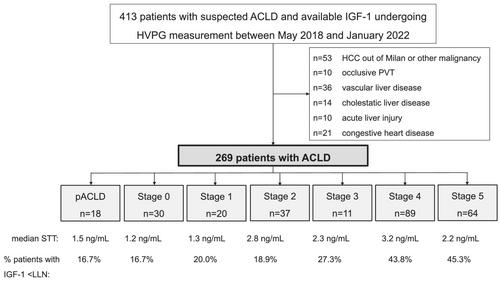
Consecutive patients undergoing hepatic venous pressure gradient [HVPG] measurement were prospectively included. Clinical stages were defined as follows: probable ACLD (pACLD): liver stiffness ≥10 kPa and HVPG ≤5 mmHg, S0: mild PH (HVPG 6–9 mmHg), S1: clinically significant PH (CSPH), S2: CSPH with varices, S3: past variceal bleeding, S4: past/current non-bleeding hepatic decompensation and S5: further decompensation.
Results
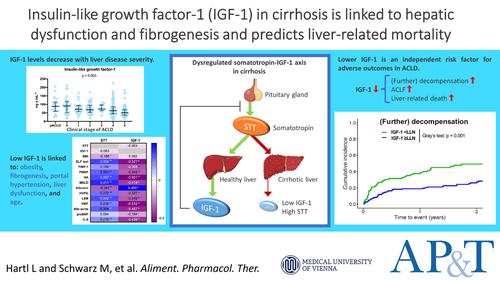
In total, 269 patients were included; 105 were compensated (pACLD: n = 18; S0: n = 30; S1: n = 20; S2: n = 37), and 164 were decompensated (S3: n = 11; S4: n = 89; S5: n = 64). Median levels of IGF-1 decreased with progressive cirrhosis (from pACLD: 88.5 ng/mL to S5: 51.0 ng/mL; p < 0.001). Patients with CSPH had significantly lower IGF-1 levels (63.5 ng/mL vs. 81.0 ng/mL; p = 0.001). IGF-1 showed an independent negative association with body mass index (BMI; aB: −1.56; p < 0.001), enhanced liver fibrosis (ELF) test (aB: −8.43; p < 0.001), MELD (aB: −1.13; p = 0.042) and age (per 10 years; aB: −6.87; p < 0.001). IGF-1 exhibited an excellent AUROC (0.856) for the prediction of liver-related death at 6 months of follow-up. Lower IGF-1 (per 10 ng/mL) was linked to higher risk of (further) decompensation (0.90; 95% CI: 0.83–0.98; p = 0.016), acute-on-chronic liver failure (ACLF; asHR: 0.80; 95% CI: 0.68–0.93; p = 0.004) and liver-related death (asHR: 0.76; 95% CI: 0.63–0.91; p = 0.004).
Conclusion
Decreased levels of IGF-1 reflect impaired hepatic function and fibrogenesis in patients with cirrhosis, which seems particularly relevant in obesity since low IGF-1 was independently linked to high BMI. Lower IGF-1 in cirrhosis predicts decompensation, ACLF and liver-related death.
期刊介绍:
Alimentary Pharmacology & Therapeutics is a global pharmacology journal focused on the impact of drugs on the human gastrointestinal and hepato-biliary systems. It covers a diverse range of topics, often with immediate clinical relevance to its readership.




 京公网安备 11010802042870号
京ICP备2023020795号-1
京公网安备 11010802042870号
京ICP备2023020795号-1

 分享
分享
 求助内容:
求助内容: 应助结果提醒方式:
 扫码关注我们
