Xiyu Gu, Yan Liu, Xiaoming Huang, Jiaqi Ding, Yuanhang Qu, Zesheng Liu, Yao Cai, Wenjuan Liu, Shishang Guo, Chengliang Sun
{"title":"分析溅射沉积 AlScN 薄膜中异常取向晶粒的异质结构形成及其对体声器件的影响","authors":"Xiyu Gu, Yan Liu, Xiaoming Huang, Jiaqi Ding, Yuanhang Qu, Zesheng Liu, Yao Cai, Wenjuan Liu, Shishang Guo, Chengliang Sun","doi":"10.1021/acsami.4c07539","DOIUrl":null,"url":null,"abstract":"The presence of abnormally oriented grains (AOGs) in sputter-deposited aluminum scandium nitride (AlScN) films significantly degrades their physical properties, compromising the performance of bulk acoustic wave (BAW) devices. This study utilizes first-principles calculations to reveal that in tetrahedral wurtzite AlScN film-doped Sc atoms tend to aggregate at the second nearest-neighbor positions, forming dense ScN octahedral structures. The rock-salt (RS) ScN continued to grow due to further Sc aggregation. However, due to inadequate scandium flux, embryonic RS structures cannot be sustained, resulting in the nucleation of AOGs at the (111) faces of the octahedral ScN structure. Electron microscopy studies indicated that AOGs possess wurtzite structures and originate at tilted grain boundaries. These boundaries were characterized as RS ScN with more Sc atoms. This corroborated the theoretical predictions. BAW resonators and filters fabricated from sputter-deposited AlScN films demonstrate that AOGs degraded the piezoelectricity of AlScN, reducing the resonator’s electromechanical coupling coefficient (<i>K</i><sub>eff</sub><sup>2</sup>). Measurements showed that AOG density increased from edge to center of the 8 in. wafer, resulting in a 3% decrease in average <i>K</i><sub>eff</sub><sup>2</sup> in the resonators and a 137 MHz decrease in the filter bandwidth at 5 dB.","PeriodicalId":5,"journal":{"name":"ACS Applied Materials & Interfaces","volume":"11 1","pages":""},"PeriodicalIF":8.2000,"publicationDate":"2024-09-23","publicationTypes":"Journal Article","fieldsOfStudy":null,"isOpenAccess":false,"openAccessPdf":"","citationCount":"0","resultStr":"{\"title\":\"Analysis of Heterostructure Formation of Abnormally Oriented Grains in Sputter-Deposited AlScN Films and Its Impact on Bulk Acoustic Wave Devices\",\"authors\":\"Xiyu Gu, Yan Liu, Xiaoming Huang, Jiaqi Ding, Yuanhang Qu, Zesheng Liu, Yao Cai, Wenjuan Liu, Shishang Guo, Chengliang Sun\",\"doi\":\"10.1021/acsami.4c07539\",\"DOIUrl\":null,\"url\":null,\"abstract\":\"The presence of abnormally oriented grains (AOGs) in sputter-deposited aluminum scandium nitride (AlScN) films significantly degrades their physical properties, compromising the performance of bulk acoustic wave (BAW) devices. This study utilizes first-principles calculations to reveal that in tetrahedral wurtzite AlScN film-doped Sc atoms tend to aggregate at the second nearest-neighbor positions, forming dense ScN octahedral structures. The rock-salt (RS) ScN continued to grow due to further Sc aggregation. However, due to inadequate scandium flux, embryonic RS structures cannot be sustained, resulting in the nucleation of AOGs at the (111) faces of the octahedral ScN structure. Electron microscopy studies indicated that AOGs possess wurtzite structures and originate at tilted grain boundaries. These boundaries were characterized as RS ScN with more Sc atoms. This corroborated the theoretical predictions. BAW resonators and filters fabricated from sputter-deposited AlScN films demonstrate that AOGs degraded the piezoelectricity of AlScN, reducing the resonator’s electromechanical coupling coefficient (<i>K</i><sub>eff</sub><sup>2</sup>). Measurements showed that AOG density increased from edge to center of the 8 in. wafer, resulting in a 3% decrease in average <i>K</i><sub>eff</sub><sup>2</sup> in the resonators and a 137 MHz decrease in the filter bandwidth at 5 dB.\",\"PeriodicalId\":5,\"journal\":{\"name\":\"ACS Applied Materials & Interfaces\",\"volume\":\"11 1\",\"pages\":\"\"},\"PeriodicalIF\":8.2000,\"publicationDate\":\"2024-09-23\",\"publicationTypes\":\"Journal Article\",\"fieldsOfStudy\":null,\"isOpenAccess\":false,\"openAccessPdf\":\"\",\"citationCount\":\"0\",\"resultStr\":null,\"platform\":\"Semanticscholar\",\"paperid\":null,\"PeriodicalName\":\"ACS Applied Materials & Interfaces\",\"FirstCategoryId\":\"88\",\"ListUrlMain\":\"https://doi.org/10.1021/acsami.4c07539\",\"RegionNum\":2,\"RegionCategory\":\"材料科学\",\"ArticlePicture\":[],\"TitleCN\":null,\"AbstractTextCN\":null,\"PMCID\":null,\"EPubDate\":\"\",\"PubModel\":\"\",\"JCR\":\"Q1\",\"JCRName\":\"MATERIALS SCIENCE, MULTIDISCIPLINARY\",\"Score\":null,\"Total\":0}","platform":"Semanticscholar","paperid":null,"PeriodicalName":"ACS Applied Materials & Interfaces","FirstCategoryId":"88","ListUrlMain":"https://doi.org/10.1021/acsami.4c07539","RegionNum":2,"RegionCategory":"材料科学","ArticlePicture":[],"TitleCN":null,"AbstractTextCN":null,"PMCID":null,"EPubDate":"","PubModel":"","JCR":"Q1","JCRName":"MATERIALS SCIENCE, MULTIDISCIPLINARY","Score":null,"Total":0}
Analysis of Heterostructure Formation of Abnormally Oriented Grains in Sputter-Deposited AlScN Films and Its Impact on Bulk Acoustic Wave Devices
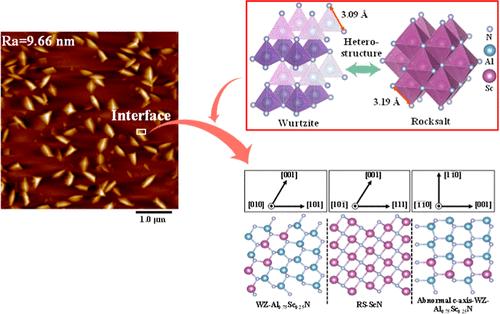
The presence of abnormally oriented grains (AOGs) in sputter-deposited aluminum scandium nitride (AlScN) films significantly degrades their physical properties, compromising the performance of bulk acoustic wave (BAW) devices. This study utilizes first-principles calculations to reveal that in tetrahedral wurtzite AlScN film-doped Sc atoms tend to aggregate at the second nearest-neighbor positions, forming dense ScN octahedral structures. The rock-salt (RS) ScN continued to grow due to further Sc aggregation. However, due to inadequate scandium flux, embryonic RS structures cannot be sustained, resulting in the nucleation of AOGs at the (111) faces of the octahedral ScN structure. Electron microscopy studies indicated that AOGs possess wurtzite structures and originate at tilted grain boundaries. These boundaries were characterized as RS ScN with more Sc atoms. This corroborated the theoretical predictions. BAW resonators and filters fabricated from sputter-deposited AlScN films demonstrate that AOGs degraded the piezoelectricity of AlScN, reducing the resonator’s electromechanical coupling coefficient (Keff2). Measurements showed that AOG density increased from edge to center of the 8 in. wafer, resulting in a 3% decrease in average Keff2 in the resonators and a 137 MHz decrease in the filter bandwidth at 5 dB.
期刊介绍:
ACS Applied Materials & Interfaces is a leading interdisciplinary journal that brings together chemists, engineers, physicists, and biologists to explore the development and utilization of newly-discovered materials and interfacial processes for specific applications. Our journal has experienced remarkable growth since its establishment in 2009, both in terms of the number of articles published and the impact of the research showcased. We are proud to foster a truly global community, with the majority of published articles originating from outside the United States, reflecting the rapid growth of applied research worldwide.




 京公网安备 11010802042870号
京ICP备2023020795号-1
京公网安备 11010802042870号
京ICP备2023020795号-1

 分享
分享
 求助内容:
求助内容: 应助结果提醒方式:
 扫码关注我们
