Chunxiao Jiang, Yan Yu, Jinbo Zhu, Lun Nie, Yiming Xu, Xiangxiang Liu, Ruoxin Li, Guangtao Chang
{"title":"无需化学预处理即可在涤纶织物上直接印制分散染料油墨。","authors":"Chunxiao Jiang, Yan Yu, Jinbo Zhu, Lun Nie, Yiming Xu, Xiangxiang Liu, Ruoxin Li, Guangtao Chang","doi":"10.1021/acs.langmuir.4c01586","DOIUrl":null,"url":null,"abstract":"<p><p>Direct inkjet digital printing is a relatively green and environmentally friendly textile printing method with a wide range of applications in the textile printing and dyeing industry. However, pretreatment of the fabric is required before digital printing, which will generate certain energy consumption and wastewater. In this study, a digital direct inkjet printing method was developed to improve the printing accuracy of poly(ethylene terephthalate) (PET) fabrics without any pretreatment. A kind of direct inkjet printing ink was prepared by the response change in temperature viscosity. The increase in viscosity inhibits ink bleeding on the fabric, thereby improving printing accuracy. A thermosensitive direct inkjet printing disperse dye ink was prepared by adding cetyltrimethylammonium bromide (CTAB) and 3-methylsalicylic acid (3MS) to the ink. By evaluating the changes in the ink particle size, shear viscosity, and temperature viscosity, it was found that this thermosensitive ink has an excellent average particle size and special changes in viscosity with increasing temperature. When this heat-sensitive ink is printed on a polyester fabric, the fabric does not need pretreatment to improve the clarity of printing, and the printed fabric has satisfactory color fastness to friction and washing.</p>","PeriodicalId":50,"journal":{"name":"Langmuir","volume":" ","pages":"20897-20905"},"PeriodicalIF":3.9000,"publicationDate":"2024-10-08","publicationTypes":"Journal Article","fieldsOfStudy":null,"isOpenAccess":false,"openAccessPdf":"","citationCount":"0","resultStr":"{\"title\":\"Direct Printing of Disperse Dye Inks to Polyester Fabrics without Chemical Pretreatment.\",\"authors\":\"Chunxiao Jiang, Yan Yu, Jinbo Zhu, Lun Nie, Yiming Xu, Xiangxiang Liu, Ruoxin Li, Guangtao Chang\",\"doi\":\"10.1021/acs.langmuir.4c01586\",\"DOIUrl\":null,\"url\":null,\"abstract\":\"<p><p>Direct inkjet digital printing is a relatively green and environmentally friendly textile printing method with a wide range of applications in the textile printing and dyeing industry. However, pretreatment of the fabric is required before digital printing, which will generate certain energy consumption and wastewater. In this study, a digital direct inkjet printing method was developed to improve the printing accuracy of poly(ethylene terephthalate) (PET) fabrics without any pretreatment. A kind of direct inkjet printing ink was prepared by the response change in temperature viscosity. The increase in viscosity inhibits ink bleeding on the fabric, thereby improving printing accuracy. A thermosensitive direct inkjet printing disperse dye ink was prepared by adding cetyltrimethylammonium bromide (CTAB) and 3-methylsalicylic acid (3MS) to the ink. By evaluating the changes in the ink particle size, shear viscosity, and temperature viscosity, it was found that this thermosensitive ink has an excellent average particle size and special changes in viscosity with increasing temperature. When this heat-sensitive ink is printed on a polyester fabric, the fabric does not need pretreatment to improve the clarity of printing, and the printed fabric has satisfactory color fastness to friction and washing.</p>\",\"PeriodicalId\":50,\"journal\":{\"name\":\"Langmuir\",\"volume\":\" \",\"pages\":\"20897-20905\"},\"PeriodicalIF\":3.9000,\"publicationDate\":\"2024-10-08\",\"publicationTypes\":\"Journal Article\",\"fieldsOfStudy\":null,\"isOpenAccess\":false,\"openAccessPdf\":\"\",\"citationCount\":\"0\",\"resultStr\":null,\"platform\":\"Semanticscholar\",\"paperid\":null,\"PeriodicalName\":\"Langmuir\",\"FirstCategoryId\":\"92\",\"ListUrlMain\":\"https://doi.org/10.1021/acs.langmuir.4c01586\",\"RegionNum\":2,\"RegionCategory\":\"化学\",\"ArticlePicture\":[],\"TitleCN\":null,\"AbstractTextCN\":null,\"PMCID\":null,\"EPubDate\":\"2024/9/24 0:00:00\",\"PubModel\":\"Epub\",\"JCR\":\"Q2\",\"JCRName\":\"CHEMISTRY, MULTIDISCIPLINARY\",\"Score\":null,\"Total\":0}","platform":"Semanticscholar","paperid":null,"PeriodicalName":"Langmuir","FirstCategoryId":"92","ListUrlMain":"https://doi.org/10.1021/acs.langmuir.4c01586","RegionNum":2,"RegionCategory":"化学","ArticlePicture":[],"TitleCN":null,"AbstractTextCN":null,"PMCID":null,"EPubDate":"2024/9/24 0:00:00","PubModel":"Epub","JCR":"Q2","JCRName":"CHEMISTRY, MULTIDISCIPLINARY","Score":null,"Total":0}
Direct Printing of Disperse Dye Inks to Polyester Fabrics without Chemical Pretreatment.
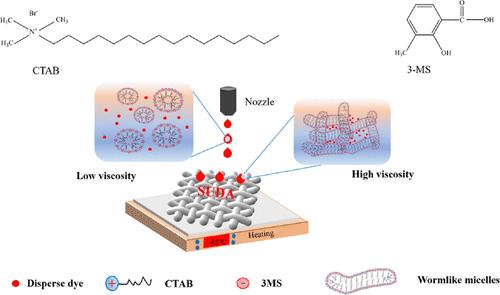
Direct inkjet digital printing is a relatively green and environmentally friendly textile printing method with a wide range of applications in the textile printing and dyeing industry. However, pretreatment of the fabric is required before digital printing, which will generate certain energy consumption and wastewater. In this study, a digital direct inkjet printing method was developed to improve the printing accuracy of poly(ethylene terephthalate) (PET) fabrics without any pretreatment. A kind of direct inkjet printing ink was prepared by the response change in temperature viscosity. The increase in viscosity inhibits ink bleeding on the fabric, thereby improving printing accuracy. A thermosensitive direct inkjet printing disperse dye ink was prepared by adding cetyltrimethylammonium bromide (CTAB) and 3-methylsalicylic acid (3MS) to the ink. By evaluating the changes in the ink particle size, shear viscosity, and temperature viscosity, it was found that this thermosensitive ink has an excellent average particle size and special changes in viscosity with increasing temperature. When this heat-sensitive ink is printed on a polyester fabric, the fabric does not need pretreatment to improve the clarity of printing, and the printed fabric has satisfactory color fastness to friction and washing.
期刊介绍:
Langmuir is an interdisciplinary journal publishing articles in the following subject categories:
Colloids: surfactants and self-assembly, dispersions, emulsions, foams
Interfaces: adsorption, reactions, films, forces
Biological Interfaces: biocolloids, biomolecular and biomimetic materials
Materials: nano- and mesostructured materials, polymers, gels, liquid crystals
Electrochemistry: interfacial charge transfer, charge transport, electrocatalysis, electrokinetic phenomena, bioelectrochemistry
Devices and Applications: sensors, fluidics, patterning, catalysis, photonic crystals
However, when high-impact, original work is submitted that does not fit within the above categories, decisions to accept or decline such papers will be based on one criteria: What Would Irving Do?
Langmuir ranks #2 in citations out of 136 journals in the category of Physical Chemistry with 113,157 total citations. The journal received an Impact Factor of 4.384*.
This journal is also indexed in the categories of Materials Science (ranked #1) and Multidisciplinary Chemistry (ranked #5).




 京公网安备 11010802042870号
京ICP备2023020795号-1
京公网安备 11010802042870号
京ICP备2023020795号-1

 分享
分享
 求助内容:
求助内容: 应助结果提醒方式:
 扫码关注我们
