Ruxandra Christodorescu, Oliviana Geavlete, Marc Ferrini, Thomas Kümler, Konstantinos Toutoutzas, Antoni Bayes-Genis, Petar Seferovic, Marco Metra, Ovidiu Chioncel, Giuseppe M.C. Rosano, Gianluigi Savarese
{"title":"将 2021 年 ESC 心衰指南建议转化为日常实践:心力衰竭调查结果。ESC心脏病学实践委员会和ESC心力衰竭协会的科学声明","authors":"Ruxandra Christodorescu, Oliviana Geavlete, Marc Ferrini, Thomas Kümler, Konstantinos Toutoutzas, Antoni Bayes-Genis, Petar Seferovic, Marco Metra, Ovidiu Chioncel, Giuseppe M.C. Rosano, Gianluigi Savarese","doi":"10.1002/ejhf.3444","DOIUrl":null,"url":null,"abstract":"<div>\n \n \n <section>\n \n <h3> Aims</h3>\n \n <p>Real-world data show that guidelines are insufficiently implemented, and particularly guideline-directed medical therapies (GDMT) are underused in patients with heart failure and reduced ejection fraction (HFrEF) in clinical practice. The Council for Cardiology Practice and the Heart Failure Association of the European Society of Cardiology (ESC) developed a survey aiming to (i) evaluate the perspectives of the cardiology community on the 2021 ESC heart failure (HF) guidelines, (ii) pinpoint disparities in disease management, and (iii) propose strategies to enhance adherence to HF guidelines.</p>\n </section>\n \n <section>\n \n <h3> Methods and results</h3>\n \n <p>A 22-question survey regarding the diagnosis and treatment of HFrEF was delivered between March and June 2022. Of 457 physicians, 54% were general cardiologists, 19.4% were HF specialists, 18.9% other cardiac specialists, and 7.7% non-cardiac specialists. For diagnosis, 52.1% employed echocardiography and natriuretic peptides (NPs), 33.2% primarily used echocardiography, and 14.7% predominantly relied on NPs. The first drug class initiated in HFrEF was angiotensin-converting enzyme inhibitors/angiotensin receptor–neprilysin inhibitor (ACEi/ARNi) (91.2%), beta-blockers (BB) (73.8%), mineralocorticoid receptor antagonists (MRAs) (53.4%), and sodium–glucose cotransporter 2 (SGLT2) inhibitors (48.1%). The combination ACEi/ARNi + MRA+ BB was preferred by 39.3% of physicians, ACEi/ARNi + SGLT2 inhibitors + BB by 33.3%, and ACEi/ARNi + BB by 22.2%. The time required to initiate and optimize GDMT was estimated to be <1 month by 8.3%, 1–3 months by 52%, 3–6 months by 31.8%, and >6 months by 7.9%. Compared to general cardiologists, HF specialists/academic cardiologists reported lower estimated time-to-initiation, and more commonly preferred a parallel initiation of GDMT rather than a sequential approach.</p>\n </section>\n \n <section>\n \n <h3> Conclusion</h3>\n \n <p>Participants generally followed diagnostic and treatment guidelines, but variations in HFrEF management across care settings or HF specialties were noted. The survey may raise awareness and promote standardized HF care.</p>\n </section>\n </div>","PeriodicalId":164,"journal":{"name":"European Journal of Heart Failure","volume":"27 3","pages":"412-420"},"PeriodicalIF":10.3000,"publicationDate":"2024-09-24","publicationTypes":"Journal Article","fieldsOfStudy":null,"isOpenAccess":false,"openAccessPdf":"","citationCount":"0","resultStr":"{\"title\":\"Translating the 2021 ESC heart failure guideline recommendations in daily practice: Results from a heart failure survey. A scientific statement of the ESC Council for Cardiology Practice and the Heart Failure Association of the ESC\",\"authors\":\"Ruxandra Christodorescu, Oliviana Geavlete, Marc Ferrini, Thomas Kümler, Konstantinos Toutoutzas, Antoni Bayes-Genis, Petar Seferovic, Marco Metra, Ovidiu Chioncel, Giuseppe M.C. Rosano, Gianluigi Savarese\",\"doi\":\"10.1002/ejhf.3444\",\"DOIUrl\":null,\"url\":null,\"abstract\":\"<div>\\n \\n \\n <section>\\n \\n <h3> Aims</h3>\\n \\n <p>Real-world data show that guidelines are insufficiently implemented, and particularly guideline-directed medical therapies (GDMT) are underused in patients with heart failure and reduced ejection fraction (HFrEF) in clinical practice. The Council for Cardiology Practice and the Heart Failure Association of the European Society of Cardiology (ESC) developed a survey aiming to (i) evaluate the perspectives of the cardiology community on the 2021 ESC heart failure (HF) guidelines, (ii) pinpoint disparities in disease management, and (iii) propose strategies to enhance adherence to HF guidelines.</p>\\n </section>\\n \\n <section>\\n \\n <h3> Methods and results</h3>\\n \\n <p>A 22-question survey regarding the diagnosis and treatment of HFrEF was delivered between March and June 2022. Of 457 physicians, 54% were general cardiologists, 19.4% were HF specialists, 18.9% other cardiac specialists, and 7.7% non-cardiac specialists. For diagnosis, 52.1% employed echocardiography and natriuretic peptides (NPs), 33.2% primarily used echocardiography, and 14.7% predominantly relied on NPs. The first drug class initiated in HFrEF was angiotensin-converting enzyme inhibitors/angiotensin receptor–neprilysin inhibitor (ACEi/ARNi) (91.2%), beta-blockers (BB) (73.8%), mineralocorticoid receptor antagonists (MRAs) (53.4%), and sodium–glucose cotransporter 2 (SGLT2) inhibitors (48.1%). The combination ACEi/ARNi + MRA+ BB was preferred by 39.3% of physicians, ACEi/ARNi + SGLT2 inhibitors + BB by 33.3%, and ACEi/ARNi + BB by 22.2%. The time required to initiate and optimize GDMT was estimated to be <1 month by 8.3%, 1–3 months by 52%, 3–6 months by 31.8%, and >6 months by 7.9%. Compared to general cardiologists, HF specialists/academic cardiologists reported lower estimated time-to-initiation, and more commonly preferred a parallel initiation of GDMT rather than a sequential approach.</p>\\n </section>\\n \\n <section>\\n \\n <h3> Conclusion</h3>\\n \\n <p>Participants generally followed diagnostic and treatment guidelines, but variations in HFrEF management across care settings or HF specialties were noted. The survey may raise awareness and promote standardized HF care.</p>\\n </section>\\n </div>\",\"PeriodicalId\":164,\"journal\":{\"name\":\"European Journal of Heart Failure\",\"volume\":\"27 3\",\"pages\":\"412-420\"},\"PeriodicalIF\":10.3000,\"publicationDate\":\"2024-09-24\",\"publicationTypes\":\"Journal Article\",\"fieldsOfStudy\":null,\"isOpenAccess\":false,\"openAccessPdf\":\"\",\"citationCount\":\"0\",\"resultStr\":null,\"platform\":\"Semanticscholar\",\"paperid\":null,\"PeriodicalName\":\"European Journal of Heart Failure\",\"FirstCategoryId\":\"3\",\"ListUrlMain\":\"https://onlinelibrary.wiley.com/doi/10.1002/ejhf.3444\",\"RegionNum\":1,\"RegionCategory\":\"医学\",\"ArticlePicture\":[],\"TitleCN\":null,\"AbstractTextCN\":null,\"PMCID\":null,\"EPubDate\":\"\",\"PubModel\":\"\",\"JCR\":\"Q1\",\"JCRName\":\"CARDIAC & CARDIOVASCULAR SYSTEMS\",\"Score\":null,\"Total\":0}","platform":"Semanticscholar","paperid":null,"PeriodicalName":"European Journal of Heart Failure","FirstCategoryId":"3","ListUrlMain":"https://onlinelibrary.wiley.com/doi/10.1002/ejhf.3444","RegionNum":1,"RegionCategory":"医学","ArticlePicture":[],"TitleCN":null,"AbstractTextCN":null,"PMCID":null,"EPubDate":"","PubModel":"","JCR":"Q1","JCRName":"CARDIAC & CARDIOVASCULAR SYSTEMS","Score":null,"Total":0}
Translating the 2021 ESC heart failure guideline recommendations in daily practice: Results from a heart failure survey. A scientific statement of the ESC Council for Cardiology Practice and the Heart Failure Association of the ESC
Aims
Real-world data show that guidelines are insufficiently implemented, and particularly guideline-directed medical therapies (GDMT) are underused in patients with heart failure and reduced ejection fraction (HFrEF) in clinical practice. The Council for Cardiology Practice and the Heart Failure Association of the European Society of Cardiology (ESC) developed a survey aiming to (i) evaluate the perspectives of the cardiology community on the 2021 ESC heart failure (HF) guidelines, (ii) pinpoint disparities in disease management, and (iii) propose strategies to enhance adherence to HF guidelines.
Methods and results
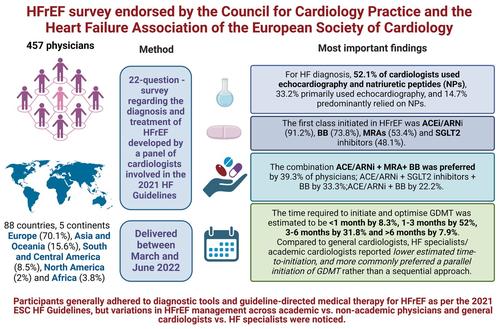
A 22-question survey regarding the diagnosis and treatment of HFrEF was delivered between March and June 2022. Of 457 physicians, 54% were general cardiologists, 19.4% were HF specialists, 18.9% other cardiac specialists, and 7.7% non-cardiac specialists. For diagnosis, 52.1% employed echocardiography and natriuretic peptides (NPs), 33.2% primarily used echocardiography, and 14.7% predominantly relied on NPs. The first drug class initiated in HFrEF was angiotensin-converting enzyme inhibitors/angiotensin receptor–neprilysin inhibitor (ACEi/ARNi) (91.2%), beta-blockers (BB) (73.8%), mineralocorticoid receptor antagonists (MRAs) (53.4%), and sodium–glucose cotransporter 2 (SGLT2) inhibitors (48.1%). The combination ACEi/ARNi + MRA+ BB was preferred by 39.3% of physicians, ACEi/ARNi + SGLT2 inhibitors + BB by 33.3%, and ACEi/ARNi + BB by 22.2%. The time required to initiate and optimize GDMT was estimated to be <1 month by 8.3%, 1–3 months by 52%, 3–6 months by 31.8%, and >6 months by 7.9%. Compared to general cardiologists, HF specialists/academic cardiologists reported lower estimated time-to-initiation, and more commonly preferred a parallel initiation of GDMT rather than a sequential approach.
Conclusion
Participants generally followed diagnostic and treatment guidelines, but variations in HFrEF management across care settings or HF specialties were noted. The survey may raise awareness and promote standardized HF care.
期刊介绍:
European Journal of Heart Failure is an international journal dedicated to advancing knowledge in the field of heart failure management. The journal publishes reviews and editorials aimed at improving understanding, prevention, investigation, and treatment of heart failure. It covers various disciplines such as molecular and cellular biology, pathology, physiology, electrophysiology, pharmacology, clinical sciences, social sciences, and population sciences. The journal welcomes submissions of manuscripts on basic, clinical, and population sciences, as well as original contributions on nursing, care of the elderly, primary care, health economics, and other related specialist fields. It is published monthly and has a readership that includes cardiologists, emergency room physicians, intensivists, internists, general physicians, cardiac nurses, diabetologists, epidemiologists, basic scientists focusing on cardiovascular research, and those working in rehabilitation. The journal is abstracted and indexed in various databases such as Academic Search, Embase, MEDLINE/PubMed, and Science Citation Index.





 京公网安备 11010802042870号
京ICP备2023020795号-1
京公网安备 11010802042870号
京ICP备2023020795号-1

 分享
分享
 求助内容:
求助内容: 应助结果提醒方式:
 扫码关注我们
