{"title":"三叠纪晚期银杏叶植物的叶矿诱导化学防御。","authors":"Tao Zhao, Sui Wan, Senleyi Li, Zhuo Feng","doi":"10.1111/nph.20154","DOIUrl":null,"url":null,"abstract":"<p>Leaf mining is a distinctive foliar feeding strategy employed by insect larvae in which they inhabit and feed on the internal tissues of leaves (Hering, <span>1951</span>). This strategy has independently evolved multiple times in four holometabolous insect orders: Coleoptera, Diptera, Lepidoptera, and Hymenoptera (Connor & Taverner, <span>1997</span>). Leaf mining offers several advantages to the insect larvae, including higher feeding efficiencies and protection from UV radiation, desiccation, and disease infection (Connor & Taverner, <span>1997</span>). Some species can even manipulate their host plants' metabolism to meet their nutritional needs (Zhang <i>et al</i>., <span>2017</span>). However, for the host plants, leaf mining can lead to increased water and nutrient loss, reduced photosynthesis, and increased/decreased defenses (Zhang <i>et al</i>., <span>2016</span>; Chen <i>et al</i>., <span>2017</span>).</p><p>Although insect damage traces of leaf mining are not commonly preserved in the fossil record, they indeed provide a critical window into the ancient relationships between endophytic insects and their host plants (Labandeira & Wappler, <span>2023</span>). The oldest unequivocal leaf mines date back to the Early Triassic, with diversification occurring in the Late Triassic (Cariglino <i>et al</i>., <span>2022</span>; Imada <i>et al</i>., <span>2022</span>; Xiao <i>et al</i>., <span>2024</span>). The preserved feeding traces of leaf mining provide valuable insights into the diversity of leaf miners in ancient terrestrial ecosystems, their host plants, and their responses to past climate and ecosystem changes (Wilf <i>et al</i>., <span>2001</span>, <span>2006</span>; Currano <i>et al</i>., <span>2010</span>). Despite the wealth of information derived from these insect damage traces, the impact of leaf mining on the chemistry of fossil leaves remains largely unexplored.</p><p>Plant cuticles, composed mainly of cutin, waxes, polysaccharides, and phenolic compounds, are valuable materials for palaeobotanical studies, due to their high preservation potential (Kerp, <span>1990</span>; Guignard, <span>2019</span>). Besides revealing morphological details of cells, recent studies suggest that fossil plant cuticles can even preserve chemical information that is informative for phylogenetic studies (Vajda <i>et al</i>., <span>2017</span>, <span>2021</span>). While interactions between plants and leaf miners primarily occur within the inner tissues of leaves, the resultant chemicals could potentially disperse and deposit into the cuticles (Müller, <span>2008</span>).</p><p>In this study, we utilized attenuated total reflectance-Fourier transform infrared spectroscopy (ATR-FTIR) to investigate whether leaf mining affects leaf chemistry in the extant plant <i>Hedera nepalensis</i> and if such impacts can be discerned in fossil ginkgophytes. ATR-FTIR allows the acquisition of spectra of cuticles without isolation (España <i>et al</i>., <span>2014</span>; Jardine <i>et al</i>., <span>2019</span>). We used leaves of <i>H. nepalensis</i> as a modern reference due to their availability and the scarcity of insect damage on the leaves of <i>Ginkgo biloba</i>, the only living representative of the Ginkgoales (Pan <i>et al</i>., <span>2016</span>). <i>Hedera nepalensis</i> is a widespread evergreen angiosperm in Asia and grows at elevations between 0 and 3500 m above sea level (Green <i>et al</i>., <span>2011</span>). Fossil ginkgophyte leaves (<i>Baiera multipartite</i>) obtained from the Upper Triassic in Southwest China were analyzed for their chemical characteristics.</p><p>Fourteen modern leaves of <i>H. nepalensis</i> K. Koch (Fig. 1a) were sampled between September and October 2023, comprising eight unmined leaves and six mined leaves. One yellow leaf of <i>G. biloba</i> L., was sampled for comparison.</p><p>Thirty-three fossil ginkgophyte leaves (<i>B. multipartite</i> Sze et Lee) (Fig. 1b,c) collected from the Upper Triassic Xujiahe Formation in Southwest China were sampled, consisting of 21 unmined leaves and 12 mined leaves. Among the mined leaves, eight were sampled from both the mined portions and unmined portions, while four were solely sampled from the mined portions. The Xujiahe Formation in the Sichuan Basin is a terrestrial sedimentary sequence with alternating lacustrine and fluvial depositional facies (Wang <i>et al</i>., <span>2010</span>). Specifically, in the Rongxian fossil site (29°27′11″ N, 104°18′02″ E) in the southeastern Sichuan Basin, the formation measures 532–764 m in thickness and is divided into six members. The specimens were collected from the roof-shale of a coal bed within the fifth member of the Xujiahe Formation (see Feng <i>et al</i>., <span>2022</span> for more details), and are housed at the Palaeobotanical Collections of Institute of Palaeontology, Yunnan University (YNUPB).</p><p>ATR-FTIR analysis was conducted using a Nicolet iS50 FTIR spectrometer equipped with a ZnSe crystal ATR accessory at the Institute of Palaeontology, Yunnan University. The instrumental setup included a spectral resolution of 4 cm<sup>−1</sup>, a wavenumber range of 4000–550 cm<sup>−1</sup>, and 64 scans. No chemical treatments were performed before the analysis. For modern leaves, only the adaxial (upper leaf surface) cuticles were analyzed. For each unmined leaf, 3 to 4 spectra were obtained, while for each mined leaf, 3 to 4 were obtained from both the mined and unmined portions, respectively. In the case of fossil leaves, both adaxial and abaxial (lower leaf surface) cuticles were analyzed, as they are difficult to distinguish visually. Then, the spectra of the adaxial cuticles were selected based on the relative intensity of the C=O band at 1700 cm<sup>−1</sup>, which is relatively higher in the spectra of the adaxial cuticles (Jardine <i>et al</i>., <span>2019</span>). Moreover, the associated sediment was analyzed for comparison.</p><p>Principal component analysis-linear discriminate analysis (PCA-LDA) was performed to obtain information about the spectra variation among the sample groups. First, PCA was performed to reduce the dimensionality of the data, and then LDA was performed on the PC scores to unveil differences among the sample groups. The number of principal components (PCs) used as the input for LDA was determined using leave-one-out cross-validation (LOOCV) (Supporting Information Fig. S1). Model performance was evaluated using Accuracy and Kappa (<i>κ</i>). Accuracy, the proportion of correctly predicted instances, is simple and intuitive but may be misleading in imbalanced datasets. Kappa, by contrast, accounts for chance agreement, providing a more robust assessment of model performance, particularly in imbalanced datasets.</p><p>For modern leaves, analyses were performed using the entire spectral range and the 3000–2800 cm<sup>−1</sup> range. For fossil leaves, analyses were restricted to the 3000–2800 cm<sup>−1</sup> range to avoid potential interference from sediment signals. Before analyzing the full spectra, the spectra were baseline-corrected using the ‘rubberband’ method in the R package <i>alkahest</i> and normalized to the C=O band between 1750 and 1680 cm<sup>−1</sup>. For the 3000–2800 cm<sup>−1</sup> spectral range, spectra were baseline-corrected using the “linear” method and normalized to the CH<sub>2</sub> band between 2940 and 2890 cm<sup>−1</sup>. All analyses were conducted in R 4.3.2 (R Core Team, <span>2023</span>).</p><p>The separation of mined portions from unmined leaves in our PCA-LDA of both modern and fossil leaves indicates that the chemical responses of leaves to leaf mining can be detected with ATR-FTIR.</p><p>Carboxylic acids play important roles in plant defenses, and many of them have aliphatic chains. For example, the jasmonic acid, which is derived from linolenic acid, regulates both direct and indirect plant defenses against insects (War <i>et al</i>., <span>2012</span>). Jasmonic acid can induce the synthesis of molecules in all three major classes of plant secondary metabolites: terpenoids, alkaloids, and phenolic compounds (Geyter <i>et al</i>., <span>2012</span>). C18 unsaturated fatty acids, such as linoleic acid and linolenic acids, can serve as precursors of green-leaf volatiles, which can attract the natural enemies of the herbivores (Aljbory & Chen, <span>2018</span>). The relatively higher content of carboxylic acids in the mined portions of modern leaves suggests that leaf mining activated the defense system in modern leaves. The relatively higher contents of polysaccharides in the mined portions of modern leaves align with previous studies that indicate leaf miners can manipulate plant physiology to accumulate sugars in the mines (Giron <i>et al</i>., <span>2013</span>). That is to say, the leaf miners manipulated plant physiology and suffered plant defense simultaneously. Similarly, Zhang <i>et al</i>. (<span>2016</span>) showed that leaf mining by <i>Phyllonorycter blancardella</i> was associated with enhanced biosynthesis of cytokinins, jasmonic acid, and phenolic compounds in apple trees. It has been demonstrated that leaf miners use cytokinins, a group of plant hormones, to manipulate plant physiology. Thus, the enhanced biosynthesis of cytokinins and jasmonic acid is consistent with our observation of higher contents of polysaccharides and carboxylic acids in mined portions of modern leaves. Our failure to detect an increased content of phenolic compounds in mined portions is likely due to the fact that the IR beam did not reach the induced phenolic compounds. Materska <i>et al</i>. (<span>2022</span>) showed that phenolic compounds accumulate mainly in tissues adjacent to the foraging sites of leaf miners in horse chestnut.</p><p>The incorporation of minerals into fossil cuticles constrains the usable spectral range for PCA-LDA. However, restricting the analyses to the 3000–2800 cm<sup>−1</sup> range still allows the detection of the effects of leaf mining in both modern and fossil leaves. This is because many carboxylic acids involved in plant defenses contain aliphatic chains that are detectable in this range. Although the fossil leaves analyzed in this study belong to a gymnosperm, it has been demonstrated that <i>G. biloba</i>, the only extant representative of the Ginkgoales, responds to herbivory with the same defense mechanisms adopted by the most recent angiosperms (Mohanta <i>et al</i>., <span>2012</span>). Moreover, a multispecies genome-wide analysis suggests that jasmonic acid, salicylic acid, and abscisic signaling pathways, all of which regulate plant defenses, might have emerged in the last common ancestor of land plants (Wang <i>et al</i>., <span>2015</span>). Interestingly, unlike in modern leaves, the unmined portions of fossil leaves appear to be similarly affected as the mined portions. This suggests that leaf mining may have induced both local and systemic defenses in the fossil ginkgophyte, while in the extant plant <i>H. nepalensis</i>, the responses appear to be more localized.</p><p><i>Ginkgo biloba</i> is renowned for its strong resistance to various insects and pathogens (Major, <span>1967</span>). It has been suggested that continuing herbivore pressure could result in an escalation of plant defenses (Futuyma & Agrawal, <span>2009</span>). Indeed, evidence of insect damage on fossil ginkgophytes is accumulating. Besides leaf mining, endophytic oviposition and external foliage feeding have been reported from Late Triassic ginkgophyte leaves (Feng <i>et al</i>., <span>2022</span>; Xu <i>et al</i>., <span>2024</span>). Xiao <i>et al</i>. (<span>2024</span>) documented three mines from Middle Jurassic ginkgophyte leaves. The evidence of chemical response to leaf mining in the Triassic leaves, as well as flavonoids in Cretaceous leaves (Zhao <i>et al</i>., <span>2006</span>), suggests that fossil materials may hold clues to the evolutionary history of defense mechanisms in the Ginkgoales.</p><p>The study of plant–insect interactions in the fossil record has provided valuable insights into the co-evolutionary dynamics between plants and insects through geological history (Labandeira & Wappler, <span>2023</span>). Although recent research has made significant progress in documenting various types of insect damage on plant tissues, there exists a notable bias in our understanding, with a predominant focus on the damage over plant defenses (McCoy <i>et al</i>., <span>2021</span>). Our knowledge of fossil plant defenses largely relies on fossilized structural defenses such as spines and trichomes and morphological evidence of chemical defenses such as amber and oil body cells (McCoy <i>et al</i>., <span>2021</span>). Our results highlight the potential of chemical analysis in gaining insights into plant defenses in deep time.</p><p>In summary, our research presents evidence for chemical defense of a Triassic ginkgophyte plant to leaf mining, and demonstrates the feasibility of gaining insights into plant defenses in deep time through chemical analysis.</p><p>None declared.</p><p>TZ and ZF conceived and designed this study. ZF and SW collected fossil specimens. ZF, SW and TZ collected modern specimens. TZ and SL conducted ATR-FTIR analysis. TZ analyzed the data. TZ wrote the manuscript with input from other authors. All authors read and approved the final manuscript.</p><p>The ATR-FTIR spectra and R code are available on the OSF (https://osf.io/eckgh/).</p>","PeriodicalId":214,"journal":{"name":"New Phytologist","volume":"245 1","pages":"27-32"},"PeriodicalIF":8.7000,"publicationDate":"2024-12-04","publicationTypes":"Journal Article","fieldsOfStudy":null,"isOpenAccess":false,"openAccessPdf":"https://onlinelibrary.wiley.com/doi/epdf/10.1111/nph.20154","citationCount":"0","resultStr":"{\"title\":\"Leaf mining induced chemical defense of a Late Triassic ginkgophyte plant\",\"authors\":\"Tao Zhao, Sui Wan, Senleyi Li, Zhuo Feng\",\"doi\":\"10.1111/nph.20154\",\"DOIUrl\":null,\"url\":null,\"abstract\":\"<p>Leaf mining is a distinctive foliar feeding strategy employed by insect larvae in which they inhabit and feed on the internal tissues of leaves (Hering, <span>1951</span>). This strategy has independently evolved multiple times in four holometabolous insect orders: Coleoptera, Diptera, Lepidoptera, and Hymenoptera (Connor & Taverner, <span>1997</span>). Leaf mining offers several advantages to the insect larvae, including higher feeding efficiencies and protection from UV radiation, desiccation, and disease infection (Connor & Taverner, <span>1997</span>). Some species can even manipulate their host plants' metabolism to meet their nutritional needs (Zhang <i>et al</i>., <span>2017</span>). However, for the host plants, leaf mining can lead to increased water and nutrient loss, reduced photosynthesis, and increased/decreased defenses (Zhang <i>et al</i>., <span>2016</span>; Chen <i>et al</i>., <span>2017</span>).</p><p>Although insect damage traces of leaf mining are not commonly preserved in the fossil record, they indeed provide a critical window into the ancient relationships between endophytic insects and their host plants (Labandeira & Wappler, <span>2023</span>). The oldest unequivocal leaf mines date back to the Early Triassic, with diversification occurring in the Late Triassic (Cariglino <i>et al</i>., <span>2022</span>; Imada <i>et al</i>., <span>2022</span>; Xiao <i>et al</i>., <span>2024</span>). The preserved feeding traces of leaf mining provide valuable insights into the diversity of leaf miners in ancient terrestrial ecosystems, their host plants, and their responses to past climate and ecosystem changes (Wilf <i>et al</i>., <span>2001</span>, <span>2006</span>; Currano <i>et al</i>., <span>2010</span>). Despite the wealth of information derived from these insect damage traces, the impact of leaf mining on the chemistry of fossil leaves remains largely unexplored.</p><p>Plant cuticles, composed mainly of cutin, waxes, polysaccharides, and phenolic compounds, are valuable materials for palaeobotanical studies, due to their high preservation potential (Kerp, <span>1990</span>; Guignard, <span>2019</span>). Besides revealing morphological details of cells, recent studies suggest that fossil plant cuticles can even preserve chemical information that is informative for phylogenetic studies (Vajda <i>et al</i>., <span>2017</span>, <span>2021</span>). While interactions between plants and leaf miners primarily occur within the inner tissues of leaves, the resultant chemicals could potentially disperse and deposit into the cuticles (Müller, <span>2008</span>).</p><p>In this study, we utilized attenuated total reflectance-Fourier transform infrared spectroscopy (ATR-FTIR) to investigate whether leaf mining affects leaf chemistry in the extant plant <i>Hedera nepalensis</i> and if such impacts can be discerned in fossil ginkgophytes. ATR-FTIR allows the acquisition of spectra of cuticles without isolation (España <i>et al</i>., <span>2014</span>; Jardine <i>et al</i>., <span>2019</span>). We used leaves of <i>H. nepalensis</i> as a modern reference due to their availability and the scarcity of insect damage on the leaves of <i>Ginkgo biloba</i>, the only living representative of the Ginkgoales (Pan <i>et al</i>., <span>2016</span>). <i>Hedera nepalensis</i> is a widespread evergreen angiosperm in Asia and grows at elevations between 0 and 3500 m above sea level (Green <i>et al</i>., <span>2011</span>). Fossil ginkgophyte leaves (<i>Baiera multipartite</i>) obtained from the Upper Triassic in Southwest China were analyzed for their chemical characteristics.</p><p>Fourteen modern leaves of <i>H. nepalensis</i> K. Koch (Fig. 1a) were sampled between September and October 2023, comprising eight unmined leaves and six mined leaves. One yellow leaf of <i>G. biloba</i> L., was sampled for comparison.</p><p>Thirty-three fossil ginkgophyte leaves (<i>B. multipartite</i> Sze et Lee) (Fig. 1b,c) collected from the Upper Triassic Xujiahe Formation in Southwest China were sampled, consisting of 21 unmined leaves and 12 mined leaves. Among the mined leaves, eight were sampled from both the mined portions and unmined portions, while four were solely sampled from the mined portions. The Xujiahe Formation in the Sichuan Basin is a terrestrial sedimentary sequence with alternating lacustrine and fluvial depositional facies (Wang <i>et al</i>., <span>2010</span>). Specifically, in the Rongxian fossil site (29°27′11″ N, 104°18′02″ E) in the southeastern Sichuan Basin, the formation measures 532–764 m in thickness and is divided into six members. The specimens were collected from the roof-shale of a coal bed within the fifth member of the Xujiahe Formation (see Feng <i>et al</i>., <span>2022</span> for more details), and are housed at the Palaeobotanical Collections of Institute of Palaeontology, Yunnan University (YNUPB).</p><p>ATR-FTIR analysis was conducted using a Nicolet iS50 FTIR spectrometer equipped with a ZnSe crystal ATR accessory at the Institute of Palaeontology, Yunnan University. The instrumental setup included a spectral resolution of 4 cm<sup>−1</sup>, a wavenumber range of 4000–550 cm<sup>−1</sup>, and 64 scans. No chemical treatments were performed before the analysis. For modern leaves, only the adaxial (upper leaf surface) cuticles were analyzed. For each unmined leaf, 3 to 4 spectra were obtained, while for each mined leaf, 3 to 4 were obtained from both the mined and unmined portions, respectively. In the case of fossil leaves, both adaxial and abaxial (lower leaf surface) cuticles were analyzed, as they are difficult to distinguish visually. Then, the spectra of the adaxial cuticles were selected based on the relative intensity of the C=O band at 1700 cm<sup>−1</sup>, which is relatively higher in the spectra of the adaxial cuticles (Jardine <i>et al</i>., <span>2019</span>). Moreover, the associated sediment was analyzed for comparison.</p><p>Principal component analysis-linear discriminate analysis (PCA-LDA) was performed to obtain information about the spectra variation among the sample groups. First, PCA was performed to reduce the dimensionality of the data, and then LDA was performed on the PC scores to unveil differences among the sample groups. The number of principal components (PCs) used as the input for LDA was determined using leave-one-out cross-validation (LOOCV) (Supporting Information Fig. S1). Model performance was evaluated using Accuracy and Kappa (<i>κ</i>). Accuracy, the proportion of correctly predicted instances, is simple and intuitive but may be misleading in imbalanced datasets. Kappa, by contrast, accounts for chance agreement, providing a more robust assessment of model performance, particularly in imbalanced datasets.</p><p>For modern leaves, analyses were performed using the entire spectral range and the 3000–2800 cm<sup>−1</sup> range. For fossil leaves, analyses were restricted to the 3000–2800 cm<sup>−1</sup> range to avoid potential interference from sediment signals. Before analyzing the full spectra, the spectra were baseline-corrected using the ‘rubberband’ method in the R package <i>alkahest</i> and normalized to the C=O band between 1750 and 1680 cm<sup>−1</sup>. For the 3000–2800 cm<sup>−1</sup> spectral range, spectra were baseline-corrected using the “linear” method and normalized to the CH<sub>2</sub> band between 2940 and 2890 cm<sup>−1</sup>. All analyses were conducted in R 4.3.2 (R Core Team, <span>2023</span>).</p><p>The separation of mined portions from unmined leaves in our PCA-LDA of both modern and fossil leaves indicates that the chemical responses of leaves to leaf mining can be detected with ATR-FTIR.</p><p>Carboxylic acids play important roles in plant defenses, and many of them have aliphatic chains. For example, the jasmonic acid, which is derived from linolenic acid, regulates both direct and indirect plant defenses against insects (War <i>et al</i>., <span>2012</span>). Jasmonic acid can induce the synthesis of molecules in all three major classes of plant secondary metabolites: terpenoids, alkaloids, and phenolic compounds (Geyter <i>et al</i>., <span>2012</span>). C18 unsaturated fatty acids, such as linoleic acid and linolenic acids, can serve as precursors of green-leaf volatiles, which can attract the natural enemies of the herbivores (Aljbory & Chen, <span>2018</span>). The relatively higher content of carboxylic acids in the mined portions of modern leaves suggests that leaf mining activated the defense system in modern leaves. The relatively higher contents of polysaccharides in the mined portions of modern leaves align with previous studies that indicate leaf miners can manipulate plant physiology to accumulate sugars in the mines (Giron <i>et al</i>., <span>2013</span>). That is to say, the leaf miners manipulated plant physiology and suffered plant defense simultaneously. Similarly, Zhang <i>et al</i>. (<span>2016</span>) showed that leaf mining by <i>Phyllonorycter blancardella</i> was associated with enhanced biosynthesis of cytokinins, jasmonic acid, and phenolic compounds in apple trees. It has been demonstrated that leaf miners use cytokinins, a group of plant hormones, to manipulate plant physiology. Thus, the enhanced biosynthesis of cytokinins and jasmonic acid is consistent with our observation of higher contents of polysaccharides and carboxylic acids in mined portions of modern leaves. Our failure to detect an increased content of phenolic compounds in mined portions is likely due to the fact that the IR beam did not reach the induced phenolic compounds. Materska <i>et al</i>. (<span>2022</span>) showed that phenolic compounds accumulate mainly in tissues adjacent to the foraging sites of leaf miners in horse chestnut.</p><p>The incorporation of minerals into fossil cuticles constrains the usable spectral range for PCA-LDA. However, restricting the analyses to the 3000–2800 cm<sup>−1</sup> range still allows the detection of the effects of leaf mining in both modern and fossil leaves. This is because many carboxylic acids involved in plant defenses contain aliphatic chains that are detectable in this range. Although the fossil leaves analyzed in this study belong to a gymnosperm, it has been demonstrated that <i>G. biloba</i>, the only extant representative of the Ginkgoales, responds to herbivory with the same defense mechanisms adopted by the most recent angiosperms (Mohanta <i>et al</i>., <span>2012</span>). Moreover, a multispecies genome-wide analysis suggests that jasmonic acid, salicylic acid, and abscisic signaling pathways, all of which regulate plant defenses, might have emerged in the last common ancestor of land plants (Wang <i>et al</i>., <span>2015</span>). Interestingly, unlike in modern leaves, the unmined portions of fossil leaves appear to be similarly affected as the mined portions. This suggests that leaf mining may have induced both local and systemic defenses in the fossil ginkgophyte, while in the extant plant <i>H. nepalensis</i>, the responses appear to be more localized.</p><p><i>Ginkgo biloba</i> is renowned for its strong resistance to various insects and pathogens (Major, <span>1967</span>). It has been suggested that continuing herbivore pressure could result in an escalation of plant defenses (Futuyma & Agrawal, <span>2009</span>). Indeed, evidence of insect damage on fossil ginkgophytes is accumulating. Besides leaf mining, endophytic oviposition and external foliage feeding have been reported from Late Triassic ginkgophyte leaves (Feng <i>et al</i>., <span>2022</span>; Xu <i>et al</i>., <span>2024</span>). Xiao <i>et al</i>. (<span>2024</span>) documented three mines from Middle Jurassic ginkgophyte leaves. The evidence of chemical response to leaf mining in the Triassic leaves, as well as flavonoids in Cretaceous leaves (Zhao <i>et al</i>., <span>2006</span>), suggests that fossil materials may hold clues to the evolutionary history of defense mechanisms in the Ginkgoales.</p><p>The study of plant–insect interactions in the fossil record has provided valuable insights into the co-evolutionary dynamics between plants and insects through geological history (Labandeira & Wappler, <span>2023</span>). Although recent research has made significant progress in documenting various types of insect damage on plant tissues, there exists a notable bias in our understanding, with a predominant focus on the damage over plant defenses (McCoy <i>et al</i>., <span>2021</span>). Our knowledge of fossil plant defenses largely relies on fossilized structural defenses such as spines and trichomes and morphological evidence of chemical defenses such as amber and oil body cells (McCoy <i>et al</i>., <span>2021</span>). Our results highlight the potential of chemical analysis in gaining insights into plant defenses in deep time.</p><p>In summary, our research presents evidence for chemical defense of a Triassic ginkgophyte plant to leaf mining, and demonstrates the feasibility of gaining insights into plant defenses in deep time through chemical analysis.</p><p>None declared.</p><p>TZ and ZF conceived and designed this study. ZF and SW collected fossil specimens. ZF, SW and TZ collected modern specimens. TZ and SL conducted ATR-FTIR analysis. TZ analyzed the data. TZ wrote the manuscript with input from other authors. All authors read and approved the final manuscript.</p><p>The ATR-FTIR spectra and R code are available on the OSF (https://osf.io/eckgh/).</p>\",\"PeriodicalId\":214,\"journal\":{\"name\":\"New Phytologist\",\"volume\":\"245 1\",\"pages\":\"27-32\"},\"PeriodicalIF\":8.7000,\"publicationDate\":\"2024-12-04\",\"publicationTypes\":\"Journal Article\",\"fieldsOfStudy\":null,\"isOpenAccess\":false,\"openAccessPdf\":\"https://onlinelibrary.wiley.com/doi/epdf/10.1111/nph.20154\",\"citationCount\":\"0\",\"resultStr\":null,\"platform\":\"Semanticscholar\",\"paperid\":null,\"PeriodicalName\":\"New Phytologist\",\"FirstCategoryId\":\"99\",\"ListUrlMain\":\"https://onlinelibrary.wiley.com/doi/10.1111/nph.20154\",\"RegionNum\":1,\"RegionCategory\":\"生物学\",\"ArticlePicture\":[],\"TitleCN\":null,\"AbstractTextCN\":null,\"PMCID\":null,\"EPubDate\":\"2024/9/25 0:00:00\",\"PubModel\":\"Epub\",\"JCR\":\"Q1\",\"JCRName\":\"PLANT SCIENCES\",\"Score\":null,\"Total\":0}","platform":"Semanticscholar","paperid":null,"PeriodicalName":"New Phytologist","FirstCategoryId":"99","ListUrlMain":"https://onlinelibrary.wiley.com/doi/10.1111/nph.20154","RegionNum":1,"RegionCategory":"生物学","ArticlePicture":[],"TitleCN":null,"AbstractTextCN":null,"PMCID":null,"EPubDate":"2024/9/25 0:00:00","PubModel":"Epub","JCR":"Q1","JCRName":"PLANT SCIENCES","Score":null,"Total":0}
引用次数: 0
摘要
采叶是昆虫幼虫采用的一种独特的叶面取食策略,它们栖息在叶子的内部组织中并以其为食(Hering, 1951)。这一策略在四个全变形昆虫目中独立进化了多次:鞘翅目、双翅目、鳞翅目和膜翅目(Connor &;酒店老板,1997)。树叶挖掘为昆虫幼虫提供了几个优势,包括更高的取食效率和防止紫外线辐射、干燥和疾病感染(Connor &;酒店老板,1997)。一些物种甚至可以操纵宿主植物的代谢来满足它们的营养需求(Zhang et al., 2017)。然而,对于寄主植物来说,叶片挖掘会导致水分和养分流失增加,光合作用减少,防御能力增强/减弱(Zhang et al., 2016;陈等人,2017)。虽然树叶挖掘的昆虫伤害痕迹通常不会保存在化石记录中,但它们确实为内生昆虫与其寄主植物之间的古代关系提供了一个关键的窗口(Labandeira &;Wappler, 2023)。最古老的明确叶矿可以追溯到早三叠世,多样化发生在晚三叠世(Cariglino et al., 2022;Imada等人,2022;肖等人,2024)。保存下来的采叶痕迹为了解古代陆地生态系统中采叶植物的多样性、寄主植物及其对过去气候和生态系统变化的响应提供了有价值的见解(Wilf et al., 2001,2006;Currano et al., 2010)。尽管从这些昆虫破坏痕迹中获得了丰富的信息,但树叶开采对化石叶子化学的影响在很大程度上仍未被探索。植物角质层主要由角质、蜡质、多糖和酚类化合物组成,由于具有很高的保存潜力,是古植物学研究的宝贵材料(Kerp, 1990;Guignard, 2019)。除了揭示细胞的形态细节,最近的研究表明,化石植物角质层甚至可以保存化学信息,为系统发育研究提供信息(Vajda et al., 2017,2021)。虽然植物与采叶者之间的相互作用主要发生在叶片的内部组织中,但由此产生的化学物质可能会分散并沉积到角质层中(m<s:1> ller, 2008)。在这项研究中,我们利用衰减全反射-傅里叶变换红外光谱(ATR-FTIR)来研究树叶开采是否会影响现存植物Hedera nepalensis的叶子化学成分,以及这种影响是否可以在化石银杏植物中识别出来。ATR-FTIR可以在不隔离的情况下获取角质层的光谱(España et al., 2014;Jardine等人,2019)。我们使用尼泊尔树的叶子作为现代参考,因为它们的可用性和银杏叶上昆虫危害的稀缺性,银杏叶是银杏唯一的活体代表(Pan et al., 2016)。Hedera nepalensis是亚洲广泛分布的常绿被子植物,生长在海拔0 - 3500米之间(Green et al., 2011)。对西南地区上三叠统银杏叶化石进行了化学特征分析。在2023年9月至10月期间,对尼泊尔杉树K. Koch的14片现代叶子(图1a)进行了采样,包括8片未开采的叶子和6片开采的叶子。选取1片黄叶进行比较。采集西南地区上三叠统须家河组银杏叶化石33片(B. multipartite Sze et Lee)(图1b,c),其中未采叶21片,采叶12片。在被开采的叶子中,8个从开采部分和未开采部分采样,4个仅从开采部分采样。四川盆地须家河组为湖相与河流相交替发育的陆相沉积层序(Wang et al., 2010)。四川盆地东南部容县化石遗址(29°27′11″N, 104°18′02″E)的地层厚度为532 ~ 764 m,共分为6段。标本采集自须家河组五段煤层顶页岩(详见Feng et al., 2022),保存于云南大学古生物研究所古植物馆藏。ATR-FTIR分析采用云南大学古生物研究所配有ZnSe晶体ATR附件的Nicolet iS50 FTIR光谱仪进行。仪器设置包括4 cm - 1的光谱分辨率,4000-550 cm - 1的波数范围,和64次扫描。分析前未进行化学处理。对于现代叶片,只分析了叶片正面(上表面)角质层。对于每片未开采的叶片,分别获得3 ~ 4个光谱,而对于每片已开采的叶片,从开采和未开采的部分分别获得3 ~ 4个光谱。 在化石叶片的情况下,分析了正面和背面(叶下表面)角质层,因为它们难以视觉区分。然后,根据1700 cm−1处C=O波段的相对强度选择近轴角质层的光谱(Jardine et al., 2019),该波段在近轴角质层的光谱中相对较高。并对伴生泥沙进行了对比分析。采用主成分分析-线性判别分析(PCA-LDA)分析样品组间的光谱变化。首先用PCA对数据进行降维,然后用LDA对PC得分进行分析,揭示样本组之间的差异。使用留一交叉验证(LOOCV)确定LDA输入的主成分(PCs)的数量(支持信息图S1)。使用Accuracy和Kappa (κ)来评估模型的性能。准确性,即正确预测实例的比例,是简单而直观的,但在不平衡的数据集中可能会产生误导。相比之下,Kappa考虑了偶然性的一致性,提供了对模型性能的更可靠的评估,特别是在不平衡的数据集中。对于现代叶片,使用整个光谱范围和3000-2800 cm−1范围进行分析。对于化石叶片,分析被限制在3000-2800 cm−1范围内,以避免沉积物信号的潜在干扰。在分析全光谱之前,使用R包碱中的“橡皮筋”方法对光谱进行基线校正,并归一化到1750 ~ 1680 cm−1之间的C=O波段。在3000 ~ 2800 cm−1的光谱范围内,采用“线性”方法对光谱进行基线校正,并归一化为2940 ~ 2890 cm−1之间的CH2波段。所有分析均在R 4.3.2中进行(R Core Team, 2023)。在我们的PCA-LDA中,现代和化石叶片的开采部分与未开采部分的分离表明,ATR-FTIR可以检测叶片对叶片开采的化学反应。羧酸在植物防御中起着重要作用,许多羧酸具有脂肪链。例如,从亚麻酸中提取的茉莉酸调节植物对昆虫的直接和间接防御(War et al., 2012)。茉莉酸可以诱导萜类、生物碱和酚类化合物这三大类植物次生代谢产物的分子合成(Geyter et al., 2012)。C18不饱和脂肪酸,如亚油酸和亚麻酸,可以作为绿叶挥发物的前体,可以吸引食草动物的天敌(Aljbory &;陈,2018)。现代树叶中相对较高的羧酸含量表明,树叶开采激活了现代树叶的防御系统。在现代叶子的开采部分中,多糖含量相对较高,这与先前的研究一致,表明采叶者可以操纵植物生理学,在矿中积累糖(Giron et al., 2013)。也就是说,采叶虫在操纵植物生理的同时,也遭受了植物的防御。同样,Zhang等人(2016)表明,白绿Phyllonorycter blancardella对树叶的挖掘与苹果树细胞分裂素、茉莉酸和酚类化合物的生物合成增强有关。已经证明,叶矿工利用细胞分裂素(一组植物激素)来操纵植物生理。因此,细胞分裂素和茉莉酸的生物合成增强与我们观察到的现代树叶中多糖和羧酸含量较高是一致的。我们未能检测到开采部分中酚类化合物含量的增加,这可能是由于红外光束没有到达诱导的酚类化合物。Materska等人(2022)发现,七叶树中酚类化合物主要在采叶虫觅食部位附近的组织中积累。矿物与化石角质层的结合限制了PCA-LDA的可用光谱范围。然而,将分析限制在3000-2800 cm−1范围内,仍然可以在现代和化石叶子中检测到叶子挖掘的影响。这是因为许多参与植物防御的羧酸含有在这个范围内可检测到的脂肪链。虽然本研究分析的化石叶片属于裸子植物,但已经证明,银杏属唯一现存的代表G. biloba对草食的反应与最新被子植物采用的防御机制相同(Mohanta et al., 2012)。此外,一项多物种全基因组分析表明,茉莉酸、水杨酸和脱落信号通路可能已经出现在陆地植物的最后一个共同祖先中(Wang et al., 2015)。 有趣的是,与现代树叶不同,化石树叶的未开采部分似乎受到了与开采部分相似的影响。这表明,在化石银杏植物中,采叶可能引起了局部和系统的防御,而在现存的尼泊尔树中,这种反应似乎更局限于局部。银杏以其对各种昆虫和病原体的强大抵抗力而闻名(Major, 1967)。有人认为,持续的食草动物压力可能导致植物防御的升级(Futuyma &;Agrawal, 2009)。事实上,昆虫破坏银杏植物化石的证据正在积累。除了采叶外,晚三叠世银杏叶还存在内生产卵和外叶取食(Feng et al., 2022;Xu et al., 2024)。Xiao et al.(2024)记录了中侏罗世银杏叶中的三个矿。三叠纪叶中对叶挖掘的化学反应,以及白垩纪叶中黄酮类化合物(Zhao et al., 2006)的证据表明,化石材料可能为银杏防御机制的进化史提供线索。化石记录中植物-昆虫相互作用的研究为植物和昆虫在地质历史中的共同进化动力学提供了有价值的见解(Labandeira &;Wappler, 2023)。尽管最近的研究在记录昆虫对植物组织的各种损害方面取得了重大进展,但我们的理解存在明显的偏差,主要集中在植物防御的损害上(McCoy等,2021)。我们对植物化石防御的认识在很大程度上依赖于化石结构防御,如棘和毛状体,以及化学防御的形态学证据,如琥珀和油体细胞(McCoy等,2021)。我们的研究结果强调了化学分析在深入了解植物防御方面的潜力。综上所述,本研究提供了三叠纪银杏植物对叶片挖掘的化学防御证据,并证明了通过化学分析深入了解植物防御的可行性。没有宣布。TZ和ZF构思并设计了本研究。ZF和SW收集化石标本。ZF, SW和TZ收集了现代标本。TZ和SL进行了ATR-FTIR分析。TZ分析了数据。TZ根据其他作者的意见撰写了这份手稿。所有作者都阅读并批准了最终的手稿。
Leaf mining induced chemical defense of a Late Triassic ginkgophyte plant
Leaf mining is a distinctive foliar feeding strategy employed by insect larvae in which they inhabit and feed on the internal tissues of leaves (Hering, 1951). This strategy has independently evolved multiple times in four holometabolous insect orders: Coleoptera, Diptera, Lepidoptera, and Hymenoptera (Connor & Taverner, 1997). Leaf mining offers several advantages to the insect larvae, including higher feeding efficiencies and protection from UV radiation, desiccation, and disease infection (Connor & Taverner, 1997). Some species can even manipulate their host plants' metabolism to meet their nutritional needs (Zhang et al., 2017). However, for the host plants, leaf mining can lead to increased water and nutrient loss, reduced photosynthesis, and increased/decreased defenses (Zhang et al., 2016; Chen et al., 2017).
Although insect damage traces of leaf mining are not commonly preserved in the fossil record, they indeed provide a critical window into the ancient relationships between endophytic insects and their host plants (Labandeira & Wappler, 2023). The oldest unequivocal leaf mines date back to the Early Triassic, with diversification occurring in the Late Triassic (Cariglino et al., 2022; Imada et al., 2022; Xiao et al., 2024). The preserved feeding traces of leaf mining provide valuable insights into the diversity of leaf miners in ancient terrestrial ecosystems, their host plants, and their responses to past climate and ecosystem changes (Wilf et al., 2001, 2006; Currano et al., 2010). Despite the wealth of information derived from these insect damage traces, the impact of leaf mining on the chemistry of fossil leaves remains largely unexplored.
Plant cuticles, composed mainly of cutin, waxes, polysaccharides, and phenolic compounds, are valuable materials for palaeobotanical studies, due to their high preservation potential (Kerp, 1990; Guignard, 2019). Besides revealing morphological details of cells, recent studies suggest that fossil plant cuticles can even preserve chemical information that is informative for phylogenetic studies (Vajda et al., 2017, 2021). While interactions between plants and leaf miners primarily occur within the inner tissues of leaves, the resultant chemicals could potentially disperse and deposit into the cuticles (Müller, 2008).
In this study, we utilized attenuated total reflectance-Fourier transform infrared spectroscopy (ATR-FTIR) to investigate whether leaf mining affects leaf chemistry in the extant plant Hedera nepalensis and if such impacts can be discerned in fossil ginkgophytes. ATR-FTIR allows the acquisition of spectra of cuticles without isolation (España et al., 2014; Jardine et al., 2019). We used leaves of H. nepalensis as a modern reference due to their availability and the scarcity of insect damage on the leaves of Ginkgo biloba, the only living representative of the Ginkgoales (Pan et al., 2016). Hedera nepalensis is a widespread evergreen angiosperm in Asia and grows at elevations between 0 and 3500 m above sea level (Green et al., 2011). Fossil ginkgophyte leaves (Baiera multipartite) obtained from the Upper Triassic in Southwest China were analyzed for their chemical characteristics.
Fourteen modern leaves of H. nepalensis K. Koch (Fig. 1a) were sampled between September and October 2023, comprising eight unmined leaves and six mined leaves. One yellow leaf of G. biloba L., was sampled for comparison.
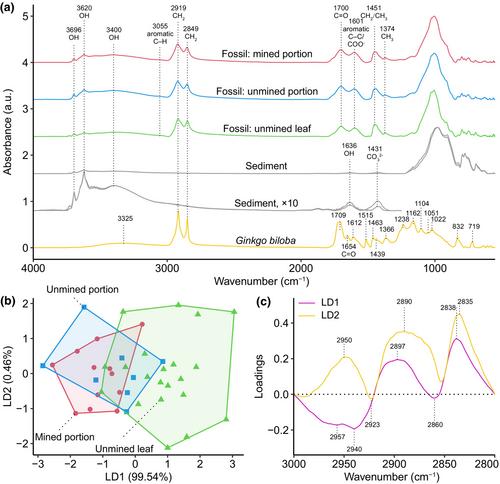
Thirty-three fossil ginkgophyte leaves (B. multipartite Sze et Lee) (Fig. 1b,c) collected from the Upper Triassic Xujiahe Formation in Southwest China were sampled, consisting of 21 unmined leaves and 12 mined leaves. Among the mined leaves, eight were sampled from both the mined portions and unmined portions, while four were solely sampled from the mined portions. The Xujiahe Formation in the Sichuan Basin is a terrestrial sedimentary sequence with alternating lacustrine and fluvial depositional facies (Wang et al., 2010). Specifically, in the Rongxian fossil site (29°27′11″ N, 104°18′02″ E) in the southeastern Sichuan Basin, the formation measures 532–764 m in thickness and is divided into six members. The specimens were collected from the roof-shale of a coal bed within the fifth member of the Xujiahe Formation (see Feng et al., 2022 for more details), and are housed at the Palaeobotanical Collections of Institute of Palaeontology, Yunnan University (YNUPB).
ATR-FTIR analysis was conducted using a Nicolet iS50 FTIR spectrometer equipped with a ZnSe crystal ATR accessory at the Institute of Palaeontology, Yunnan University. The instrumental setup included a spectral resolution of 4 cm−1, a wavenumber range of 4000–550 cm−1, and 64 scans. No chemical treatments were performed before the analysis. For modern leaves, only the adaxial (upper leaf surface) cuticles were analyzed. For each unmined leaf, 3 to 4 spectra were obtained, while for each mined leaf, 3 to 4 were obtained from both the mined and unmined portions, respectively. In the case of fossil leaves, both adaxial and abaxial (lower leaf surface) cuticles were analyzed, as they are difficult to distinguish visually. Then, the spectra of the adaxial cuticles were selected based on the relative intensity of the C=O band at 1700 cm−1, which is relatively higher in the spectra of the adaxial cuticles (Jardine et al., 2019). Moreover, the associated sediment was analyzed for comparison.
Principal component analysis-linear discriminate analysis (PCA-LDA) was performed to obtain information about the spectra variation among the sample groups. First, PCA was performed to reduce the dimensionality of the data, and then LDA was performed on the PC scores to unveil differences among the sample groups. The number of principal components (PCs) used as the input for LDA was determined using leave-one-out cross-validation (LOOCV) (Supporting Information Fig. S1). Model performance was evaluated using Accuracy and Kappa (κ). Accuracy, the proportion of correctly predicted instances, is simple and intuitive but may be misleading in imbalanced datasets. Kappa, by contrast, accounts for chance agreement, providing a more robust assessment of model performance, particularly in imbalanced datasets.
For modern leaves, analyses were performed using the entire spectral range and the 3000–2800 cm−1 range. For fossil leaves, analyses were restricted to the 3000–2800 cm−1 range to avoid potential interference from sediment signals. Before analyzing the full spectra, the spectra were baseline-corrected using the ‘rubberband’ method in the R package alkahest and normalized to the C=O band between 1750 and 1680 cm−1. For the 3000–2800 cm−1 spectral range, spectra were baseline-corrected using the “linear” method and normalized to the CH2 band between 2940 and 2890 cm−1. All analyses were conducted in R 4.3.2 (R Core Team, 2023).
The separation of mined portions from unmined leaves in our PCA-LDA of both modern and fossil leaves indicates that the chemical responses of leaves to leaf mining can be detected with ATR-FTIR.
Carboxylic acids play important roles in plant defenses, and many of them have aliphatic chains. For example, the jasmonic acid, which is derived from linolenic acid, regulates both direct and indirect plant defenses against insects (War et al., 2012). Jasmonic acid can induce the synthesis of molecules in all three major classes of plant secondary metabolites: terpenoids, alkaloids, and phenolic compounds (Geyter et al., 2012). C18 unsaturated fatty acids, such as linoleic acid and linolenic acids, can serve as precursors of green-leaf volatiles, which can attract the natural enemies of the herbivores (Aljbory & Chen, 2018). The relatively higher content of carboxylic acids in the mined portions of modern leaves suggests that leaf mining activated the defense system in modern leaves. The relatively higher contents of polysaccharides in the mined portions of modern leaves align with previous studies that indicate leaf miners can manipulate plant physiology to accumulate sugars in the mines (Giron et al., 2013). That is to say, the leaf miners manipulated plant physiology and suffered plant defense simultaneously. Similarly, Zhang et al. (2016) showed that leaf mining by Phyllonorycter blancardella was associated with enhanced biosynthesis of cytokinins, jasmonic acid, and phenolic compounds in apple trees. It has been demonstrated that leaf miners use cytokinins, a group of plant hormones, to manipulate plant physiology. Thus, the enhanced biosynthesis of cytokinins and jasmonic acid is consistent with our observation of higher contents of polysaccharides and carboxylic acids in mined portions of modern leaves. Our failure to detect an increased content of phenolic compounds in mined portions is likely due to the fact that the IR beam did not reach the induced phenolic compounds. Materska et al. (2022) showed that phenolic compounds accumulate mainly in tissues adjacent to the foraging sites of leaf miners in horse chestnut.
The incorporation of minerals into fossil cuticles constrains the usable spectral range for PCA-LDA. However, restricting the analyses to the 3000–2800 cm−1 range still allows the detection of the effects of leaf mining in both modern and fossil leaves. This is because many carboxylic acids involved in plant defenses contain aliphatic chains that are detectable in this range. Although the fossil leaves analyzed in this study belong to a gymnosperm, it has been demonstrated that G. biloba, the only extant representative of the Ginkgoales, responds to herbivory with the same defense mechanisms adopted by the most recent angiosperms (Mohanta et al., 2012). Moreover, a multispecies genome-wide analysis suggests that jasmonic acid, salicylic acid, and abscisic signaling pathways, all of which regulate plant defenses, might have emerged in the last common ancestor of land plants (Wang et al., 2015). Interestingly, unlike in modern leaves, the unmined portions of fossil leaves appear to be similarly affected as the mined portions. This suggests that leaf mining may have induced both local and systemic defenses in the fossil ginkgophyte, while in the extant plant H. nepalensis, the responses appear to be more localized.
Ginkgo biloba is renowned for its strong resistance to various insects and pathogens (Major, 1967). It has been suggested that continuing herbivore pressure could result in an escalation of plant defenses (Futuyma & Agrawal, 2009). Indeed, evidence of insect damage on fossil ginkgophytes is accumulating. Besides leaf mining, endophytic oviposition and external foliage feeding have been reported from Late Triassic ginkgophyte leaves (Feng et al., 2022; Xu et al., 2024). Xiao et al. (2024) documented three mines from Middle Jurassic ginkgophyte leaves. The evidence of chemical response to leaf mining in the Triassic leaves, as well as flavonoids in Cretaceous leaves (Zhao et al., 2006), suggests that fossil materials may hold clues to the evolutionary history of defense mechanisms in the Ginkgoales.
The study of plant–insect interactions in the fossil record has provided valuable insights into the co-evolutionary dynamics between plants and insects through geological history (Labandeira & Wappler, 2023). Although recent research has made significant progress in documenting various types of insect damage on plant tissues, there exists a notable bias in our understanding, with a predominant focus on the damage over plant defenses (McCoy et al., 2021). Our knowledge of fossil plant defenses largely relies on fossilized structural defenses such as spines and trichomes and morphological evidence of chemical defenses such as amber and oil body cells (McCoy et al., 2021). Our results highlight the potential of chemical analysis in gaining insights into plant defenses in deep time.
In summary, our research presents evidence for chemical defense of a Triassic ginkgophyte plant to leaf mining, and demonstrates the feasibility of gaining insights into plant defenses in deep time through chemical analysis.
None declared.
TZ and ZF conceived and designed this study. ZF and SW collected fossil specimens. ZF, SW and TZ collected modern specimens. TZ and SL conducted ATR-FTIR analysis. TZ analyzed the data. TZ wrote the manuscript with input from other authors. All authors read and approved the final manuscript.
The ATR-FTIR spectra and R code are available on the OSF (https://osf.io/eckgh/).
期刊介绍:
New Phytologist is an international electronic journal published 24 times a year. It is owned by the New Phytologist Foundation, a non-profit-making charitable organization dedicated to promoting plant science. The journal publishes excellent, novel, rigorous, and timely research and scholarship in plant science and its applications. The articles cover topics in five sections: Physiology & Development, Environment, Interaction, Evolution, and Transformative Plant Biotechnology. These sections encompass intracellular processes, global environmental change, and encourage cross-disciplinary approaches. The journal recognizes the use of techniques from molecular and cell biology, functional genomics, modeling, and system-based approaches in plant science. Abstracting and Indexing Information for New Phytologist includes Academic Search, AgBiotech News & Information, Agroforestry Abstracts, Biochemistry & Biophysics Citation Index, Botanical Pesticides, CAB Abstracts®, Environment Index, Global Health, and Plant Breeding Abstracts, and others.









 京公网安备 11010802042870号
京ICP备2023020795号-1
京公网安备 11010802042870号
京ICP备2023020795号-1

 分享
分享
 求助内容:
求助内容: 应助结果提醒方式:
 扫码关注我们
