{"title":"推进临床-基础-临床研究:探索治疗卵巢癌的新型免疫靶点","authors":"Yuanzhuo Gu, Long Zhang, Weiguo Lv","doi":"10.1038/s41392-024-01970-6","DOIUrl":null,"url":null,"abstract":"<p>In a recent paper published in <i>Cell</i>,<sup>1</sup> Luo and colleagues performed a multi-omics analysis of a prospective phase II clinical trial and elucidated the effector regulatory T cells (eTregs) as novel immunotarget for ovarian cancer with homologous recombination deficiency (HRD), analyzing for the first time at the clinical level how poly (ADP-ribose) polymerase (PARP) inhibitors reshape the ovarian cancer microenvironment. The implications of targeting eTregs and combining PARP inhibitors could pave the way for more effective therapies clinically, which is also a typical example of practicing the concept of reverse transformation medicine (RTM) (Fig. 1).</p><figure><figcaption><b data-test=\"figure-caption-text\">Fig. 1</b></figcaption><picture><source srcset=\"//media.springernature.com/lw685/springer-static/image/art%3A10.1038%2Fs41392-024-01970-6/MediaObjects/41392_2024_1970_Fig1_HTML.png?as=webp\" type=\"image/webp\"/><img alt=\"figure 1\" aria-describedby=\"Fig1\" height=\"869\" loading=\"lazy\" src=\"//media.springernature.com/lw685/springer-static/image/art%3A10.1038%2Fs41392-024-01970-6/MediaObjects/41392_2024_1970_Fig1_HTML.png\" width=\"685\"/></picture><p>Schematic diagram of the clinical-basic-clinical cycle. The upper panel presents a specific case study exemplifying the integrative clinical-basic-clinical approach, which recently published in a <i>Cell</i> paper. <b>a</b> The current therapy for HRD ovarian cancer mainly includes surgery, platinum-based neoadjuvant chemotherapy and PARPi maintenance. On this basis, the authors hope to deeply analyze the unique immune profiles of the ovarian cancer tumor microenvironment and provide clues to the phenomenon that HRD tumors respond to PARPi rather than PD-1 immunotherapy. <b>b</b> Next, the authors pioneered a clinical trial of neoadjuvant PARPi for oral monotherapy of HRD advanced ovarian cancer (NANT, NCT04507841). <b>c</b> CCR8<sup>+</sup> eTregs was then identified as a key responder using multi-modality profiling in clinical samples, emerging as a novel immunotarget for HRD ovarian cancer. <b>d</b> Anti-CCR8 mAb was successfully verified an effective immunotherapy regimen, which pave the way for the more effective therapies and improving patient outcomes combined with niraparib. <b>e</b> The lower panel of the diagram illustrates the cyclical loop that connects clinical practice with basic research and back to clinical application, aiming to address key biological questions and to pioneer innovative therapeutic strategies. This process concludes the main four steps: (1) discover new biological insights based on the current clinical therapy; (2) design new clinical trials according to the current unsolved research questions; (3) identify key responders using clinical samples and multi-modality profiling; (4) enlighten novel immunotargets to help develop new clinical therapy</p><span>Full size image</span><svg aria-hidden=\"true\" focusable=\"false\" height=\"16\" role=\"img\" width=\"16\"><use xlink:href=\"#icon-eds-i-chevron-right-small\" xmlns:xlink=\"http://www.w3.org/1999/xlink\"></use></svg></figure>","PeriodicalId":21766,"journal":{"name":"Signal Transduction and Targeted Therapy","volume":"25 1","pages":""},"PeriodicalIF":52.7000,"publicationDate":"2024-09-30","publicationTypes":"Journal Article","fieldsOfStudy":null,"isOpenAccess":false,"openAccessPdf":"","citationCount":"0","resultStr":"{\"title\":\"Advancing clinical-basic-clinical research: exploring novel immunotargets for ovarian cancer\",\"authors\":\"Yuanzhuo Gu, Long Zhang, Weiguo Lv\",\"doi\":\"10.1038/s41392-024-01970-6\",\"DOIUrl\":null,\"url\":null,\"abstract\":\"<p>In a recent paper published in <i>Cell</i>,<sup>1</sup> Luo and colleagues performed a multi-omics analysis of a prospective phase II clinical trial and elucidated the effector regulatory T cells (eTregs) as novel immunotarget for ovarian cancer with homologous recombination deficiency (HRD), analyzing for the first time at the clinical level how poly (ADP-ribose) polymerase (PARP) inhibitors reshape the ovarian cancer microenvironment. The implications of targeting eTregs and combining PARP inhibitors could pave the way for more effective therapies clinically, which is also a typical example of practicing the concept of reverse transformation medicine (RTM) (Fig. 1).</p><figure><figcaption><b data-test=\\\"figure-caption-text\\\">Fig. 1</b></figcaption><picture><source srcset=\\\"//media.springernature.com/lw685/springer-static/image/art%3A10.1038%2Fs41392-024-01970-6/MediaObjects/41392_2024_1970_Fig1_HTML.png?as=webp\\\" type=\\\"image/webp\\\"/><img alt=\\\"figure 1\\\" aria-describedby=\\\"Fig1\\\" height=\\\"869\\\" loading=\\\"lazy\\\" src=\\\"//media.springernature.com/lw685/springer-static/image/art%3A10.1038%2Fs41392-024-01970-6/MediaObjects/41392_2024_1970_Fig1_HTML.png\\\" width=\\\"685\\\"/></picture><p>Schematic diagram of the clinical-basic-clinical cycle. The upper panel presents a specific case study exemplifying the integrative clinical-basic-clinical approach, which recently published in a <i>Cell</i> paper. <b>a</b> The current therapy for HRD ovarian cancer mainly includes surgery, platinum-based neoadjuvant chemotherapy and PARPi maintenance. On this basis, the authors hope to deeply analyze the unique immune profiles of the ovarian cancer tumor microenvironment and provide clues to the phenomenon that HRD tumors respond to PARPi rather than PD-1 immunotherapy. <b>b</b> Next, the authors pioneered a clinical trial of neoadjuvant PARPi for oral monotherapy of HRD advanced ovarian cancer (NANT, NCT04507841). <b>c</b> CCR8<sup>+</sup> eTregs was then identified as a key responder using multi-modality profiling in clinical samples, emerging as a novel immunotarget for HRD ovarian cancer. <b>d</b> Anti-CCR8 mAb was successfully verified an effective immunotherapy regimen, which pave the way for the more effective therapies and improving patient outcomes combined with niraparib. <b>e</b> The lower panel of the diagram illustrates the cyclical loop that connects clinical practice with basic research and back to clinical application, aiming to address key biological questions and to pioneer innovative therapeutic strategies. This process concludes the main four steps: (1) discover new biological insights based on the current clinical therapy; (2) design new clinical trials according to the current unsolved research questions; (3) identify key responders using clinical samples and multi-modality profiling; (4) enlighten novel immunotargets to help develop new clinical therapy</p><span>Full size image</span><svg aria-hidden=\\\"true\\\" focusable=\\\"false\\\" height=\\\"16\\\" role=\\\"img\\\" width=\\\"16\\\"><use xlink:href=\\\"#icon-eds-i-chevron-right-small\\\" xmlns:xlink=\\\"http://www.w3.org/1999/xlink\\\"></use></svg></figure>\",\"PeriodicalId\":21766,\"journal\":{\"name\":\"Signal Transduction and Targeted Therapy\",\"volume\":\"25 1\",\"pages\":\"\"},\"PeriodicalIF\":52.7000,\"publicationDate\":\"2024-09-30\",\"publicationTypes\":\"Journal Article\",\"fieldsOfStudy\":null,\"isOpenAccess\":false,\"openAccessPdf\":\"\",\"citationCount\":\"0\",\"resultStr\":null,\"platform\":\"Semanticscholar\",\"paperid\":null,\"PeriodicalName\":\"Signal Transduction and Targeted Therapy\",\"FirstCategoryId\":\"3\",\"ListUrlMain\":\"https://doi.org/10.1038/s41392-024-01970-6\",\"RegionNum\":1,\"RegionCategory\":\"医学\",\"ArticlePicture\":[],\"TitleCN\":null,\"AbstractTextCN\":null,\"PMCID\":null,\"EPubDate\":\"\",\"PubModel\":\"\",\"JCR\":\"Q1\",\"JCRName\":\"BIOCHEMISTRY & MOLECULAR BIOLOGY\",\"Score\":null,\"Total\":0}","platform":"Semanticscholar","paperid":null,"PeriodicalName":"Signal Transduction and Targeted Therapy","FirstCategoryId":"3","ListUrlMain":"https://doi.org/10.1038/s41392-024-01970-6","RegionNum":1,"RegionCategory":"医学","ArticlePicture":[],"TitleCN":null,"AbstractTextCN":null,"PMCID":null,"EPubDate":"","PubModel":"","JCR":"Q1","JCRName":"BIOCHEMISTRY & MOLECULAR BIOLOGY","Score":null,"Total":0}
Advancing clinical-basic-clinical research: exploring novel immunotargets for ovarian cancer
In a recent paper published in Cell,1 Luo and colleagues performed a multi-omics analysis of a prospective phase II clinical trial and elucidated the effector regulatory T cells (eTregs) as novel immunotarget for ovarian cancer with homologous recombination deficiency (HRD), analyzing for the first time at the clinical level how poly (ADP-ribose) polymerase (PARP) inhibitors reshape the ovarian cancer microenvironment. The implications of targeting eTregs and combining PARP inhibitors could pave the way for more effective therapies clinically, which is also a typical example of practicing the concept of reverse transformation medicine (RTM) (Fig. 1).
Fig. 1
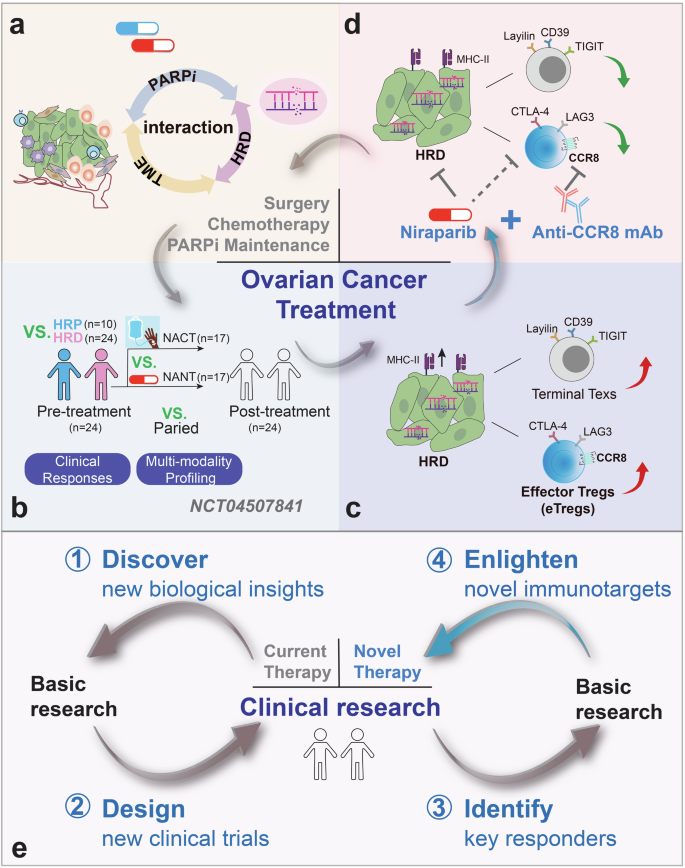
Schematic diagram of the clinical-basic-clinical cycle. The upper panel presents a specific case study exemplifying the integrative clinical-basic-clinical approach, which recently published in a Cell paper. a The current therapy for HRD ovarian cancer mainly includes surgery, platinum-based neoadjuvant chemotherapy and PARPi maintenance. On this basis, the authors hope to deeply analyze the unique immune profiles of the ovarian cancer tumor microenvironment and provide clues to the phenomenon that HRD tumors respond to PARPi rather than PD-1 immunotherapy. b Next, the authors pioneered a clinical trial of neoadjuvant PARPi for oral monotherapy of HRD advanced ovarian cancer (NANT, NCT04507841). c CCR8+ eTregs was then identified as a key responder using multi-modality profiling in clinical samples, emerging as a novel immunotarget for HRD ovarian cancer. d Anti-CCR8 mAb was successfully verified an effective immunotherapy regimen, which pave the way for the more effective therapies and improving patient outcomes combined with niraparib. e The lower panel of the diagram illustrates the cyclical loop that connects clinical practice with basic research and back to clinical application, aiming to address key biological questions and to pioneer innovative therapeutic strategies. This process concludes the main four steps: (1) discover new biological insights based on the current clinical therapy; (2) design new clinical trials according to the current unsolved research questions; (3) identify key responders using clinical samples and multi-modality profiling; (4) enlighten novel immunotargets to help develop new clinical therapy
期刊介绍:
Signal Transduction and Targeted Therapy is an open access journal that focuses on timely publication of cutting-edge discoveries and advancements in basic science and clinical research related to signal transduction and targeted therapy.
Scope: The journal covers research on major human diseases, including, but not limited to:
Cancer,Cardiovascular diseases,Autoimmune diseases,Nervous system diseases.





 京公网安备 11010802042870号
京ICP备2023020795号-1
京公网安备 11010802042870号
京ICP备2023020795号-1

 分享
分享
 求助内容:
求助内容: 应助结果提醒方式:
 扫码关注我们
