{"title":"极化对磺胺类药物 H 键受体特性的影响。","authors":"Fergal E. Hanna , Christopher A. Hunter","doi":"10.1039/d4cc03530e","DOIUrl":null,"url":null,"abstract":"<div><div>The strengths of H-bonding interactions in networks are affected by cooperativity between the interacting sites. Compounds with an intramolecular H-bond between a sulfonamide NH group and pyridine nitrogen were used to measure the magnitude of cooperative effects on intermolecular H-bonding interactions with the sulfonamide oxygen. X-ray crystallography and <sup>1</sup>H NMR experiments confirm the presence of the intramolecular H-bond and show that it is maintained in the 1 : 1 complex formed with perfluoro-<em>tert</em>-butanol (PFTB) in <em>n</em>-octane solution. Association constants for formation of 1 : 1 complexes with PFTB were determined using UV/Vis absorption titrations for a series of compounds equipped with different pyridine groups. Substituents on the pyridine were used to tune the strength of the intramolecular H-bond and investigate the effects on the strength of the intermolecular H-bond. Electron-donating groups on the pyridine that increase the strength of the intramolecular H-bond were found to increase in the strength of the intermolecular interaction with PFTB. The results were used to determine the H-bond acceptor parameters, <em>β</em>, for the sulfonamide oxygen group, and the values show a linear relationship with the value of <em>β</em> for the pyridine nitrogen. The slope of this relationship corresponds to the cooperativity parameter, <em>κ</em>, which is +0.16. The positive cooperativity observed in H-bonded sulfonamides is comparable to the value measured previously for the amide group (<em>κ</em> = +0.20).</div></div>","PeriodicalId":67,"journal":{"name":"Chemical Communications","volume":"60 82","pages":"Pages 11750-11753"},"PeriodicalIF":4.2000,"publicationDate":"2024-08-30","publicationTypes":"Journal Article","fieldsOfStudy":null,"isOpenAccess":false,"openAccessPdf":"https://pubs.rsc.org/en/content/articlepdf/2024/cc/d4cc03530e?page=search","citationCount":"0","resultStr":"{\"title\":\"Polarisation effects on the H-bond acceptor properties of sulfonamides†\",\"authors\":\"Fergal E. Hanna , Christopher A. Hunter\",\"doi\":\"10.1039/d4cc03530e\",\"DOIUrl\":null,\"url\":null,\"abstract\":\"<div><div>The strengths of H-bonding interactions in networks are affected by cooperativity between the interacting sites. Compounds with an intramolecular H-bond between a sulfonamide NH group and pyridine nitrogen were used to measure the magnitude of cooperative effects on intermolecular H-bonding interactions with the sulfonamide oxygen. X-ray crystallography and <sup>1</sup>H NMR experiments confirm the presence of the intramolecular H-bond and show that it is maintained in the 1 : 1 complex formed with perfluoro-<em>tert</em>-butanol (PFTB) in <em>n</em>-octane solution. Association constants for formation of 1 : 1 complexes with PFTB were determined using UV/Vis absorption titrations for a series of compounds equipped with different pyridine groups. Substituents on the pyridine were used to tune the strength of the intramolecular H-bond and investigate the effects on the strength of the intermolecular H-bond. Electron-donating groups on the pyridine that increase the strength of the intramolecular H-bond were found to increase in the strength of the intermolecular interaction with PFTB. The results were used to determine the H-bond acceptor parameters, <em>β</em>, for the sulfonamide oxygen group, and the values show a linear relationship with the value of <em>β</em> for the pyridine nitrogen. The slope of this relationship corresponds to the cooperativity parameter, <em>κ</em>, which is +0.16. The positive cooperativity observed in H-bonded sulfonamides is comparable to the value measured previously for the amide group (<em>κ</em> = +0.20).</div></div>\",\"PeriodicalId\":67,\"journal\":{\"name\":\"Chemical Communications\",\"volume\":\"60 82\",\"pages\":\"Pages 11750-11753\"},\"PeriodicalIF\":4.2000,\"publicationDate\":\"2024-08-30\",\"publicationTypes\":\"Journal Article\",\"fieldsOfStudy\":null,\"isOpenAccess\":false,\"openAccessPdf\":\"https://pubs.rsc.org/en/content/articlepdf/2024/cc/d4cc03530e?page=search\",\"citationCount\":\"0\",\"resultStr\":null,\"platform\":\"Semanticscholar\",\"paperid\":null,\"PeriodicalName\":\"Chemical Communications\",\"FirstCategoryId\":\"92\",\"ListUrlMain\":\"https://www.sciencedirect.com/org/science/article/pii/S1359734524019761\",\"RegionNum\":2,\"RegionCategory\":\"化学\",\"ArticlePicture\":[],\"TitleCN\":null,\"AbstractTextCN\":null,\"PMCID\":null,\"EPubDate\":\"2024/9/25 0:00:00\",\"PubModel\":\"Epub\",\"JCR\":\"Q2\",\"JCRName\":\"CHEMISTRY, MULTIDISCIPLINARY\",\"Score\":null,\"Total\":0}","platform":"Semanticscholar","paperid":null,"PeriodicalName":"Chemical Communications","FirstCategoryId":"92","ListUrlMain":"https://www.sciencedirect.com/org/science/article/pii/S1359734524019761","RegionNum":2,"RegionCategory":"化学","ArticlePicture":[],"TitleCN":null,"AbstractTextCN":null,"PMCID":null,"EPubDate":"2024/9/25 0:00:00","PubModel":"Epub","JCR":"Q2","JCRName":"CHEMISTRY, MULTIDISCIPLINARY","Score":null,"Total":0}
引用次数: 0
摘要
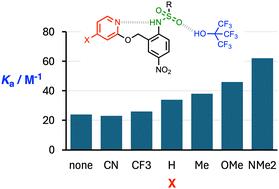
网络中 H 键相互作用的强度受到相互作用位点之间合作性的影响。我们利用磺酰胺 NH 基团和吡啶氮之间具有分子内 H 键的化合物来测量分子间 H 键相互作用与磺酰胺氧的协同效应的大小。X 射线晶体学和 1H NMR 实验证实了分子内 H 键的存在,并表明在 1 :1 复合物中保持不变。与 PFTB 形成 1 :使用紫外/可见吸收滴定法测定了一系列带有不同吡啶基团的化合物与 PFTB 形成 1 : 1 复合物的结合常数。吡啶上的取代基被用来调节分子内 H 键的强度,并研究其对分子间 H 键强度的影响。发现吡啶上的电子供能基团增加了分子内 H 键的强度,从而增加了与 PFTB 分子间相互作用的强度。研究结果用于确定磺酰胺氧基的 H 键受体参数 β,其值与吡啶氮的 β 值呈线性关系。这一关系的斜率对应于合作性参数κ,即 +0.16。在以 H 键结合的磺酰胺中观察到的正合作性与之前测得的酰胺基的值(κ = +0.20)相当。
Polarisation effects on the H-bond acceptor properties of sulfonamides†
The strengths of H-bonding interactions in networks are affected by cooperativity between the interacting sites. Compounds with an intramolecular H-bond between a sulfonamide NH group and pyridine nitrogen were used to measure the magnitude of cooperative effects on intermolecular H-bonding interactions with the sulfonamide oxygen. X-ray crystallography and 1H NMR experiments confirm the presence of the intramolecular H-bond and show that it is maintained in the 1 : 1 complex formed with perfluoro-tert-butanol (PFTB) in n-octane solution. Association constants for formation of 1 : 1 complexes with PFTB were determined using UV/Vis absorption titrations for a series of compounds equipped with different pyridine groups. Substituents on the pyridine were used to tune the strength of the intramolecular H-bond and investigate the effects on the strength of the intermolecular H-bond. Electron-donating groups on the pyridine that increase the strength of the intramolecular H-bond were found to increase in the strength of the intermolecular interaction with PFTB. The results were used to determine the H-bond acceptor parameters, β, for the sulfonamide oxygen group, and the values show a linear relationship with the value of β for the pyridine nitrogen. The slope of this relationship corresponds to the cooperativity parameter, κ, which is +0.16. The positive cooperativity observed in H-bonded sulfonamides is comparable to the value measured previously for the amide group (κ = +0.20).
期刊介绍:
ChemComm (Chemical Communications) is renowned as the fastest publisher of articles providing information on new avenues of research, drawn from all the world''s major areas of chemical research.




 京公网安备 11010802042870号
京ICP备2023020795号-1
京公网安备 11010802042870号
京ICP备2023020795号-1

 分享
分享
 求助内容:
求助内容: 应助结果提醒方式:
 扫码关注我们
