Thabo Mahendiran , Dorina Thanou , Ortal Senouf , Yassine Jamaa , Stephane Fournier , Bernard De Bruyne , Emmanuel Abbé , Olivier Muller , Edward Andò
{"title":"AngioPy分割:用于冠状动脉分割的开源、用户指导型深度学习工具。","authors":"Thabo Mahendiran , Dorina Thanou , Ortal Senouf , Yassine Jamaa , Stephane Fournier , Bernard De Bruyne , Emmanuel Abbé , Olivier Muller , Edward Andò","doi":"10.1016/j.ijcard.2024.132598","DOIUrl":null,"url":null,"abstract":"<div><h3>Background</h3><div>Quantitative coronary angiography (QCA) typically employs traditional edge detection algorithms that often require manual correction. This has important implications for the accuracy of downstream 3D coronary reconstructions and computed haemodynamic indices (e.g. angiography-derived fractional flow reserve).</div><div>We developed <em>AngioPy</em>, a deep-learning model for coronary segmentation that employs user-defined ground-truth points to boost performance and minimise manual correction. We compared its performance without correction with an established QCA system.</div></div><div><h3>Methods</h3><div>Deep learning models integrating user-defined ground-truth points were developed using 2455 images from the Fractional Flow Reserve versus Angiography for Multivessel Evaluation 2 (FAME 2) study. External validation was performed on a dataset of 580 images. Vessel dimensions from 203 images with mild/moderate stenoses segmented by <em>AngioPy</em> (without correction) and an established QCA system (Medis QFR®) were compared (609 diameters).</div></div><div><h3>Results</h3><div>The top-performing model had an average F1 score of 0.927 (pixel accuracy 0.998, precision 0.925, sensitivity 0.930, specificity 0.999) with 99.2 % of masks exhibiting an F1 score > 0.8. Similar results were seen with external validation (F1 score 0.924, pixel accuracy 0.997, precision 0.921, sensitivity 0.929, specificity 0.999). Vessel dimensions from <em>AngioPy</em> exhibited excellent agreement with QCA (<em>r</em> = 0.96 [95 % CI 0.95–0.96], <em>p</em> < 0.001; mean difference − 0.18 mm [limits of agreement (LOA): −0.84 to 0.49]), including the minimal luminal diameter (<em>r</em> = 0.93 [95 % CI 0.91–0.95], <em>p</em> < 0.001; mean difference − 0.06 mm [LOA: −0.70 to 0.59]).</div></div><div><h3>Conclusion</h3><div><em>AngioPy</em>, an open-source tool, performs rapid and accurate coronary segmentation without the need for manual correction. It has the potential to increase the accuracy and efficiency of QCA.</div></div>","PeriodicalId":13710,"journal":{"name":"International journal of cardiology","volume":"418 ","pages":"Article 132598"},"PeriodicalIF":3.3000,"publicationDate":"2025-01-01","publicationTypes":"Journal Article","fieldsOfStudy":null,"isOpenAccess":false,"openAccessPdf":"","citationCount":"0","resultStr":"{\"title\":\"AngioPy Segmentation: An open-source, user-guided deep learning tool for coronary artery segmentation\",\"authors\":\"Thabo Mahendiran , Dorina Thanou , Ortal Senouf , Yassine Jamaa , Stephane Fournier , Bernard De Bruyne , Emmanuel Abbé , Olivier Muller , Edward Andò\",\"doi\":\"10.1016/j.ijcard.2024.132598\",\"DOIUrl\":null,\"url\":null,\"abstract\":\"<div><h3>Background</h3><div>Quantitative coronary angiography (QCA) typically employs traditional edge detection algorithms that often require manual correction. This has important implications for the accuracy of downstream 3D coronary reconstructions and computed haemodynamic indices (e.g. angiography-derived fractional flow reserve).</div><div>We developed <em>AngioPy</em>, a deep-learning model for coronary segmentation that employs user-defined ground-truth points to boost performance and minimise manual correction. We compared its performance without correction with an established QCA system.</div></div><div><h3>Methods</h3><div>Deep learning models integrating user-defined ground-truth points were developed using 2455 images from the Fractional Flow Reserve versus Angiography for Multivessel Evaluation 2 (FAME 2) study. External validation was performed on a dataset of 580 images. Vessel dimensions from 203 images with mild/moderate stenoses segmented by <em>AngioPy</em> (without correction) and an established QCA system (Medis QFR®) were compared (609 diameters).</div></div><div><h3>Results</h3><div>The top-performing model had an average F1 score of 0.927 (pixel accuracy 0.998, precision 0.925, sensitivity 0.930, specificity 0.999) with 99.2 % of masks exhibiting an F1 score > 0.8. Similar results were seen with external validation (F1 score 0.924, pixel accuracy 0.997, precision 0.921, sensitivity 0.929, specificity 0.999). Vessel dimensions from <em>AngioPy</em> exhibited excellent agreement with QCA (<em>r</em> = 0.96 [95 % CI 0.95–0.96], <em>p</em> < 0.001; mean difference − 0.18 mm [limits of agreement (LOA): −0.84 to 0.49]), including the minimal luminal diameter (<em>r</em> = 0.93 [95 % CI 0.91–0.95], <em>p</em> < 0.001; mean difference − 0.06 mm [LOA: −0.70 to 0.59]).</div></div><div><h3>Conclusion</h3><div><em>AngioPy</em>, an open-source tool, performs rapid and accurate coronary segmentation without the need for manual correction. It has the potential to increase the accuracy and efficiency of QCA.</div></div>\",\"PeriodicalId\":13710,\"journal\":{\"name\":\"International journal of cardiology\",\"volume\":\"418 \",\"pages\":\"Article 132598\"},\"PeriodicalIF\":3.3000,\"publicationDate\":\"2025-01-01\",\"publicationTypes\":\"Journal Article\",\"fieldsOfStudy\":null,\"isOpenAccess\":false,\"openAccessPdf\":\"\",\"citationCount\":\"0\",\"resultStr\":null,\"platform\":\"Semanticscholar\",\"paperid\":null,\"PeriodicalName\":\"International journal of cardiology\",\"FirstCategoryId\":\"3\",\"ListUrlMain\":\"https://www.sciencedirect.com/science/article/pii/S0167527324012208\",\"RegionNum\":2,\"RegionCategory\":\"医学\",\"ArticlePicture\":[],\"TitleCN\":null,\"AbstractTextCN\":null,\"PMCID\":null,\"EPubDate\":\"2024/9/26 0:00:00\",\"PubModel\":\"Epub\",\"JCR\":\"Q2\",\"JCRName\":\"CARDIAC & CARDIOVASCULAR SYSTEMS\",\"Score\":null,\"Total\":0}","platform":"Semanticscholar","paperid":null,"PeriodicalName":"International journal of cardiology","FirstCategoryId":"3","ListUrlMain":"https://www.sciencedirect.com/science/article/pii/S0167527324012208","RegionNum":2,"RegionCategory":"医学","ArticlePicture":[],"TitleCN":null,"AbstractTextCN":null,"PMCID":null,"EPubDate":"2024/9/26 0:00:00","PubModel":"Epub","JCR":"Q2","JCRName":"CARDIAC & CARDIOVASCULAR SYSTEMS","Score":null,"Total":0}
AngioPy Segmentation: An open-source, user-guided deep learning tool for coronary artery segmentation
Background
Quantitative coronary angiography (QCA) typically employs traditional edge detection algorithms that often require manual correction. This has important implications for the accuracy of downstream 3D coronary reconstructions and computed haemodynamic indices (e.g. angiography-derived fractional flow reserve).
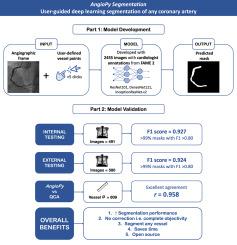
We developed AngioPy, a deep-learning model for coronary segmentation that employs user-defined ground-truth points to boost performance and minimise manual correction. We compared its performance without correction with an established QCA system.
Methods
Deep learning models integrating user-defined ground-truth points were developed using 2455 images from the Fractional Flow Reserve versus Angiography for Multivessel Evaluation 2 (FAME 2) study. External validation was performed on a dataset of 580 images. Vessel dimensions from 203 images with mild/moderate stenoses segmented by AngioPy (without correction) and an established QCA system (Medis QFR®) were compared (609 diameters).
Results
The top-performing model had an average F1 score of 0.927 (pixel accuracy 0.998, precision 0.925, sensitivity 0.930, specificity 0.999) with 99.2 % of masks exhibiting an F1 score > 0.8. Similar results were seen with external validation (F1 score 0.924, pixel accuracy 0.997, precision 0.921, sensitivity 0.929, specificity 0.999). Vessel dimensions from AngioPy exhibited excellent agreement with QCA (r = 0.96 [95 % CI 0.95–0.96], p < 0.001; mean difference − 0.18 mm [limits of agreement (LOA): −0.84 to 0.49]), including the minimal luminal diameter (r = 0.93 [95 % CI 0.91–0.95], p < 0.001; mean difference − 0.06 mm [LOA: −0.70 to 0.59]).
Conclusion
AngioPy, an open-source tool, performs rapid and accurate coronary segmentation without the need for manual correction. It has the potential to increase the accuracy and efficiency of QCA.
期刊介绍:
The International Journal of Cardiology is devoted to cardiology in the broadest sense. Both basic research and clinical papers can be submitted. The journal serves the interest of both practicing clinicians and researchers.
In addition to original papers, we are launching a range of new manuscript types, including Consensus and Position Papers, Systematic Reviews, Meta-analyses, and Short communications. Case reports are no longer acceptable. Controversial techniques, issues on health policy and social medicine are discussed and serve as useful tools for encouraging debate.




 京公网安备 11010802042870号
京ICP备2023020795号-1
京公网安备 11010802042870号
京ICP备2023020795号-1

 分享
分享
 求助内容:
求助内容: 应助结果提醒方式:
 扫码关注我们
