Neda Cramer, Johannes Mohr, Michael P. Schön, Rotraut Mössner
{"title":"用JAK抑制剂upadacitinib治疗严重的手部和全身混合性湿疹。","authors":"Neda Cramer, Johannes Mohr, Michael P. Schön, Rotraut Mössner","doi":"10.1111/ddg.15532","DOIUrl":null,"url":null,"abstract":"<p>Dear Editors,</p><p>Hand eczema (HE) is a widespread chronic inflammatory itchy and painful skin disease with an estimated lifetime prevalence of 14.5%.<span><sup>1</sup></span> Its complex pathogenesis involves intrinsic and extrinsic influences, some of which are mutually reinforcing.<span><sup>1, 2</sup></span> Atopic dermatitis (AD) is considered the most prevalent endogenous predisposing factor.<span><sup>1</sup></span> Treatment of steroid-refractory HE is often difficult because the triggering pathogenic influences are frequently repetitive or long-lasting, chronic tissue alterations may already be present, and there are not many therapeutic alternatives. This case report illustrates a patient with severe HE and partly lichenoid generalized eczema, in whom atopic diathesis as well as irritative triggers were present and who was successfully treated with upadacitinib.</p><p>An 81-year-old patient presented with a two-months history of painful palmoplantar hyperkeratosis refractory to potent topical steroids. Exacerbation and generalization of the dermatitis had occurred after the COVID-19 vaccinations. Palmar lesions worsened when he performed his occupational work as a violin maker, but also persisted during extended work-free periods. Twenty years ago, he was diagnosed with psoriasis, which had remitted rapidly. Other pre-existing conditions include prostate carcinoma first diagnosed 12 years ago, presently in remission, and cigarette smoking. He presented with generalized, partially lichenoid erythematous plaques on the entire integument as well as pronounced palmoplantar hyperkeratosis, deep rhagades, and scaling (Figure 1a). The first histologic analysis of the palm revealed epithelial hyperplasia, lichenoid lymphocytic infiltrate with marked epidermotropism predominantly of CD8<sup>+</sup>-cells. Because of the lack of clonal lymphocyte proliferation, lymphoma was less likely. Histological results of repeated skin biopsies from the abdomen were compatible with subacute eczema. We diagnosed severe mixed HE with components of atopic and irritant contact dermatitis, possibly aggravated by SARS-CoV-2 vaccinations, and disseminated, partially lichenoid, eczema in atopic diatheses (total IgE 672.00 kU/l, normal range < 120.00 kU/l). Anamnestically, there were no concrete indications of an allergic contact dermatitis. An epicutaneous test was not possible due to the pronounced skin findings. Under therapy with acitretin (30 mg/d) and UV irradiation (UVB 311 nm, and cream-PUVA) the skin lesions initially worsened, whereupon the patient discontinued UV therapy and continued treatment with the other two modalities only irregularly. After 4 weeks, he was readmitted because of a marked exacerbation.</p><p>We resumed therapy, but skin lesions worsened, and side effects such as dryness and redness of the eyes occurred, so acitretin was discontinued after altogether 5 months. Therapy with methotrexate 15 mg s.c. was initiated, and within 2 weeks liver enzymes increased fourfold, so methotrexate was discontinued. Subsequently, therapy with upadacitinib 15 mg was initiated.</p><p>After 3 days of upadacitinib therapy, the patient reported a marked alleviation of itching and pain, and after 8 days, he noted substantial improvement in skin lesions. A follow-up examination after 6 weeks showed a clear improvement. The skin lesions had almost cleared, with only the palms showing mild scaling (Figure 1b). Mometasone ointment was used only as needed. After 4.5 months of upadacitinib therapy, <i>Hand Eczema Severity Index</i> (HECSI) had dropped from 130 before therapy to 0, <i>Investigator's Global Assessment</i> (IGA) from 4 to 0, <i>Eczema Area and Severity Index</i> (EASI) from 25.9 to 0.9, and <i>Dermatology Life Quality Index</i> (DLQI) dropped from 20 to 0. Apart from slightly elevated lipid levels, no side effects occurred.</p><p>JAK inhibitors (JAKi) are considered the next generation of systemic therapeutics for AD, with baricitinib, abrocitinib and upadacitinib being currently approved in Europe.<span><sup>3-5</sup></span> The latter two act preferentially on JAK1.<span><sup>6-8</sup></span> Upadacitinib has been explored recently in atopic HE demonstrating efficacy in a post hoc subgroup analysis of the <i>Measure Up 1</i> and <i>2</i> studies.<span><sup>9</sup></span> In contrast to our patient with a HECSI score of 130, the mean HESCI score at baseline in these two studies was only 44.5, just reaching the level of severe HE (HECSI score between 38 and 117), while a HECSI score of ≥ 117 defines very severe HE. In an analysis of the Dutch BioDay ad therapy registry, good efficacy of upadacitinib in atopic HE was also found, here mean HECSI amounted to 44.2.<span><sup>10</sup></span> In subgroup analyses of patients with irritant contact dermatitis (ICD; n = 12), they found that the contribution of ICD did not affect the efficacy of upadacitinib.<span><sup>10</sup></span> Topical therapy with the pan-JAKi delgocitinib has also shown good efficacy in chronic HE.<span><sup>11, 12</sup></span> At the time of initiation of upadacitinib therapy, there was only a <i>Direct Healthcare Professional Communication</i> for the JAKi tofacitinib reporting an increased risk of serious adverse events with the use of tofacitinib compared with TNF-alpha inhibitors.<span><sup>13</sup></span> However, this was later considered to be a class effect of JAKi and it was recommended that upadacitinib should not be used in patients with certain risk factors such as smoking, age over 65, or a history of malignancy unless a better alternative was available.<span><sup>14</sup></span> After a risk-benefit assessment, we initially continued upadacitinib therapy under close clinical and laboratory monitoring and reduced the dose of upadacitinib to 15 mg every other day after a total of 8 months of upadacitinib therapy. After a total of 10 months, the excellent therapeutic response persisted, and upadacitinib therapy was discontinued. As for the differential diagnosis of cutaneous T-cell lymphoma (CTCL), it could not be definitively ruled out in our patient and he will be continuously monitored for CTCL, including repeat biopsies in case of worsening. The good therapeutic response of skin lesions also does not preclude the diagnosis of CTCL, as dysregulation of JAKs has been reported in cutaneous T-cell lymphoma, and JAKi as potential therapeutic agents for CTCL are being discussed,<span><sup>15</sup></span> with so far inhomogeneous clinical data. For example, while a tofacitinib-induced lymphomatoid papulosis has been reported,<span><sup>16</sup></span> therapeutic success of upadacitinib in a patient with erythrodermic mycosis fungoides has also been observed,<span><sup>17</sup></span> and in a clinical phase 2 trial, ruxolitinib achieved a partial response in one out of seven patients with mycosis fungoides.<span><sup>18</sup></span></p><p>In our patient, a few days after discontinuation of upadacitinib, a severe relapse occurred. Newly identified risks of upadacitinib and other therapeutic options, particularly dupilumab, a monoclonal antibody directed against the alpha chain of the IL-4 receptor that has been licensed for treatment of atopic dermatitis were discussed with the patient. At the beginning, we had opted for treatment with upadacitinib due to its higher efficacy and the expected faster onset of action compared to dupilumab. Upadacitinib had been discontinued after resolution of skin lesions, and when the relapse occurred, the patient chose to resume upadacitinib despite its newly identified safety risks. Upadacitinib therapy again led to a resolution of skin lesions, and upadacitinib dose was reduced to 15 mg every other day. We plan to further reduce upadacitinib dose in case of persisting good clinical response and, if the patient consents, as exit strategy, switch from upadacitinib to dupilumab without a treatment-free interval.</p><p>Our case demonstrates the good efficacy of upadacitinib in a patient with very severe mixed HE with components of atopic and irritant contact dermatitis, that did not respond adequately to topical steroids and systemic therapies. Thus, upadacitinib may be a promising therapeutic option for severe HE that warrants further study.</p><p>J.M. has been an advisor and/or received grants and/or participated in clinical trials of the following companies: Abbvie, Allmirall, Biogen IDEC, Boehringer-Ingelheim, Celgene, Janssen-Cilag, Leo Pharma GmbH, Lilly, MSD SHARP & DOHME, Novartis Pharma, Pfizer and UCB. R.M. has been an advisor and/or received speakers’ honoraria and/or received grants and/or participated in clinical trials of the following companies: Abbvie, Almirall, Biogen IDEC, Boehringer-Ingelheim, Celgene, Janssen-Cilag, Leo Pharma, Lilly, MSD SHARP & DOHME, Novartis Pharma, Pfizer and UCB. M.P.S. has been an advisor and/or received speakers’ honoraria and/or received grants and/or participated in clinical trials of the following companies: Abbvie, Allmirall, Biogen, Boehringer-Ingelheim, Janssen-Cilag, Leo, Lilly, Novartis, UCB. N.C. reports no conflicts of interest.</p>","PeriodicalId":14758,"journal":{"name":"Journal Der Deutschen Dermatologischen Gesellschaft","volume":"23 1","pages":"93-95"},"PeriodicalIF":3.8000,"publicationDate":"2024-09-27","publicationTypes":"Journal Article","fieldsOfStudy":null,"isOpenAccess":false,"openAccessPdf":"https://www.ncbi.nlm.nih.gov/pmc/articles/PMC11711924/pdf/","citationCount":"0","resultStr":"{\"title\":\"Severe mixed hand and generalized eczema treated with the JAK inhibitor upadacitinib\",\"authors\":\"Neda Cramer, Johannes Mohr, Michael P. Schön, Rotraut Mössner\",\"doi\":\"10.1111/ddg.15532\",\"DOIUrl\":null,\"url\":null,\"abstract\":\"<p>Dear Editors,</p><p>Hand eczema (HE) is a widespread chronic inflammatory itchy and painful skin disease with an estimated lifetime prevalence of 14.5%.<span><sup>1</sup></span> Its complex pathogenesis involves intrinsic and extrinsic influences, some of which are mutually reinforcing.<span><sup>1, 2</sup></span> Atopic dermatitis (AD) is considered the most prevalent endogenous predisposing factor.<span><sup>1</sup></span> Treatment of steroid-refractory HE is often difficult because the triggering pathogenic influences are frequently repetitive or long-lasting, chronic tissue alterations may already be present, and there are not many therapeutic alternatives. This case report illustrates a patient with severe HE and partly lichenoid generalized eczema, in whom atopic diathesis as well as irritative triggers were present and who was successfully treated with upadacitinib.</p><p>An 81-year-old patient presented with a two-months history of painful palmoplantar hyperkeratosis refractory to potent topical steroids. Exacerbation and generalization of the dermatitis had occurred after the COVID-19 vaccinations. Palmar lesions worsened when he performed his occupational work as a violin maker, but also persisted during extended work-free periods. Twenty years ago, he was diagnosed with psoriasis, which had remitted rapidly. Other pre-existing conditions include prostate carcinoma first diagnosed 12 years ago, presently in remission, and cigarette smoking. He presented with generalized, partially lichenoid erythematous plaques on the entire integument as well as pronounced palmoplantar hyperkeratosis, deep rhagades, and scaling (Figure 1a). The first histologic analysis of the palm revealed epithelial hyperplasia, lichenoid lymphocytic infiltrate with marked epidermotropism predominantly of CD8<sup>+</sup>-cells. Because of the lack of clonal lymphocyte proliferation, lymphoma was less likely. Histological results of repeated skin biopsies from the abdomen were compatible with subacute eczema. We diagnosed severe mixed HE with components of atopic and irritant contact dermatitis, possibly aggravated by SARS-CoV-2 vaccinations, and disseminated, partially lichenoid, eczema in atopic diatheses (total IgE 672.00 kU/l, normal range < 120.00 kU/l). Anamnestically, there were no concrete indications of an allergic contact dermatitis. An epicutaneous test was not possible due to the pronounced skin findings. Under therapy with acitretin (30 mg/d) and UV irradiation (UVB 311 nm, and cream-PUVA) the skin lesions initially worsened, whereupon the patient discontinued UV therapy and continued treatment with the other two modalities only irregularly. After 4 weeks, he was readmitted because of a marked exacerbation.</p><p>We resumed therapy, but skin lesions worsened, and side effects such as dryness and redness of the eyes occurred, so acitretin was discontinued after altogether 5 months. Therapy with methotrexate 15 mg s.c. was initiated, and within 2 weeks liver enzymes increased fourfold, so methotrexate was discontinued. Subsequently, therapy with upadacitinib 15 mg was initiated.</p><p>After 3 days of upadacitinib therapy, the patient reported a marked alleviation of itching and pain, and after 8 days, he noted substantial improvement in skin lesions. A follow-up examination after 6 weeks showed a clear improvement. The skin lesions had almost cleared, with only the palms showing mild scaling (Figure 1b). Mometasone ointment was used only as needed. After 4.5 months of upadacitinib therapy, <i>Hand Eczema Severity Index</i> (HECSI) had dropped from 130 before therapy to 0, <i>Investigator's Global Assessment</i> (IGA) from 4 to 0, <i>Eczema Area and Severity Index</i> (EASI) from 25.9 to 0.9, and <i>Dermatology Life Quality Index</i> (DLQI) dropped from 20 to 0. Apart from slightly elevated lipid levels, no side effects occurred.</p><p>JAK inhibitors (JAKi) are considered the next generation of systemic therapeutics for AD, with baricitinib, abrocitinib and upadacitinib being currently approved in Europe.<span><sup>3-5</sup></span> The latter two act preferentially on JAK1.<span><sup>6-8</sup></span> Upadacitinib has been explored recently in atopic HE demonstrating efficacy in a post hoc subgroup analysis of the <i>Measure Up 1</i> and <i>2</i> studies.<span><sup>9</sup></span> In contrast to our patient with a HECSI score of 130, the mean HESCI score at baseline in these two studies was only 44.5, just reaching the level of severe HE (HECSI score between 38 and 117), while a HECSI score of ≥ 117 defines very severe HE. In an analysis of the Dutch BioDay ad therapy registry, good efficacy of upadacitinib in atopic HE was also found, here mean HECSI amounted to 44.2.<span><sup>10</sup></span> In subgroup analyses of patients with irritant contact dermatitis (ICD; n = 12), they found that the contribution of ICD did not affect the efficacy of upadacitinib.<span><sup>10</sup></span> Topical therapy with the pan-JAKi delgocitinib has also shown good efficacy in chronic HE.<span><sup>11, 12</sup></span> At the time of initiation of upadacitinib therapy, there was only a <i>Direct Healthcare Professional Communication</i> for the JAKi tofacitinib reporting an increased risk of serious adverse events with the use of tofacitinib compared with TNF-alpha inhibitors.<span><sup>13</sup></span> However, this was later considered to be a class effect of JAKi and it was recommended that upadacitinib should not be used in patients with certain risk factors such as smoking, age over 65, or a history of malignancy unless a better alternative was available.<span><sup>14</sup></span> After a risk-benefit assessment, we initially continued upadacitinib therapy under close clinical and laboratory monitoring and reduced the dose of upadacitinib to 15 mg every other day after a total of 8 months of upadacitinib therapy. After a total of 10 months, the excellent therapeutic response persisted, and upadacitinib therapy was discontinued. As for the differential diagnosis of cutaneous T-cell lymphoma (CTCL), it could not be definitively ruled out in our patient and he will be continuously monitored for CTCL, including repeat biopsies in case of worsening. The good therapeutic response of skin lesions also does not preclude the diagnosis of CTCL, as dysregulation of JAKs has been reported in cutaneous T-cell lymphoma, and JAKi as potential therapeutic agents for CTCL are being discussed,<span><sup>15</sup></span> with so far inhomogeneous clinical data. For example, while a tofacitinib-induced lymphomatoid papulosis has been reported,<span><sup>16</sup></span> therapeutic success of upadacitinib in a patient with erythrodermic mycosis fungoides has also been observed,<span><sup>17</sup></span> and in a clinical phase 2 trial, ruxolitinib achieved a partial response in one out of seven patients with mycosis fungoides.<span><sup>18</sup></span></p><p>In our patient, a few days after discontinuation of upadacitinib, a severe relapse occurred. Newly identified risks of upadacitinib and other therapeutic options, particularly dupilumab, a monoclonal antibody directed against the alpha chain of the IL-4 receptor that has been licensed for treatment of atopic dermatitis were discussed with the patient. At the beginning, we had opted for treatment with upadacitinib due to its higher efficacy and the expected faster onset of action compared to dupilumab. Upadacitinib had been discontinued after resolution of skin lesions, and when the relapse occurred, the patient chose to resume upadacitinib despite its newly identified safety risks. Upadacitinib therapy again led to a resolution of skin lesions, and upadacitinib dose was reduced to 15 mg every other day. We plan to further reduce upadacitinib dose in case of persisting good clinical response and, if the patient consents, as exit strategy, switch from upadacitinib to dupilumab without a treatment-free interval.</p><p>Our case demonstrates the good efficacy of upadacitinib in a patient with very severe mixed HE with components of atopic and irritant contact dermatitis, that did not respond adequately to topical steroids and systemic therapies. Thus, upadacitinib may be a promising therapeutic option for severe HE that warrants further study.</p><p>J.M. has been an advisor and/or received grants and/or participated in clinical trials of the following companies: Abbvie, Allmirall, Biogen IDEC, Boehringer-Ingelheim, Celgene, Janssen-Cilag, Leo Pharma GmbH, Lilly, MSD SHARP & DOHME, Novartis Pharma, Pfizer and UCB. R.M. has been an advisor and/or received speakers’ honoraria and/or received grants and/or participated in clinical trials of the following companies: Abbvie, Almirall, Biogen IDEC, Boehringer-Ingelheim, Celgene, Janssen-Cilag, Leo Pharma, Lilly, MSD SHARP & DOHME, Novartis Pharma, Pfizer and UCB. M.P.S. has been an advisor and/or received speakers’ honoraria and/or received grants and/or participated in clinical trials of the following companies: Abbvie, Allmirall, Biogen, Boehringer-Ingelheim, Janssen-Cilag, Leo, Lilly, Novartis, UCB. N.C. reports no conflicts of interest.</p>\",\"PeriodicalId\":14758,\"journal\":{\"name\":\"Journal Der Deutschen Dermatologischen Gesellschaft\",\"volume\":\"23 1\",\"pages\":\"93-95\"},\"PeriodicalIF\":3.8000,\"publicationDate\":\"2024-09-27\",\"publicationTypes\":\"Journal Article\",\"fieldsOfStudy\":null,\"isOpenAccess\":false,\"openAccessPdf\":\"https://www.ncbi.nlm.nih.gov/pmc/articles/PMC11711924/pdf/\",\"citationCount\":\"0\",\"resultStr\":null,\"platform\":\"Semanticscholar\",\"paperid\":null,\"PeriodicalName\":\"Journal Der Deutschen Dermatologischen Gesellschaft\",\"FirstCategoryId\":\"3\",\"ListUrlMain\":\"https://onlinelibrary.wiley.com/doi/10.1111/ddg.15532\",\"RegionNum\":4,\"RegionCategory\":\"医学\",\"ArticlePicture\":[],\"TitleCN\":null,\"AbstractTextCN\":null,\"PMCID\":null,\"EPubDate\":\"\",\"PubModel\":\"\",\"JCR\":\"Q1\",\"JCRName\":\"DERMATOLOGY\",\"Score\":null,\"Total\":0}","platform":"Semanticscholar","paperid":null,"PeriodicalName":"Journal Der Deutschen Dermatologischen Gesellschaft","FirstCategoryId":"3","ListUrlMain":"https://onlinelibrary.wiley.com/doi/10.1111/ddg.15532","RegionNum":4,"RegionCategory":"医学","ArticlePicture":[],"TitleCN":null,"AbstractTextCN":null,"PMCID":null,"EPubDate":"","PubModel":"","JCR":"Q1","JCRName":"DERMATOLOGY","Score":null,"Total":0}
Severe mixed hand and generalized eczema treated with the JAK inhibitor upadacitinib
Dear Editors,
Hand eczema (HE) is a widespread chronic inflammatory itchy and painful skin disease with an estimated lifetime prevalence of 14.5%.1 Its complex pathogenesis involves intrinsic and extrinsic influences, some of which are mutually reinforcing.1, 2 Atopic dermatitis (AD) is considered the most prevalent endogenous predisposing factor.1 Treatment of steroid-refractory HE is often difficult because the triggering pathogenic influences are frequently repetitive or long-lasting, chronic tissue alterations may already be present, and there are not many therapeutic alternatives. This case report illustrates a patient with severe HE and partly lichenoid generalized eczema, in whom atopic diathesis as well as irritative triggers were present and who was successfully treated with upadacitinib.
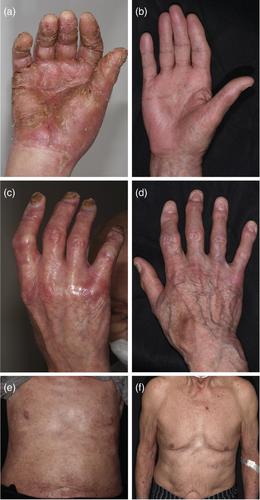
An 81-year-old patient presented with a two-months history of painful palmoplantar hyperkeratosis refractory to potent topical steroids. Exacerbation and generalization of the dermatitis had occurred after the COVID-19 vaccinations. Palmar lesions worsened when he performed his occupational work as a violin maker, but also persisted during extended work-free periods. Twenty years ago, he was diagnosed with psoriasis, which had remitted rapidly. Other pre-existing conditions include prostate carcinoma first diagnosed 12 years ago, presently in remission, and cigarette smoking. He presented with generalized, partially lichenoid erythematous plaques on the entire integument as well as pronounced palmoplantar hyperkeratosis, deep rhagades, and scaling (Figure 1a). The first histologic analysis of the palm revealed epithelial hyperplasia, lichenoid lymphocytic infiltrate with marked epidermotropism predominantly of CD8+-cells. Because of the lack of clonal lymphocyte proliferation, lymphoma was less likely. Histological results of repeated skin biopsies from the abdomen were compatible with subacute eczema. We diagnosed severe mixed HE with components of atopic and irritant contact dermatitis, possibly aggravated by SARS-CoV-2 vaccinations, and disseminated, partially lichenoid, eczema in atopic diatheses (total IgE 672.00 kU/l, normal range < 120.00 kU/l). Anamnestically, there were no concrete indications of an allergic contact dermatitis. An epicutaneous test was not possible due to the pronounced skin findings. Under therapy with acitretin (30 mg/d) and UV irradiation (UVB 311 nm, and cream-PUVA) the skin lesions initially worsened, whereupon the patient discontinued UV therapy and continued treatment with the other two modalities only irregularly. After 4 weeks, he was readmitted because of a marked exacerbation.
We resumed therapy, but skin lesions worsened, and side effects such as dryness and redness of the eyes occurred, so acitretin was discontinued after altogether 5 months. Therapy with methotrexate 15 mg s.c. was initiated, and within 2 weeks liver enzymes increased fourfold, so methotrexate was discontinued. Subsequently, therapy with upadacitinib 15 mg was initiated.
After 3 days of upadacitinib therapy, the patient reported a marked alleviation of itching and pain, and after 8 days, he noted substantial improvement in skin lesions. A follow-up examination after 6 weeks showed a clear improvement. The skin lesions had almost cleared, with only the palms showing mild scaling (Figure 1b). Mometasone ointment was used only as needed. After 4.5 months of upadacitinib therapy, Hand Eczema Severity Index (HECSI) had dropped from 130 before therapy to 0, Investigator's Global Assessment (IGA) from 4 to 0, Eczema Area and Severity Index (EASI) from 25.9 to 0.9, and Dermatology Life Quality Index (DLQI) dropped from 20 to 0. Apart from slightly elevated lipid levels, no side effects occurred.
JAK inhibitors (JAKi) are considered the next generation of systemic therapeutics for AD, with baricitinib, abrocitinib and upadacitinib being currently approved in Europe.3-5 The latter two act preferentially on JAK1.6-8 Upadacitinib has been explored recently in atopic HE demonstrating efficacy in a post hoc subgroup analysis of the Measure Up 1 and 2 studies.9 In contrast to our patient with a HECSI score of 130, the mean HESCI score at baseline in these two studies was only 44.5, just reaching the level of severe HE (HECSI score between 38 and 117), while a HECSI score of ≥ 117 defines very severe HE. In an analysis of the Dutch BioDay ad therapy registry, good efficacy of upadacitinib in atopic HE was also found, here mean HECSI amounted to 44.2.10 In subgroup analyses of patients with irritant contact dermatitis (ICD; n = 12), they found that the contribution of ICD did not affect the efficacy of upadacitinib.10 Topical therapy with the pan-JAKi delgocitinib has also shown good efficacy in chronic HE.11, 12 At the time of initiation of upadacitinib therapy, there was only a Direct Healthcare Professional Communication for the JAKi tofacitinib reporting an increased risk of serious adverse events with the use of tofacitinib compared with TNF-alpha inhibitors.13 However, this was later considered to be a class effect of JAKi and it was recommended that upadacitinib should not be used in patients with certain risk factors such as smoking, age over 65, or a history of malignancy unless a better alternative was available.14 After a risk-benefit assessment, we initially continued upadacitinib therapy under close clinical and laboratory monitoring and reduced the dose of upadacitinib to 15 mg every other day after a total of 8 months of upadacitinib therapy. After a total of 10 months, the excellent therapeutic response persisted, and upadacitinib therapy was discontinued. As for the differential diagnosis of cutaneous T-cell lymphoma (CTCL), it could not be definitively ruled out in our patient and he will be continuously monitored for CTCL, including repeat biopsies in case of worsening. The good therapeutic response of skin lesions also does not preclude the diagnosis of CTCL, as dysregulation of JAKs has been reported in cutaneous T-cell lymphoma, and JAKi as potential therapeutic agents for CTCL are being discussed,15 with so far inhomogeneous clinical data. For example, while a tofacitinib-induced lymphomatoid papulosis has been reported,16 therapeutic success of upadacitinib in a patient with erythrodermic mycosis fungoides has also been observed,17 and in a clinical phase 2 trial, ruxolitinib achieved a partial response in one out of seven patients with mycosis fungoides.18
In our patient, a few days after discontinuation of upadacitinib, a severe relapse occurred. Newly identified risks of upadacitinib and other therapeutic options, particularly dupilumab, a monoclonal antibody directed against the alpha chain of the IL-4 receptor that has been licensed for treatment of atopic dermatitis were discussed with the patient. At the beginning, we had opted for treatment with upadacitinib due to its higher efficacy and the expected faster onset of action compared to dupilumab. Upadacitinib had been discontinued after resolution of skin lesions, and when the relapse occurred, the patient chose to resume upadacitinib despite its newly identified safety risks. Upadacitinib therapy again led to a resolution of skin lesions, and upadacitinib dose was reduced to 15 mg every other day. We plan to further reduce upadacitinib dose in case of persisting good clinical response and, if the patient consents, as exit strategy, switch from upadacitinib to dupilumab without a treatment-free interval.
Our case demonstrates the good efficacy of upadacitinib in a patient with very severe mixed HE with components of atopic and irritant contact dermatitis, that did not respond adequately to topical steroids and systemic therapies. Thus, upadacitinib may be a promising therapeutic option for severe HE that warrants further study.
J.M. has been an advisor and/or received grants and/or participated in clinical trials of the following companies: Abbvie, Allmirall, Biogen IDEC, Boehringer-Ingelheim, Celgene, Janssen-Cilag, Leo Pharma GmbH, Lilly, MSD SHARP & DOHME, Novartis Pharma, Pfizer and UCB. R.M. has been an advisor and/or received speakers’ honoraria and/or received grants and/or participated in clinical trials of the following companies: Abbvie, Almirall, Biogen IDEC, Boehringer-Ingelheim, Celgene, Janssen-Cilag, Leo Pharma, Lilly, MSD SHARP & DOHME, Novartis Pharma, Pfizer and UCB. M.P.S. has been an advisor and/or received speakers’ honoraria and/or received grants and/or participated in clinical trials of the following companies: Abbvie, Allmirall, Biogen, Boehringer-Ingelheim, Janssen-Cilag, Leo, Lilly, Novartis, UCB. N.C. reports no conflicts of interest.
期刊介绍:
The JDDG publishes scientific papers from a wide range of disciplines, such as dermatovenereology, allergology, phlebology, dermatosurgery, dermatooncology, and dermatohistopathology. Also in JDDG: information on medical training, continuing education, a calendar of events, book reviews and society announcements.
Papers can be submitted in German or English language. In the print version, all articles are published in German. In the online version, all key articles are published in English.




 京公网安备 11010802042870号
京ICP备2023020795号-1
京公网安备 11010802042870号
京ICP备2023020795号-1

 分享
分享
 求助内容:
求助内容: 应助结果提醒方式:
 扫码关注我们
