{"title":"社论:接受阿特珠单抗和贝伐单抗治疗的不可切除肝细胞癌患者转换疗法的预测因素和生存结果:转换、部分应答和完全应答患者的比较分析。","authors":"Joao Gorgulho, Johann von Felden","doi":"10.1111/apt.18296","DOIUrl":null,"url":null,"abstract":"<p>The manuscript by Hatanaka et al. addresses the relevant topic of conversion therapy for unresectable HCC after immune checkpoint inhibitor (ICI) therapy with the combination of atezolizumab and bevacizumab within a large retrospective cohort of 946 HCC patients [<span>1</span>].</p><p>ICI therapy has revolutionised the treatment landscape for unresectable HCC. Different combination regimens have already been tested positive in first-line clinical phase III trials against previous standards sorafenib or lenvatinib with objective response rates (ORR) between 20% and 36%: the IMbrave150 trial tested atezolizumab (anti-PD-L1) with bevacizumab (anti-VEGF) (ORR: 27.3% vs. 11.9% with a complete response [CR] rate of 5.5% vs. 0%, overall survival [OS] not reached vs. 13.2 months) [<span>2</span>], the HIMALAYA trial tested tremelimumab (anti-CTLA-4) with durvalumab (anti-PD-1) (ORR: 20.1% with a CR rate of 3.1%, OS 16.4 vs. 13.8 months) [<span>3</span>], and the Checkmate-9dw recently reported positive results for Ipilimumab (anti-CTLA-4) with nivolumab (anti-PD1) (ORR: 36.1% with a CR rate of 7%, OS 23.7 vs. 20.6 months) [<span>4</span>].</p><p>The concept of conversion therapy defines a strategy to convert priorly unresectable tumours from a palliative setting into a curative setting making them eligible for, for example, resection or ablation. A key characteristic for these patients is an objective response of tumours. With ICI as the new standard in unresectable HCC bringing along fairly good ORR, this concept has gained increasing awareness in the field. Yet, markers predicting response to ICI therapy per se and identifying which patients then actually benefit from this strategy are lacking.</p><p>Two previous studies including patients with TACE-ineligible BCLC-B or BCLC-C stages have reported a significant survival benefit in patients who underwent conversion therapy compared to ones that remained on ICI therapy [<span>5, 6</span>]. Converted patients were more likely to have lower modified albumin bilirubin (mALBI) grades and BCLC-B stage [<span>5, 6</span>]. The current study by Hatanaka et al. confirmed these findings. However, the novelty and impact for clinical management of the present manuscript resides mainly in the findings that patients experiencing PR on systemic therapy with atezolizumab and bevacizumab had a significantly longer survival when undergoing conversion therapy compared to patients continuing ICI therapy. In contrast, patients experiencing CR with ICI therapy do not necessarily benefit from conversion therapy, mainly due to excellent survival when continuing ICI therapy [<span>1</span>] (Figure 1).</p><p>Despite its promise, future prospective randomised efforts are needed to confirm these findings and rule out potential selection bias inherent to the retrospective design of available studies.</p><p><b>Joao Gorgulho:</b> conceptualization, writing – original draft, writing – review and editing. <b>Johann von Felden:</b> conceptualization, writing – original draft, writing – review and editing, project administration.</p><p>Johann von Felden has received honoraria from Roche and AstraZeneca. Further author declares no conflicts of interest.</p><p>This article is linked to Hatanaka et al papers. To view these articles, visit https://doi.org/10.1111/apt.18237 and https://doi.org/10.1111/apt.18319.</p>","PeriodicalId":121,"journal":{"name":"Alimentary Pharmacology & Therapeutics","volume":"60 10","pages":"1467-1468"},"PeriodicalIF":6.8000,"publicationDate":"2024-10-04","publicationTypes":"Journal Article","fieldsOfStudy":null,"isOpenAccess":false,"openAccessPdf":"https://onlinelibrary.wiley.com/doi/epdf/10.1111/apt.18296","citationCount":"0","resultStr":"{\"title\":\"Editorial: Predictive Factors and Survival Outcome of Conversion Therapy for Unresectable Hepatocellular Carcinoma Patients Receiving Atezolizumab and Bevacizumab: Comparative Analysis of Conversion, Partial Response and Complete Response Patients\",\"authors\":\"Joao Gorgulho, Johann von Felden\",\"doi\":\"10.1111/apt.18296\",\"DOIUrl\":null,\"url\":null,\"abstract\":\"<p>The manuscript by Hatanaka et al. addresses the relevant topic of conversion therapy for unresectable HCC after immune checkpoint inhibitor (ICI) therapy with the combination of atezolizumab and bevacizumab within a large retrospective cohort of 946 HCC patients [<span>1</span>].</p><p>ICI therapy has revolutionised the treatment landscape for unresectable HCC. Different combination regimens have already been tested positive in first-line clinical phase III trials against previous standards sorafenib or lenvatinib with objective response rates (ORR) between 20% and 36%: the IMbrave150 trial tested atezolizumab (anti-PD-L1) with bevacizumab (anti-VEGF) (ORR: 27.3% vs. 11.9% with a complete response [CR] rate of 5.5% vs. 0%, overall survival [OS] not reached vs. 13.2 months) [<span>2</span>], the HIMALAYA trial tested tremelimumab (anti-CTLA-4) with durvalumab (anti-PD-1) (ORR: 20.1% with a CR rate of 3.1%, OS 16.4 vs. 13.8 months) [<span>3</span>], and the Checkmate-9dw recently reported positive results for Ipilimumab (anti-CTLA-4) with nivolumab (anti-PD1) (ORR: 36.1% with a CR rate of 7%, OS 23.7 vs. 20.6 months) [<span>4</span>].</p><p>The concept of conversion therapy defines a strategy to convert priorly unresectable tumours from a palliative setting into a curative setting making them eligible for, for example, resection or ablation. A key characteristic for these patients is an objective response of tumours. With ICI as the new standard in unresectable HCC bringing along fairly good ORR, this concept has gained increasing awareness in the field. Yet, markers predicting response to ICI therapy per se and identifying which patients then actually benefit from this strategy are lacking.</p><p>Two previous studies including patients with TACE-ineligible BCLC-B or BCLC-C stages have reported a significant survival benefit in patients who underwent conversion therapy compared to ones that remained on ICI therapy [<span>5, 6</span>]. Converted patients were more likely to have lower modified albumin bilirubin (mALBI) grades and BCLC-B stage [<span>5, 6</span>]. The current study by Hatanaka et al. confirmed these findings. However, the novelty and impact for clinical management of the present manuscript resides mainly in the findings that patients experiencing PR on systemic therapy with atezolizumab and bevacizumab had a significantly longer survival when undergoing conversion therapy compared to patients continuing ICI therapy. In contrast, patients experiencing CR with ICI therapy do not necessarily benefit from conversion therapy, mainly due to excellent survival when continuing ICI therapy [<span>1</span>] (Figure 1).</p><p>Despite its promise, future prospective randomised efforts are needed to confirm these findings and rule out potential selection bias inherent to the retrospective design of available studies.</p><p><b>Joao Gorgulho:</b> conceptualization, writing – original draft, writing – review and editing. <b>Johann von Felden:</b> conceptualization, writing – original draft, writing – review and editing, project administration.</p><p>Johann von Felden has received honoraria from Roche and AstraZeneca. Further author declares no conflicts of interest.</p><p>This article is linked to Hatanaka et al papers. To view these articles, visit https://doi.org/10.1111/apt.18237 and https://doi.org/10.1111/apt.18319.</p>\",\"PeriodicalId\":121,\"journal\":{\"name\":\"Alimentary Pharmacology & Therapeutics\",\"volume\":\"60 10\",\"pages\":\"1467-1468\"},\"PeriodicalIF\":6.8000,\"publicationDate\":\"2024-10-04\",\"publicationTypes\":\"Journal Article\",\"fieldsOfStudy\":null,\"isOpenAccess\":false,\"openAccessPdf\":\"https://onlinelibrary.wiley.com/doi/epdf/10.1111/apt.18296\",\"citationCount\":\"0\",\"resultStr\":null,\"platform\":\"Semanticscholar\",\"paperid\":null,\"PeriodicalName\":\"Alimentary Pharmacology & Therapeutics\",\"FirstCategoryId\":\"3\",\"ListUrlMain\":\"https://onlinelibrary.wiley.com/doi/10.1111/apt.18296\",\"RegionNum\":1,\"RegionCategory\":\"医学\",\"ArticlePicture\":[],\"TitleCN\":null,\"AbstractTextCN\":null,\"PMCID\":null,\"EPubDate\":\"\",\"PubModel\":\"\",\"JCR\":\"Q1\",\"JCRName\":\"GASTROENTEROLOGY & HEPATOLOGY\",\"Score\":null,\"Total\":0}","platform":"Semanticscholar","paperid":null,"PeriodicalName":"Alimentary Pharmacology & Therapeutics","FirstCategoryId":"3","ListUrlMain":"https://onlinelibrary.wiley.com/doi/10.1111/apt.18296","RegionNum":1,"RegionCategory":"医学","ArticlePicture":[],"TitleCN":null,"AbstractTextCN":null,"PMCID":null,"EPubDate":"","PubModel":"","JCR":"Q1","JCRName":"GASTROENTEROLOGY & HEPATOLOGY","Score":null,"Total":0}
Editorial: Predictive Factors and Survival Outcome of Conversion Therapy for Unresectable Hepatocellular Carcinoma Patients Receiving Atezolizumab and Bevacizumab: Comparative Analysis of Conversion, Partial Response and Complete Response Patients
The manuscript by Hatanaka et al. addresses the relevant topic of conversion therapy for unresectable HCC after immune checkpoint inhibitor (ICI) therapy with the combination of atezolizumab and bevacizumab within a large retrospective cohort of 946 HCC patients [1].
ICI therapy has revolutionised the treatment landscape for unresectable HCC. Different combination regimens have already been tested positive in first-line clinical phase III trials against previous standards sorafenib or lenvatinib with objective response rates (ORR) between 20% and 36%: the IMbrave150 trial tested atezolizumab (anti-PD-L1) with bevacizumab (anti-VEGF) (ORR: 27.3% vs. 11.9% with a complete response [CR] rate of 5.5% vs. 0%, overall survival [OS] not reached vs. 13.2 months) [2], the HIMALAYA trial tested tremelimumab (anti-CTLA-4) with durvalumab (anti-PD-1) (ORR: 20.1% with a CR rate of 3.1%, OS 16.4 vs. 13.8 months) [3], and the Checkmate-9dw recently reported positive results for Ipilimumab (anti-CTLA-4) with nivolumab (anti-PD1) (ORR: 36.1% with a CR rate of 7%, OS 23.7 vs. 20.6 months) [4].
The concept of conversion therapy defines a strategy to convert priorly unresectable tumours from a palliative setting into a curative setting making them eligible for, for example, resection or ablation. A key characteristic for these patients is an objective response of tumours. With ICI as the new standard in unresectable HCC bringing along fairly good ORR, this concept has gained increasing awareness in the field. Yet, markers predicting response to ICI therapy per se and identifying which patients then actually benefit from this strategy are lacking.
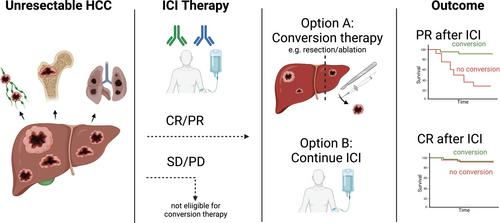
Two previous studies including patients with TACE-ineligible BCLC-B or BCLC-C stages have reported a significant survival benefit in patients who underwent conversion therapy compared to ones that remained on ICI therapy [5, 6]. Converted patients were more likely to have lower modified albumin bilirubin (mALBI) grades and BCLC-B stage [5, 6]. The current study by Hatanaka et al. confirmed these findings. However, the novelty and impact for clinical management of the present manuscript resides mainly in the findings that patients experiencing PR on systemic therapy with atezolizumab and bevacizumab had a significantly longer survival when undergoing conversion therapy compared to patients continuing ICI therapy. In contrast, patients experiencing CR with ICI therapy do not necessarily benefit from conversion therapy, mainly due to excellent survival when continuing ICI therapy [1] (Figure 1).
Despite its promise, future prospective randomised efforts are needed to confirm these findings and rule out potential selection bias inherent to the retrospective design of available studies.
Joao Gorgulho: conceptualization, writing – original draft, writing – review and editing. Johann von Felden: conceptualization, writing – original draft, writing – review and editing, project administration.
Johann von Felden has received honoraria from Roche and AstraZeneca. Further author declares no conflicts of interest.
This article is linked to Hatanaka et al papers. To view these articles, visit https://doi.org/10.1111/apt.18237 and https://doi.org/10.1111/apt.18319.
期刊介绍:
Alimentary Pharmacology & Therapeutics is a global pharmacology journal focused on the impact of drugs on the human gastrointestinal and hepato-biliary systems. It covers a diverse range of topics, often with immediate clinical relevance to its readership.




 京公网安备 11010802042870号
京ICP备2023020795号-1
京公网安备 11010802042870号
京ICP备2023020795号-1

 分享
分享
 求助内容:
求助内容: 应助结果提醒方式:
 扫码关注我们
