Keming Li , Yuanle Su , Zhe Sun , Zhanfeng Li , Qinjun Sun , Yanting Tian , Baoyou Liu , Gang Yue , Jinbo Xue , Yue Tian , Xianqiang Xiong
{"title":"新型噻吩 S,S-二氧化物基聚合物中的高平面电荷传输通道,用于高效光催化 CO2 到 CO 的转化","authors":"Keming Li , Yuanle Su , Zhe Sun , Zhanfeng Li , Qinjun Sun , Yanting Tian , Baoyou Liu , Gang Yue , Jinbo Xue , Yue Tian , Xianqiang Xiong","doi":"10.1016/j.seppur.2024.129942","DOIUrl":null,"url":null,"abstract":"<div><div>Achieving efficient solar-driven CO<sub>2</sub> reduction (CO<sub>2</sub>RR) into valuable carbon–neutral fuels without relying on photosensitizers, sacrificial agents, or co-catalysts has proven to be an ongoing challenge, especially for metal-free photocatalytic systems. Herein, we have developed and synthesized two innovative thiophene <em>S</em>,<em>S</em>-dioxide (TDO)-based donor (D)-acceptor (A)-type linear conjugated polymers, named TDO-T and TDO-2T, targeting CO<sub>2</sub> reduction using water vapor. By functionalizing thiophene with TDO, we have significantly improved the planarity of its molecular structure, which is vital for effective charge transport. Moreover, the robust D-A interactions between TDO and thiophene units enhance electron delocalization across the polymer backbone, thereby optimizing charge transfer characteristics and boosting local electron density. These factors lead to highly planar charge transmission pathways within the molecules, resulting in exceptional photocatalytic CO<sub>2</sub>-to-CO conversion efficiencies. Impressively, TDO-2T and TDO-T achieved conversion rates of 379.35 and 229.36 μmol g<sup>-1</sup>h<sup>−1</sup>, respectively, all without the need for photosensitizers, cocatalysts, or sacrificial agents. This research marks a groundbreaking advancement in the use of TDO units, setting a new benchmark for designing high-performance photocatalysts for CO<sub>2</sub>RR.</div></div>","PeriodicalId":427,"journal":{"name":"Separation and Purification Technology","volume":"356 ","pages":"Article 129942"},"PeriodicalIF":9.1000,"publicationDate":"2025-04-01","publicationTypes":"Journal Article","fieldsOfStudy":null,"isOpenAccess":false,"openAccessPdf":"","citationCount":"0","resultStr":"{\"title\":\"Highly planar charge transport channels in novel thiophene S,S-dioxide-based polymers for efficient photocatalytic CO2-to-CO conversion\",\"authors\":\"Keming Li , Yuanle Su , Zhe Sun , Zhanfeng Li , Qinjun Sun , Yanting Tian , Baoyou Liu , Gang Yue , Jinbo Xue , Yue Tian , Xianqiang Xiong\",\"doi\":\"10.1016/j.seppur.2024.129942\",\"DOIUrl\":null,\"url\":null,\"abstract\":\"<div><div>Achieving efficient solar-driven CO<sub>2</sub> reduction (CO<sub>2</sub>RR) into valuable carbon–neutral fuels without relying on photosensitizers, sacrificial agents, or co-catalysts has proven to be an ongoing challenge, especially for metal-free photocatalytic systems. Herein, we have developed and synthesized two innovative thiophene <em>S</em>,<em>S</em>-dioxide (TDO)-based donor (D)-acceptor (A)-type linear conjugated polymers, named TDO-T and TDO-2T, targeting CO<sub>2</sub> reduction using water vapor. By functionalizing thiophene with TDO, we have significantly improved the planarity of its molecular structure, which is vital for effective charge transport. Moreover, the robust D-A interactions between TDO and thiophene units enhance electron delocalization across the polymer backbone, thereby optimizing charge transfer characteristics and boosting local electron density. These factors lead to highly planar charge transmission pathways within the molecules, resulting in exceptional photocatalytic CO<sub>2</sub>-to-CO conversion efficiencies. Impressively, TDO-2T and TDO-T achieved conversion rates of 379.35 and 229.36 μmol g<sup>-1</sup>h<sup>−1</sup>, respectively, all without the need for photosensitizers, cocatalysts, or sacrificial agents. This research marks a groundbreaking advancement in the use of TDO units, setting a new benchmark for designing high-performance photocatalysts for CO<sub>2</sub>RR.</div></div>\",\"PeriodicalId\":427,\"journal\":{\"name\":\"Separation and Purification Technology\",\"volume\":\"356 \",\"pages\":\"Article 129942\"},\"PeriodicalIF\":9.1000,\"publicationDate\":\"2025-04-01\",\"publicationTypes\":\"Journal Article\",\"fieldsOfStudy\":null,\"isOpenAccess\":false,\"openAccessPdf\":\"\",\"citationCount\":\"0\",\"resultStr\":null,\"platform\":\"Semanticscholar\",\"paperid\":null,\"PeriodicalName\":\"Separation and Purification Technology\",\"FirstCategoryId\":\"5\",\"ListUrlMain\":\"https://www.sciencedirect.com/science/article/pii/S1383586624036815\",\"RegionNum\":1,\"RegionCategory\":\"工程技术\",\"ArticlePicture\":[],\"TitleCN\":null,\"AbstractTextCN\":null,\"PMCID\":null,\"EPubDate\":\"2024/10/5 0:00:00\",\"PubModel\":\"Epub\",\"JCR\":\"Q1\",\"JCRName\":\"ENGINEERING, CHEMICAL\",\"Score\":null,\"Total\":0}","platform":"Semanticscholar","paperid":null,"PeriodicalName":"Separation and Purification Technology","FirstCategoryId":"5","ListUrlMain":"https://www.sciencedirect.com/science/article/pii/S1383586624036815","RegionNum":1,"RegionCategory":"工程技术","ArticlePicture":[],"TitleCN":null,"AbstractTextCN":null,"PMCID":null,"EPubDate":"2024/10/5 0:00:00","PubModel":"Epub","JCR":"Q1","JCRName":"ENGINEERING, CHEMICAL","Score":null,"Total":0}
Highly planar charge transport channels in novel thiophene S,S-dioxide-based polymers for efficient photocatalytic CO2-to-CO conversion
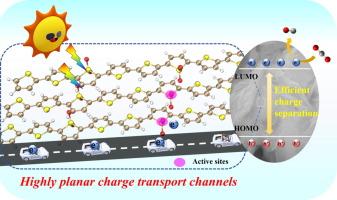
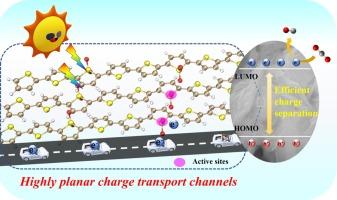
Achieving efficient solar-driven CO2 reduction (CO2RR) into valuable carbon–neutral fuels without relying on photosensitizers, sacrificial agents, or co-catalysts has proven to be an ongoing challenge, especially for metal-free photocatalytic systems. Herein, we have developed and synthesized two innovative thiophene S,S-dioxide (TDO)-based donor (D)-acceptor (A)-type linear conjugated polymers, named TDO-T and TDO-2T, targeting CO2 reduction using water vapor. By functionalizing thiophene with TDO, we have significantly improved the planarity of its molecular structure, which is vital for effective charge transport. Moreover, the robust D-A interactions between TDO and thiophene units enhance electron delocalization across the polymer backbone, thereby optimizing charge transfer characteristics and boosting local electron density. These factors lead to highly planar charge transmission pathways within the molecules, resulting in exceptional photocatalytic CO2-to-CO conversion efficiencies. Impressively, TDO-2T and TDO-T achieved conversion rates of 379.35 and 229.36 μmol g-1h−1, respectively, all without the need for photosensitizers, cocatalysts, or sacrificial agents. This research marks a groundbreaking advancement in the use of TDO units, setting a new benchmark for designing high-performance photocatalysts for CO2RR.
期刊介绍:
Separation and Purification Technology is a premier journal committed to sharing innovative methods for separation and purification in chemical and environmental engineering, encompassing both homogeneous solutions and heterogeneous mixtures. Our scope includes the separation and/or purification of liquids, vapors, and gases, as well as carbon capture and separation techniques. However, it's important to note that methods solely intended for analytical purposes are not within the scope of the journal. Additionally, disciplines such as soil science, polymer science, and metallurgy fall outside the purview of Separation and Purification Technology. Join us in advancing the field of separation and purification methods for sustainable solutions in chemical and environmental engineering.




 京公网安备 11010802042870号
京ICP备2023020795号-1
京公网安备 11010802042870号
京ICP备2023020795号-1

 分享
分享
 求助内容:
求助内容: 应助结果提醒方式:
 扫码关注我们
