{"title":"气孔进化的图景。","authors":"James W. Clark","doi":"10.1111/nph.20179","DOIUrl":null,"url":null,"abstract":"<p>Stomata are microscopic pores that allow the exchange of gases between the plant and its environment. They are typically found on aerial surfaces, opening and closing in response to environmental cues to ensure photosynthesis, respiration and transpiration. In addition, stomata also find themselves at the core of a growing body of work that views plant evolution through the lens of a new phylogenetic hypothesis: bryophyte monophyly. Monophyly refers to an inclusive group of organisms descended from a common ancestor and, in this case specifically, the recent resolution of two monophyletic groups of land plants: nonvascular bryophytes and vascular tracheophytes (Fig. 1). This is in contrast to a previously held paradigm whereby the earliest plants would have preceded various bryophyte-like lineages. Fortin and Friedman's work highlights the fundamental role of phylogeny in reconstructing the evolution of plant traits, where stomata are emerging as a fascinating model to understand how bryophyte monophyly may affect our understanding of the nature of the earliest plants (Harris <i>et al</i>., <span>2020</span>).</p><p>The evolution of stomata has been controversial: the homology of stomata in vascular and nonvascular plants has been questioned, along with the number of times they may have evolved or been lost (Ligrone <i>et al</i>., <span>2012</span>; Harris <i>et al</i>., <span>2020</span>). Likewise, their ability to respond to a diversity of environmental cues is well characterised in angiosperms and seed plants, but has been intensely debated in other groups, including ferns, lycophytes and mosses (Sussmilch <i>et al</i>., <span>2017</span>; Clark <i>et al</i>., <span>2022</span>). Until now, however, it has not been controversial to propose that among extant plants stomata are only found on the diploid, sporophyte generation. Fortin and Friedman challenge this dogma, identifying mucilage-producing pores (‘Hornwort Gametophytic Pores’ (HGPs)) in the gametophyte generation of hornworts as putatively homologous to stomata and argue that they should be considered the first example of stomata in the gametophyte generation of living plants.</p><p>To determine whether these structures are, or are not, stomata it is necessary to define what stomata are. Fortin and Friedman provide a broad definition of a stomate which is independent of function: two cells surrounding a pore, which may be able to open or close and may be filled with liquid or gas. In vascular plants (tracheophytes), stomata are broadly distributed and function as previously described, although in certain cases stomata have taken on new, specialised roles or even been lost. In nonvascular plants (bryophytes), stomata are more restricted in their distribution and are believed to primarily function in facilitating desiccation for spore release. Both lineages exhibit variations and elaborations of the simple design of stomata, but all would be encompassed by this definition. Notably, this definition excludes the liverwort air pore, a structure predicted to not be homologous and so confirms the absence of stomata in liverworts, but also the pseudostomata of Sphagnales, which lack a pore (Merced, <span>2015</span>).</p><p>One of the more striking points made by Fortin and Friedman is how frequently HGPs are overlooked in discussions of stomatal evolution (for which I am also at fault). However, the timeliness of this study is highlighted by another recent work which has reemphasised the counter-arguments (Duckett <i>et al</i>., <span>2024</span>). Duckett <i>et al</i>. (<span>2024</span>) take a hard line that these structures are definitively not stomata and present multiple arguments elaborating why these structures are unlikely to be homologous to guard cells. The majority of the arguments, laid out previously and by Duckett <i>et al</i>. against HGPs being homologous to stomata is that: they occur in the gametophyte generation; they possess different functions; and they possess anatomical differences from the stomata of other lineages. The first argument does not hold, since stomata in the gametophyte are a feature of multiple species of early land plants preserved in the Rhynie Chert (Edwards <i>et al</i>., <span>1998</span>). Against the second, Fortin and Friedman argue that two structures do not need to have a common function to be homologous. This is clear even within stomata, where floral nectaries and stomata may represent functional divergence of homologous structures within the same plant. Finally, the anatomical differences observed in HGPs are also observed in other instances among plants or could be the result of functional divergence in hornworts. For example, HGPs occur in clusters, while stomata typically are evenly spaced along the epidermis. However, other bryophyte and tracheophyte species demonstrate exceptions to this rule and clusters of stomata are known to occur naturally in multiple species across the angiosperm phylogeny including <i>Begonia</i> (Rudall <i>et al</i>., <span>2017</span>), where they are hypothesised to form via perturbations of the normal development of regularly spaced stomata, the genetic basis of which is well understood (Dow <i>et al</i>., <span>2014</span>).</p><p>If we accept the possibility that HGPs are homologous to stomata, then, hornworts represent the only extant lineage to possess stomata in the gametophyte generation. That the exception to the rule may occur in hornworts is not surprising. Hornworts are the most species-poor of all the major land plant groups, possessing a scant fossil record and numerous unique morphological traits. In a phylogenetic context, they have been considered in almost every conceivable position, from the earliest branch of land plants to the immediate sister group to vascular plants. While they are now resolved within the monophyletic bryophyte lineage, molecular dating predicts both that hornworts diverged from the remaining bryophytes during the Ordovician (> 444 million years ago) and that the surviving members of the lineage are relatively young (Harris <i>et al</i>., <span>2022</span>). The large evolutionary and geological distance between hornworts and all other plants may reconcile some of the anatomical and functional differences between HGPs and other types of stomata. Hornwort genomes are also characterised by extensive gene loss which has been found to be important during the evolution of other unique features of hornworts and may contribute to the rewiring of genetic networks (MacLeod <i>et al</i>., <span>2022</span>).</p><p>Another consequence of the possibility of HGPs being homologous to stomata is how we view the earliest land plants more broadly. The alternation of generations refers to the two long-lived and multicellular generations that plants go through, the haploid gametophyte and the diploid sporophyte, and has recently seen renewed interest as one of the outstanding questions of plant evolution (Donoghue <i>et al</i>., <span>2021</span>; Duckett <i>et al</i>., <span>2024</span>; Renner & Sokoloff, <span>2024</span>). The presence of stomata in both the gametophyte and sporophyte generation, as occurs in early plant fossils and may occur in hornworts, may indicate an isomorphic ancestor of plants, although this is currently speculative (Fig. 1). Alternatively, as Fortin and Friedman also point out, it is possible that stomata arose initially in one generation and then were co-opted into the other through ‘intergenerational heterotropy’, where a trait of one generation is expressed in the other.</p><p>The homology of stomata among vascular and nonvascular sporophytes has so far been corroborated by genetic analyses in the moss <i>Physcomitrium patens</i> alongside various vascular systems, identifying a common genetic toolkit underlying stomatal development across land plants (Chater <i>et al</i>., <span>2016</span>). The nature of these structures remains a case not closed and many of the anatomical anomalies outlined by Duckett <i>et al</i>. (<span>2024</span>) will need to be further scrutinised, yet this work has established a fascinating hypothesis and one that is readily testable. The recent establishment of a tractable and transformable model system in <i>Anthoceros</i> (Frangedakis <i>et al</i>., <span>2021</span>) means that future experiments will be able to determine whether the hornwort HGPs invoke the same developmental toolkit as <i>bona fide</i> stomata. This work may represent another intriguing complication during the evolution of stomata, with greater complexity in their evolutionary history and greater diversity in both form and function than was previously appreciated. Either way, it is clear that alongside the deluge of genomic data, comparative anatomy remains invaluable to the field of plant evolution and should continue to be explored alongside palaeobotanical, molecular and developmental evidence.</p>","PeriodicalId":214,"journal":{"name":"New Phytologist","volume":"245 1","pages":"6-8"},"PeriodicalIF":8.1000,"publicationDate":"2024-10-06","publicationTypes":"Journal Article","fieldsOfStudy":null,"isOpenAccess":false,"openAccessPdf":"https://onlinelibrary.wiley.com/doi/epdf/10.1111/nph.20179","citationCount":"0","resultStr":"{\"title\":\"Assembling the picture of stomatal evolution\",\"authors\":\"James W. Clark\",\"doi\":\"10.1111/nph.20179\",\"DOIUrl\":null,\"url\":null,\"abstract\":\"<p>Stomata are microscopic pores that allow the exchange of gases between the plant and its environment. They are typically found on aerial surfaces, opening and closing in response to environmental cues to ensure photosynthesis, respiration and transpiration. In addition, stomata also find themselves at the core of a growing body of work that views plant evolution through the lens of a new phylogenetic hypothesis: bryophyte monophyly. Monophyly refers to an inclusive group of organisms descended from a common ancestor and, in this case specifically, the recent resolution of two monophyletic groups of land plants: nonvascular bryophytes and vascular tracheophytes (Fig. 1). This is in contrast to a previously held paradigm whereby the earliest plants would have preceded various bryophyte-like lineages. Fortin and Friedman's work highlights the fundamental role of phylogeny in reconstructing the evolution of plant traits, where stomata are emerging as a fascinating model to understand how bryophyte monophyly may affect our understanding of the nature of the earliest plants (Harris <i>et al</i>., <span>2020</span>).</p><p>The evolution of stomata has been controversial: the homology of stomata in vascular and nonvascular plants has been questioned, along with the number of times they may have evolved or been lost (Ligrone <i>et al</i>., <span>2012</span>; Harris <i>et al</i>., <span>2020</span>). Likewise, their ability to respond to a diversity of environmental cues is well characterised in angiosperms and seed plants, but has been intensely debated in other groups, including ferns, lycophytes and mosses (Sussmilch <i>et al</i>., <span>2017</span>; Clark <i>et al</i>., <span>2022</span>). Until now, however, it has not been controversial to propose that among extant plants stomata are only found on the diploid, sporophyte generation. Fortin and Friedman challenge this dogma, identifying mucilage-producing pores (‘Hornwort Gametophytic Pores’ (HGPs)) in the gametophyte generation of hornworts as putatively homologous to stomata and argue that they should be considered the first example of stomata in the gametophyte generation of living plants.</p><p>To determine whether these structures are, or are not, stomata it is necessary to define what stomata are. Fortin and Friedman provide a broad definition of a stomate which is independent of function: two cells surrounding a pore, which may be able to open or close and may be filled with liquid or gas. In vascular plants (tracheophytes), stomata are broadly distributed and function as previously described, although in certain cases stomata have taken on new, specialised roles or even been lost. In nonvascular plants (bryophytes), stomata are more restricted in their distribution and are believed to primarily function in facilitating desiccation for spore release. Both lineages exhibit variations and elaborations of the simple design of stomata, but all would be encompassed by this definition. Notably, this definition excludes the liverwort air pore, a structure predicted to not be homologous and so confirms the absence of stomata in liverworts, but also the pseudostomata of Sphagnales, which lack a pore (Merced, <span>2015</span>).</p><p>One of the more striking points made by Fortin and Friedman is how frequently HGPs are overlooked in discussions of stomatal evolution (for which I am also at fault). However, the timeliness of this study is highlighted by another recent work which has reemphasised the counter-arguments (Duckett <i>et al</i>., <span>2024</span>). Duckett <i>et al</i>. (<span>2024</span>) take a hard line that these structures are definitively not stomata and present multiple arguments elaborating why these structures are unlikely to be homologous to guard cells. The majority of the arguments, laid out previously and by Duckett <i>et al</i>. against HGPs being homologous to stomata is that: they occur in the gametophyte generation; they possess different functions; and they possess anatomical differences from the stomata of other lineages. The first argument does not hold, since stomata in the gametophyte are a feature of multiple species of early land plants preserved in the Rhynie Chert (Edwards <i>et al</i>., <span>1998</span>). Against the second, Fortin and Friedman argue that two structures do not need to have a common function to be homologous. This is clear even within stomata, where floral nectaries and stomata may represent functional divergence of homologous structures within the same plant. Finally, the anatomical differences observed in HGPs are also observed in other instances among plants or could be the result of functional divergence in hornworts. For example, HGPs occur in clusters, while stomata typically are evenly spaced along the epidermis. However, other bryophyte and tracheophyte species demonstrate exceptions to this rule and clusters of stomata are known to occur naturally in multiple species across the angiosperm phylogeny including <i>Begonia</i> (Rudall <i>et al</i>., <span>2017</span>), where they are hypothesised to form via perturbations of the normal development of regularly spaced stomata, the genetic basis of which is well understood (Dow <i>et al</i>., <span>2014</span>).</p><p>If we accept the possibility that HGPs are homologous to stomata, then, hornworts represent the only extant lineage to possess stomata in the gametophyte generation. That the exception to the rule may occur in hornworts is not surprising. Hornworts are the most species-poor of all the major land plant groups, possessing a scant fossil record and numerous unique morphological traits. In a phylogenetic context, they have been considered in almost every conceivable position, from the earliest branch of land plants to the immediate sister group to vascular plants. While they are now resolved within the monophyletic bryophyte lineage, molecular dating predicts both that hornworts diverged from the remaining bryophytes during the Ordovician (> 444 million years ago) and that the surviving members of the lineage are relatively young (Harris <i>et al</i>., <span>2022</span>). The large evolutionary and geological distance between hornworts and all other plants may reconcile some of the anatomical and functional differences between HGPs and other types of stomata. Hornwort genomes are also characterised by extensive gene loss which has been found to be important during the evolution of other unique features of hornworts and may contribute to the rewiring of genetic networks (MacLeod <i>et al</i>., <span>2022</span>).</p><p>Another consequence of the possibility of HGPs being homologous to stomata is how we view the earliest land plants more broadly. The alternation of generations refers to the two long-lived and multicellular generations that plants go through, the haploid gametophyte and the diploid sporophyte, and has recently seen renewed interest as one of the outstanding questions of plant evolution (Donoghue <i>et al</i>., <span>2021</span>; Duckett <i>et al</i>., <span>2024</span>; Renner & Sokoloff, <span>2024</span>). The presence of stomata in both the gametophyte and sporophyte generation, as occurs in early plant fossils and may occur in hornworts, may indicate an isomorphic ancestor of plants, although this is currently speculative (Fig. 1). Alternatively, as Fortin and Friedman also point out, it is possible that stomata arose initially in one generation and then were co-opted into the other through ‘intergenerational heterotropy’, where a trait of one generation is expressed in the other.</p><p>The homology of stomata among vascular and nonvascular sporophytes has so far been corroborated by genetic analyses in the moss <i>Physcomitrium patens</i> alongside various vascular systems, identifying a common genetic toolkit underlying stomatal development across land plants (Chater <i>et al</i>., <span>2016</span>). The nature of these structures remains a case not closed and many of the anatomical anomalies outlined by Duckett <i>et al</i>. (<span>2024</span>) will need to be further scrutinised, yet this work has established a fascinating hypothesis and one that is readily testable. The recent establishment of a tractable and transformable model system in <i>Anthoceros</i> (Frangedakis <i>et al</i>., <span>2021</span>) means that future experiments will be able to determine whether the hornwort HGPs invoke the same developmental toolkit as <i>bona fide</i> stomata. This work may represent another intriguing complication during the evolution of stomata, with greater complexity in their evolutionary history and greater diversity in both form and function than was previously appreciated. Either way, it is clear that alongside the deluge of genomic data, comparative anatomy remains invaluable to the field of plant evolution and should continue to be explored alongside palaeobotanical, molecular and developmental evidence.</p>\",\"PeriodicalId\":214,\"journal\":{\"name\":\"New Phytologist\",\"volume\":\"245 1\",\"pages\":\"6-8\"},\"PeriodicalIF\":8.1000,\"publicationDate\":\"2024-10-06\",\"publicationTypes\":\"Journal Article\",\"fieldsOfStudy\":null,\"isOpenAccess\":false,\"openAccessPdf\":\"https://onlinelibrary.wiley.com/doi/epdf/10.1111/nph.20179\",\"citationCount\":\"0\",\"resultStr\":null,\"platform\":\"Semanticscholar\",\"paperid\":null,\"PeriodicalName\":\"New Phytologist\",\"FirstCategoryId\":\"99\",\"ListUrlMain\":\"https://nph.onlinelibrary.wiley.com/doi/10.1111/nph.20179\",\"RegionNum\":1,\"RegionCategory\":\"生物学\",\"ArticlePicture\":[],\"TitleCN\":null,\"AbstractTextCN\":null,\"PMCID\":null,\"EPubDate\":\"\",\"PubModel\":\"\",\"JCR\":\"Q1\",\"JCRName\":\"PLANT SCIENCES\",\"Score\":null,\"Total\":0}","platform":"Semanticscholar","paperid":null,"PeriodicalName":"New Phytologist","FirstCategoryId":"99","ListUrlMain":"https://nph.onlinelibrary.wiley.com/doi/10.1111/nph.20179","RegionNum":1,"RegionCategory":"生物学","ArticlePicture":[],"TitleCN":null,"AbstractTextCN":null,"PMCID":null,"EPubDate":"","PubModel":"","JCR":"Q1","JCRName":"PLANT SCIENCES","Score":null,"Total":0}
引用次数: 0
摘要
气孔是植物和环境之间气体交换的微观孔隙。它们通常出现在空气表面,根据环境信号打开和关闭,以确保光合作用、呼吸和蒸腾作用。此外,气孔也发现自己是越来越多的工作的核心,这些工作通过一个新的系统发育假说来看待植物进化:苔藓植物单系。单系系指的是由共同祖先进化而来的一组生物,在这种情况下,特别是最近发现的两个陆地植物单系群:非维管苔藓植物和维管气管植物(图1)。这与之前认为最早的植物可能先于各种苔藓植物谱系的范式相反。Fortin和Friedman的工作强调了系统发育在重建植物性状进化中的基本作用,其中气孔正在成为理解苔藓植物单系性如何影响我们对最早植物性质的理解的迷人模型(Harris et al., 2020)。气孔的进化一直存在争议:维管植物和非维管植物气孔的同源性受到质疑,以及它们可能进化或消失的次数(Ligrone et al., 2012;Harris et al., 2020)。同样,它们对多种环境信号的响应能力在被子植物和种子植物中得到了很好的表征,但在其他类群中,包括蕨类、石松类和苔藓类,却存在激烈的争论(Sussmilch et al., 2017;Clark et al., 2022)。然而,到目前为止,提出在现存植物中气孔只存在于二倍体孢子体上的观点并没有引起争议。Fortin和Friedman对这一论断提出了挑战,他们在角worts的配子体世代中将产生粘液的孔(“Hornwort Gametophytic pore”(HGPs))认定为与气孔是同源的,并认为它们应该被视为活植物配子体世代中气孔的第一个例子。为了确定这些结构是否是气孔,有必要定义气孔是什么。Fortin和Friedman提供了一个独立于功能的气孔的广义定义:两个细胞围绕着一个孔,这个孔可以打开或关闭,可以充满液体或气体。在维管植物(管生植物)中,气孔的分布和功能与前面描述的一样广泛,尽管在某些情况下气孔已经承担了新的、特殊的作用,甚至已经丢失。在非维管植物(苔藓植物)中,气孔的分布更受限制,据信气孔的主要功能是促进干燥以释放孢子。这两个世系都表现出气孔简单设计的变化和细化,但都包含在这个定义中。值得注意的是,这一定义不包括肝草的空气孔,这一结构被预测为非同源的,因此证实了肝草中没有气孔,也证实了Sphagnales的假气孔没有气孔(Merced, 2015)。Fortin和Friedman提出的一个更引人注目的观点是,在关于气孔进化的讨论中,hgp经常被忽视(这也是我的错)。然而,最近的另一项工作强调了这项研究的及时性,该工作再次强调了反对意见(Duckett et al., 2024)。Duckett等人(2024)坚持认为这些结构绝对不是气孔,并提出了多种观点,阐述了为什么这些结构不太可能与保护细胞同源。先前和Duckett等人提出的反对hgp与气孔同源的大多数论点是:它们发生在配子体一代中;它们具有不同的功能;它们的气孔在解剖学上与其他谱系的不同。第一个论点并不成立,因为配子体中的气孔是Rhynie Chert中保存的多种早期陆地植物的一个特征(Edwards et al., 1998)。针对第二种观点,Fortin和Friedman认为,两个结构不需要有共同的功能才具有同源性。即使在气孔中也是如此,花蜜和气孔可能代表同一植物内同源结构的功能差异。最后,在植物中观察到的hgp的解剖差异也在其他情况下观察到,或者可能是角苔功能差异的结果。例如,hgp成簇出现,而气孔通常沿表皮均匀分布。然而,其他苔藓植物和管生植物物种表现出这一规则的例外,并且在包括海棠花在内的被子植物系统发育的多种物种中自然存在气孔簇(Rudall等)。 (Dow et al., 2017),其中假设它们是通过干扰有规则间隔的气孔的正常发育而形成的,其遗传基础已得到很好的理解(Dow et al., 2014)。如果我们接受hgp与气孔同源的可能性,那么角苔是配子体世代中唯一具有气孔的现存谱系。这一规则的例外可能出现在角苔中,这并不奇怪。角worts是所有主要陆地植物群中物种最贫乏的,拥有很少的化石记录和许多独特的形态特征。在系统发育的背景下,从陆地植物的最早分支到维管植物的直接姐妹群,它们几乎被认为是每一个可以想象的位置。虽然它们现在在单系苔藓植物谱系中得到了解决,但分子测年预测,在奥陶纪(4.44亿年前),角苔从剩余的苔藓植物中分离出来,并且该谱系中幸存的成员相对年轻(Harris et al., 2022)。在进化和地理上,角苔类植物与其他植物之间存在较大的距离,这可能解释了它们与其他类型气孔在解剖学和功能上的一些差异。荆芥基因组还具有广泛的基因丢失的特征,这在荆芥其他独特特征的进化过程中很重要,可能有助于基因网络的重新布线(MacLeod et al., 2022)。hgp可能与气孔同源的另一个结果是我们如何更广泛地看待最早的陆地植物。代际交替是指植物经历的两个长寿的多细胞世代,即单倍体配子体和二倍体孢子体,最近作为植物进化的突出问题之一重新引起了人们的兴趣(Donoghue et al., 2021;Duckett et al., 2024;雷纳,·索科洛夫,2024)。在配子体和孢子体世代中都存在气孔,正如在早期植物化石中出现的那样,也可能在角苔中出现,这可能表明植物的祖先是同构的,尽管这目前是推测性的(图1)。另外,正如Fortin和Friedman也指出的那样,气孔可能最初出现在一代中,然后通过“代际异向”被另一代所选择,即一代的特征在另一代中表达。到目前为止,维管和非维管孢子植物之间气孔的同源性已经通过苔藓Physcomitrium patens和各种维管系统的遗传分析得到证实,确定了陆地植物气孔发育的共同遗传工具包(Chater等,2016)。这些结构的性质仍然是一个尚未结束的案例,Duckett等人(2024)概述的许多解剖异常将需要进一步仔细检查,然而这项工作已经建立了一个迷人的假设,并且很容易验证。最近在Anthoceros中建立了一个可处理和可转换的模型系统(Frangedakis et al., 2021),这意味着未来的实验将能够确定角苔hgp是否调用与真正气孔相同的发育工具包。这项工作可能代表了气孔进化过程中另一个有趣的复杂性,其进化史的复杂性和形式和功能的多样性都比以前所认识的要大。不管怎样,很明显,除了大量的基因组数据,比较解剖学在植物进化领域仍然是无价的,应该继续与古植物学、分子和发育证据一起探索。
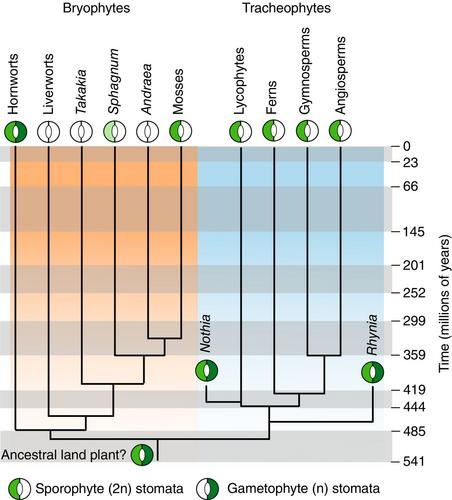
Stomata are microscopic pores that allow the exchange of gases between the plant and its environment. They are typically found on aerial surfaces, opening and closing in response to environmental cues to ensure photosynthesis, respiration and transpiration. In addition, stomata also find themselves at the core of a growing body of work that views plant evolution through the lens of a new phylogenetic hypothesis: bryophyte monophyly. Monophyly refers to an inclusive group of organisms descended from a common ancestor and, in this case specifically, the recent resolution of two monophyletic groups of land plants: nonvascular bryophytes and vascular tracheophytes (Fig. 1). This is in contrast to a previously held paradigm whereby the earliest plants would have preceded various bryophyte-like lineages. Fortin and Friedman's work highlights the fundamental role of phylogeny in reconstructing the evolution of plant traits, where stomata are emerging as a fascinating model to understand how bryophyte monophyly may affect our understanding of the nature of the earliest plants (Harris et al., 2020).
The evolution of stomata has been controversial: the homology of stomata in vascular and nonvascular plants has been questioned, along with the number of times they may have evolved or been lost (Ligrone et al., 2012; Harris et al., 2020). Likewise, their ability to respond to a diversity of environmental cues is well characterised in angiosperms and seed plants, but has been intensely debated in other groups, including ferns, lycophytes and mosses (Sussmilch et al., 2017; Clark et al., 2022). Until now, however, it has not been controversial to propose that among extant plants stomata are only found on the diploid, sporophyte generation. Fortin and Friedman challenge this dogma, identifying mucilage-producing pores (‘Hornwort Gametophytic Pores’ (HGPs)) in the gametophyte generation of hornworts as putatively homologous to stomata and argue that they should be considered the first example of stomata in the gametophyte generation of living plants.
To determine whether these structures are, or are not, stomata it is necessary to define what stomata are. Fortin and Friedman provide a broad definition of a stomate which is independent of function: two cells surrounding a pore, which may be able to open or close and may be filled with liquid or gas. In vascular plants (tracheophytes), stomata are broadly distributed and function as previously described, although in certain cases stomata have taken on new, specialised roles or even been lost. In nonvascular plants (bryophytes), stomata are more restricted in their distribution and are believed to primarily function in facilitating desiccation for spore release. Both lineages exhibit variations and elaborations of the simple design of stomata, but all would be encompassed by this definition. Notably, this definition excludes the liverwort air pore, a structure predicted to not be homologous and so confirms the absence of stomata in liverworts, but also the pseudostomata of Sphagnales, which lack a pore (Merced, 2015).
One of the more striking points made by Fortin and Friedman is how frequently HGPs are overlooked in discussions of stomatal evolution (for which I am also at fault). However, the timeliness of this study is highlighted by another recent work which has reemphasised the counter-arguments (Duckett et al., 2024). Duckett et al. (2024) take a hard line that these structures are definitively not stomata and present multiple arguments elaborating why these structures are unlikely to be homologous to guard cells. The majority of the arguments, laid out previously and by Duckett et al. against HGPs being homologous to stomata is that: they occur in the gametophyte generation; they possess different functions; and they possess anatomical differences from the stomata of other lineages. The first argument does not hold, since stomata in the gametophyte are a feature of multiple species of early land plants preserved in the Rhynie Chert (Edwards et al., 1998). Against the second, Fortin and Friedman argue that two structures do not need to have a common function to be homologous. This is clear even within stomata, where floral nectaries and stomata may represent functional divergence of homologous structures within the same plant. Finally, the anatomical differences observed in HGPs are also observed in other instances among plants or could be the result of functional divergence in hornworts. For example, HGPs occur in clusters, while stomata typically are evenly spaced along the epidermis. However, other bryophyte and tracheophyte species demonstrate exceptions to this rule and clusters of stomata are known to occur naturally in multiple species across the angiosperm phylogeny including Begonia (Rudall et al., 2017), where they are hypothesised to form via perturbations of the normal development of regularly spaced stomata, the genetic basis of which is well understood (Dow et al., 2014).
If we accept the possibility that HGPs are homologous to stomata, then, hornworts represent the only extant lineage to possess stomata in the gametophyte generation. That the exception to the rule may occur in hornworts is not surprising. Hornworts are the most species-poor of all the major land plant groups, possessing a scant fossil record and numerous unique morphological traits. In a phylogenetic context, they have been considered in almost every conceivable position, from the earliest branch of land plants to the immediate sister group to vascular plants. While they are now resolved within the monophyletic bryophyte lineage, molecular dating predicts both that hornworts diverged from the remaining bryophytes during the Ordovician (> 444 million years ago) and that the surviving members of the lineage are relatively young (Harris et al., 2022). The large evolutionary and geological distance between hornworts and all other plants may reconcile some of the anatomical and functional differences between HGPs and other types of stomata. Hornwort genomes are also characterised by extensive gene loss which has been found to be important during the evolution of other unique features of hornworts and may contribute to the rewiring of genetic networks (MacLeod et al., 2022).
Another consequence of the possibility of HGPs being homologous to stomata is how we view the earliest land plants more broadly. The alternation of generations refers to the two long-lived and multicellular generations that plants go through, the haploid gametophyte and the diploid sporophyte, and has recently seen renewed interest as one of the outstanding questions of plant evolution (Donoghue et al., 2021; Duckett et al., 2024; Renner & Sokoloff, 2024). The presence of stomata in both the gametophyte and sporophyte generation, as occurs in early plant fossils and may occur in hornworts, may indicate an isomorphic ancestor of plants, although this is currently speculative (Fig. 1). Alternatively, as Fortin and Friedman also point out, it is possible that stomata arose initially in one generation and then were co-opted into the other through ‘intergenerational heterotropy’, where a trait of one generation is expressed in the other.
The homology of stomata among vascular and nonvascular sporophytes has so far been corroborated by genetic analyses in the moss Physcomitrium patens alongside various vascular systems, identifying a common genetic toolkit underlying stomatal development across land plants (Chater et al., 2016). The nature of these structures remains a case not closed and many of the anatomical anomalies outlined by Duckett et al. (2024) will need to be further scrutinised, yet this work has established a fascinating hypothesis and one that is readily testable. The recent establishment of a tractable and transformable model system in Anthoceros (Frangedakis et al., 2021) means that future experiments will be able to determine whether the hornwort HGPs invoke the same developmental toolkit as bona fide stomata. This work may represent another intriguing complication during the evolution of stomata, with greater complexity in their evolutionary history and greater diversity in both form and function than was previously appreciated. Either way, it is clear that alongside the deluge of genomic data, comparative anatomy remains invaluable to the field of plant evolution and should continue to be explored alongside palaeobotanical, molecular and developmental evidence.
期刊介绍:
New Phytologist is an international electronic journal published 24 times a year. It is owned by the New Phytologist Foundation, a non-profit-making charitable organization dedicated to promoting plant science. The journal publishes excellent, novel, rigorous, and timely research and scholarship in plant science and its applications. The articles cover topics in five sections: Physiology & Development, Environment, Interaction, Evolution, and Transformative Plant Biotechnology. These sections encompass intracellular processes, global environmental change, and encourage cross-disciplinary approaches. The journal recognizes the use of techniques from molecular and cell biology, functional genomics, modeling, and system-based approaches in plant science. Abstracting and Indexing Information for New Phytologist includes Academic Search, AgBiotech News & Information, Agroforestry Abstracts, Biochemistry & Biophysics Citation Index, Botanical Pesticides, CAB Abstracts®, Environment Index, Global Health, and Plant Breeding Abstracts, and others.







 京公网安备 11010802042870号
京ICP备2023020795号-1
京公网安备 11010802042870号
京ICP备2023020795号-1

 分享
分享
 求助内容:
求助内容: 应助结果提醒方式:
 扫码关注我们
