Jinyu Chen, Chao Chen, Chong Zhao, Na Tu, Yunjing Chen, Xin Nie, Xiaokun Huang, Jun-Ming Liu and Xiangping Jiang
{"title":"成分/磁场诱导的八面体倾斜、畴切换和 BF-BT 陶瓷的压电特性改善(跨相变","authors":"Jinyu Chen, Chao Chen, Chong Zhao, Na Tu, Yunjing Chen, Xin Nie, Xiaokun Huang, Jun-Ming Liu and Xiangping Jiang","doi":"10.1039/D4TA03949A","DOIUrl":null,"url":null,"abstract":"<p >To clarify the structural mechanism underlying the high piezoelectric activity of (1 − <em>x</em>)BiFeO<small><sub>3</sub></small>-<em>x</em>BaTiO<small><sub>3</sub></small> ((1 − <em>x</em>)BF-<em>x</em>BT) solid solutions, the evolution of phase structure and domain configuration and their effects on piezoelectric properties were studied in a wide range of components (0.2 ≤ <em>x</em> ≤ 0.9). XRD refinement results show that with the introduction of BT, the phase structure gradually transforms from rhombohedral (R) to rhombohedral/pseudocubic (R/pC) coexistence and finally to pC, accompanied by the weakening of lattice distortion. The freezing temperature (<em>T</em><small><sub>f</sub></small>) of (1 − <em>x</em>)BF-<em>x</em>BT decreases with the increment of BT around the morphotropic phase boundary (MPB) (0.3 ≤ <em>x</em> ≤ 0.5). This indicates that the domain structure changes from ferroelectric ordered domains to nanodomains (or polar nanoregions), corresponding to the enhancement of the relaxation state. The high piezoelectric properties of 0.7BF-0.3BT are attributed to the unique heterogeneous domain structure and superior domain switching at the MPB. A large strain is achieved in 0.6BF-0.4BT, which results from the mutual transformation between relaxor nanodomains and ferroelectric ordered domains under electric field.</p>","PeriodicalId":82,"journal":{"name":"Journal of Materials Chemistry A","volume":" 44","pages":" 30420-30428"},"PeriodicalIF":9.2000,"publicationDate":"2024-10-14","publicationTypes":"Journal Article","fieldsOfStudy":null,"isOpenAccess":false,"openAccessPdf":"","citationCount":"0","resultStr":"{\"title\":\"The composition/field-induced octahedral tilt, domain switching and improved piezoelectric properties of BF-BT ceramics during phase transition†\",\"authors\":\"Jinyu Chen, Chao Chen, Chong Zhao, Na Tu, Yunjing Chen, Xin Nie, Xiaokun Huang, Jun-Ming Liu and Xiangping Jiang\",\"doi\":\"10.1039/D4TA03949A\",\"DOIUrl\":null,\"url\":null,\"abstract\":\"<p >To clarify the structural mechanism underlying the high piezoelectric activity of (1 − <em>x</em>)BiFeO<small><sub>3</sub></small>-<em>x</em>BaTiO<small><sub>3</sub></small> ((1 − <em>x</em>)BF-<em>x</em>BT) solid solutions, the evolution of phase structure and domain configuration and their effects on piezoelectric properties were studied in a wide range of components (0.2 ≤ <em>x</em> ≤ 0.9). XRD refinement results show that with the introduction of BT, the phase structure gradually transforms from rhombohedral (R) to rhombohedral/pseudocubic (R/pC) coexistence and finally to pC, accompanied by the weakening of lattice distortion. The freezing temperature (<em>T</em><small><sub>f</sub></small>) of (1 − <em>x</em>)BF-<em>x</em>BT decreases with the increment of BT around the morphotropic phase boundary (MPB) (0.3 ≤ <em>x</em> ≤ 0.5). This indicates that the domain structure changes from ferroelectric ordered domains to nanodomains (or polar nanoregions), corresponding to the enhancement of the relaxation state. The high piezoelectric properties of 0.7BF-0.3BT are attributed to the unique heterogeneous domain structure and superior domain switching at the MPB. A large strain is achieved in 0.6BF-0.4BT, which results from the mutual transformation between relaxor nanodomains and ferroelectric ordered domains under electric field.</p>\",\"PeriodicalId\":82,\"journal\":{\"name\":\"Journal of Materials Chemistry A\",\"volume\":\" 44\",\"pages\":\" 30420-30428\"},\"PeriodicalIF\":9.2000,\"publicationDate\":\"2024-10-14\",\"publicationTypes\":\"Journal Article\",\"fieldsOfStudy\":null,\"isOpenAccess\":false,\"openAccessPdf\":\"\",\"citationCount\":\"0\",\"resultStr\":null,\"platform\":\"Semanticscholar\",\"paperid\":null,\"PeriodicalName\":\"Journal of Materials Chemistry A\",\"FirstCategoryId\":\"88\",\"ListUrlMain\":\"https://pubs.rsc.org/en/content/articlelanding/2024/ta/d4ta03949a\",\"RegionNum\":2,\"RegionCategory\":\"材料科学\",\"ArticlePicture\":[],\"TitleCN\":null,\"AbstractTextCN\":null,\"PMCID\":null,\"EPubDate\":\"\",\"PubModel\":\"\",\"JCR\":\"Q1\",\"JCRName\":\"CHEMISTRY, PHYSICAL\",\"Score\":null,\"Total\":0}","platform":"Semanticscholar","paperid":null,"PeriodicalName":"Journal of Materials Chemistry A","FirstCategoryId":"88","ListUrlMain":"https://pubs.rsc.org/en/content/articlelanding/2024/ta/d4ta03949a","RegionNum":2,"RegionCategory":"材料科学","ArticlePicture":[],"TitleCN":null,"AbstractTextCN":null,"PMCID":null,"EPubDate":"","PubModel":"","JCR":"Q1","JCRName":"CHEMISTRY, PHYSICAL","Score":null,"Total":0}
The composition/field-induced octahedral tilt, domain switching and improved piezoelectric properties of BF-BT ceramics during phase transition†
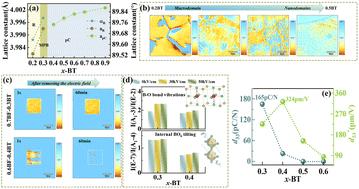
To clarify the structural mechanism underlying the high piezoelectric activity of (1 − x)BiFeO3-xBaTiO3 ((1 − x)BF-xBT) solid solutions, the evolution of phase structure and domain configuration and their effects on piezoelectric properties were studied in a wide range of components (0.2 ≤ x ≤ 0.9). XRD refinement results show that with the introduction of BT, the phase structure gradually transforms from rhombohedral (R) to rhombohedral/pseudocubic (R/pC) coexistence and finally to pC, accompanied by the weakening of lattice distortion. The freezing temperature (Tf) of (1 − x)BF-xBT decreases with the increment of BT around the morphotropic phase boundary (MPB) (0.3 ≤ x ≤ 0.5). This indicates that the domain structure changes from ferroelectric ordered domains to nanodomains (or polar nanoregions), corresponding to the enhancement of the relaxation state. The high piezoelectric properties of 0.7BF-0.3BT are attributed to the unique heterogeneous domain structure and superior domain switching at the MPB. A large strain is achieved in 0.6BF-0.4BT, which results from the mutual transformation between relaxor nanodomains and ferroelectric ordered domains under electric field.
期刊介绍:
The Journal of Materials Chemistry A, B & C covers a wide range of high-quality studies in the field of materials chemistry, with each section focusing on specific applications of the materials studied. Journal of Materials Chemistry A emphasizes applications in energy and sustainability, including topics such as artificial photosynthesis, batteries, and fuel cells. Journal of Materials Chemistry B focuses on applications in biology and medicine, while Journal of Materials Chemistry C covers applications in optical, magnetic, and electronic devices. Example topic areas within the scope of Journal of Materials Chemistry A include catalysis, green/sustainable materials, sensors, and water treatment, among others.




 京公网安备 11010802042870号
京ICP备2023020795号-1
京公网安备 11010802042870号
京ICP备2023020795号-1

 分享
分享
 求助内容:
求助内容: 应助结果提醒方式:
 扫码关注我们
