Sho Fukui, Masato Okada, Tomohiro Shinozaki, Takahiro Suzuki, Takehiro Nakai, Hiroki Ozawa, Hiromichi Tamaki, Mitsumasa Kishimoto, Hiroshi Hasegawa, Takeaki Matsuda, Javier Marrugo, Sara K. Tedeschi, Hyon K. Choi, Daniel H. Solomon
{"title":"减轻体重与目标血清尿酸水平:年度体检纵向研究","authors":"Sho Fukui, Masato Okada, Tomohiro Shinozaki, Takahiro Suzuki, Takehiro Nakai, Hiroki Ozawa, Hiromichi Tamaki, Mitsumasa Kishimoto, Hiroshi Hasegawa, Takeaki Matsuda, Javier Marrugo, Sara K. Tedeschi, Hyon K. Choi, Daniel H. Solomon","doi":"10.1002/art.43027","DOIUrl":null,"url":null,"abstract":"<div>\n \n <section>\n \n <h3> Objective</h3>\n \n <p>Our objective was to evaluate associations of weight reduction with serum urate (SU) changes and achieving an SU level <6 mg/dL in the real-world setting, outside of specific weight reduction interventions.</p>\n </section>\n \n <section>\n \n <h3> Methods</h3>\n \n <p>We analyzed systematically collected data of annual medical examination participants from October 2012 to October 2022. Exposure was weight change (increase or decrease) between two consecutive visits, categorized as minimal (≤0.9 kg, reference), small (1.0–4.9 kg), moderate (5.0–9.9 kg), and large (≥10 kg). Outcomes included SU changes between two consecutive visits and achieving an SU level <6 mg/dL in participants with hyperuricemia (SU level ≥7 mg/dL at the previous visit).</p>\n </section>\n \n <section>\n \n <h3> Results</h3>\n \n <p>We identified 58,630 eligible participants (median age 46 years, 51.3% female, 19.4% with overweight, median SU level 5.3 mg/dL, and 5.6% with a history of gout and/or hyperuricemia) with 336,814 visits over a median of 5.3 years. After adjustment for relevant covariates, linear general estimating equations estimated mean SU changes based on observed weight reductions (vs minimal changes) were as follows: small, −0.10 mg/dL (95% confidence interval [CI] −0.10 to −0.09 mg/dL); moderate, −0.34 mg/dL (95% CI −0.36 to −0.32 mg/dL); and large, −0.64 (95% CI −0.70 to −0.58 mg/dL). In participants with hyperuricemia, adjusted relative risks for achieving an SU level <6 mg/dL by modified Poisson regression were 1.25 (95% CI 1.15–1.37) in small weight reductions, 2.82 (95% CI 2.43–3.27) in moderate weight reductions, and 5.27 (95% CI 4.15–6.70) in large weight reductions, with corresponding numbers needed to treat of 61.1 for small weight reductions, 8.5 for moderate weight reductions, and 3.6 for large weight reductions.</p>\n </section>\n \n <section>\n \n <h3> Conclusion</h3>\n \n <p>Small weight reductions were associated with only small SU changes. Some participants with hyperuricemia can achieve the target SU level with moderate to large weight reductions.</p>\n \n <div>\n <figure>\n <div><picture>\n <source></source></picture><p></p>\n </div>\n </figure>\n </div>\n </section>\n </div>","PeriodicalId":129,"journal":{"name":"Arthritis & Rheumatology","volume":"77 3","pages":"346-355"},"PeriodicalIF":10.9000,"publicationDate":"2024-10-14","publicationTypes":"Journal Article","fieldsOfStudy":null,"isOpenAccess":false,"openAccessPdf":"","citationCount":"0","resultStr":"{\"title\":\"Weight Reduction and Target Serum Urate Level: A Longitudinal Study of Annual Medical Examination\",\"authors\":\"Sho Fukui, Masato Okada, Tomohiro Shinozaki, Takahiro Suzuki, Takehiro Nakai, Hiroki Ozawa, Hiromichi Tamaki, Mitsumasa Kishimoto, Hiroshi Hasegawa, Takeaki Matsuda, Javier Marrugo, Sara K. Tedeschi, Hyon K. Choi, Daniel H. Solomon\",\"doi\":\"10.1002/art.43027\",\"DOIUrl\":null,\"url\":null,\"abstract\":\"<div>\\n \\n <section>\\n \\n <h3> Objective</h3>\\n \\n <p>Our objective was to evaluate associations of weight reduction with serum urate (SU) changes and achieving an SU level <6 mg/dL in the real-world setting, outside of specific weight reduction interventions.</p>\\n </section>\\n \\n <section>\\n \\n <h3> Methods</h3>\\n \\n <p>We analyzed systematically collected data of annual medical examination participants from October 2012 to October 2022. Exposure was weight change (increase or decrease) between two consecutive visits, categorized as minimal (≤0.9 kg, reference), small (1.0–4.9 kg), moderate (5.0–9.9 kg), and large (≥10 kg). Outcomes included SU changes between two consecutive visits and achieving an SU level <6 mg/dL in participants with hyperuricemia (SU level ≥7 mg/dL at the previous visit).</p>\\n </section>\\n \\n <section>\\n \\n <h3> Results</h3>\\n \\n <p>We identified 58,630 eligible participants (median age 46 years, 51.3% female, 19.4% with overweight, median SU level 5.3 mg/dL, and 5.6% with a history of gout and/or hyperuricemia) with 336,814 visits over a median of 5.3 years. After adjustment for relevant covariates, linear general estimating equations estimated mean SU changes based on observed weight reductions (vs minimal changes) were as follows: small, −0.10 mg/dL (95% confidence interval [CI] −0.10 to −0.09 mg/dL); moderate, −0.34 mg/dL (95% CI −0.36 to −0.32 mg/dL); and large, −0.64 (95% CI −0.70 to −0.58 mg/dL). In participants with hyperuricemia, adjusted relative risks for achieving an SU level <6 mg/dL by modified Poisson regression were 1.25 (95% CI 1.15–1.37) in small weight reductions, 2.82 (95% CI 2.43–3.27) in moderate weight reductions, and 5.27 (95% CI 4.15–6.70) in large weight reductions, with corresponding numbers needed to treat of 61.1 for small weight reductions, 8.5 for moderate weight reductions, and 3.6 for large weight reductions.</p>\\n </section>\\n \\n <section>\\n \\n <h3> Conclusion</h3>\\n \\n <p>Small weight reductions were associated with only small SU changes. Some participants with hyperuricemia can achieve the target SU level with moderate to large weight reductions.</p>\\n \\n <div>\\n <figure>\\n <div><picture>\\n <source></source></picture><p></p>\\n </div>\\n </figure>\\n </div>\\n </section>\\n </div>\",\"PeriodicalId\":129,\"journal\":{\"name\":\"Arthritis & Rheumatology\",\"volume\":\"77 3\",\"pages\":\"346-355\"},\"PeriodicalIF\":10.9000,\"publicationDate\":\"2024-10-14\",\"publicationTypes\":\"Journal Article\",\"fieldsOfStudy\":null,\"isOpenAccess\":false,\"openAccessPdf\":\"\",\"citationCount\":\"0\",\"resultStr\":null,\"platform\":\"Semanticscholar\",\"paperid\":null,\"PeriodicalName\":\"Arthritis & Rheumatology\",\"FirstCategoryId\":\"3\",\"ListUrlMain\":\"https://acrjournals.onlinelibrary.wiley.com/doi/10.1002/art.43027\",\"RegionNum\":1,\"RegionCategory\":\"医学\",\"ArticlePicture\":[],\"TitleCN\":null,\"AbstractTextCN\":null,\"PMCID\":null,\"EPubDate\":\"\",\"PubModel\":\"\",\"JCR\":\"Q1\",\"JCRName\":\"RHEUMATOLOGY\",\"Score\":null,\"Total\":0}","platform":"Semanticscholar","paperid":null,"PeriodicalName":"Arthritis & Rheumatology","FirstCategoryId":"3","ListUrlMain":"https://acrjournals.onlinelibrary.wiley.com/doi/10.1002/art.43027","RegionNum":1,"RegionCategory":"医学","ArticlePicture":[],"TitleCN":null,"AbstractTextCN":null,"PMCID":null,"EPubDate":"","PubModel":"","JCR":"Q1","JCRName":"RHEUMATOLOGY","Score":null,"Total":0}
引用次数: 0
摘要
目的:在实际环境中,评估减轻体重与血清尿酸盐(SU)变化之间的关系,以及在不采取特定减轻体重干预措施的情况下,实现 SU <6 mg/dl 的目标。
Weight Reduction and Target Serum Urate Level: A Longitudinal Study of Annual Medical Examination
Objective
Our objective was to evaluate associations of weight reduction with serum urate (SU) changes and achieving an SU level <6 mg/dL in the real-world setting, outside of specific weight reduction interventions.
Methods
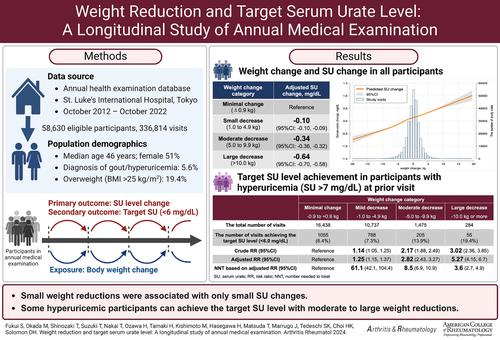
We analyzed systematically collected data of annual medical examination participants from October 2012 to October 2022. Exposure was weight change (increase or decrease) between two consecutive visits, categorized as minimal (≤0.9 kg, reference), small (1.0–4.9 kg), moderate (5.0–9.9 kg), and large (≥10 kg). Outcomes included SU changes between two consecutive visits and achieving an SU level <6 mg/dL in participants with hyperuricemia (SU level ≥7 mg/dL at the previous visit).
Results
We identified 58,630 eligible participants (median age 46 years, 51.3% female, 19.4% with overweight, median SU level 5.3 mg/dL, and 5.6% with a history of gout and/or hyperuricemia) with 336,814 visits over a median of 5.3 years. After adjustment for relevant covariates, linear general estimating equations estimated mean SU changes based on observed weight reductions (vs minimal changes) were as follows: small, −0.10 mg/dL (95% confidence interval [CI] −0.10 to −0.09 mg/dL); moderate, −0.34 mg/dL (95% CI −0.36 to −0.32 mg/dL); and large, −0.64 (95% CI −0.70 to −0.58 mg/dL). In participants with hyperuricemia, adjusted relative risks for achieving an SU level <6 mg/dL by modified Poisson regression were 1.25 (95% CI 1.15–1.37) in small weight reductions, 2.82 (95% CI 2.43–3.27) in moderate weight reductions, and 5.27 (95% CI 4.15–6.70) in large weight reductions, with corresponding numbers needed to treat of 61.1 for small weight reductions, 8.5 for moderate weight reductions, and 3.6 for large weight reductions.
Conclusion
Small weight reductions were associated with only small SU changes. Some participants with hyperuricemia can achieve the target SU level with moderate to large weight reductions.
期刊介绍:
Arthritis & Rheumatology is the official journal of the American College of Rheumatology and focuses on the natural history, pathophysiology, treatment, and outcome of rheumatic diseases. It is a peer-reviewed publication that aims to provide the highest quality basic and clinical research in this field. The journal covers a wide range of investigative areas and also includes review articles, editorials, and educational material for researchers and clinicians. Being recognized as a leading research journal in rheumatology, Arthritis & Rheumatology serves the global community of rheumatology investigators and clinicians.








 京公网安备 11010802042870号
京ICP备2023020795号-1
京公网安备 11010802042870号
京ICP备2023020795号-1

 分享
分享
 求助内容:
求助内容: 应助结果提醒方式:
 扫码关注我们
